AUKUS public inquiry poised to answer some tough questions

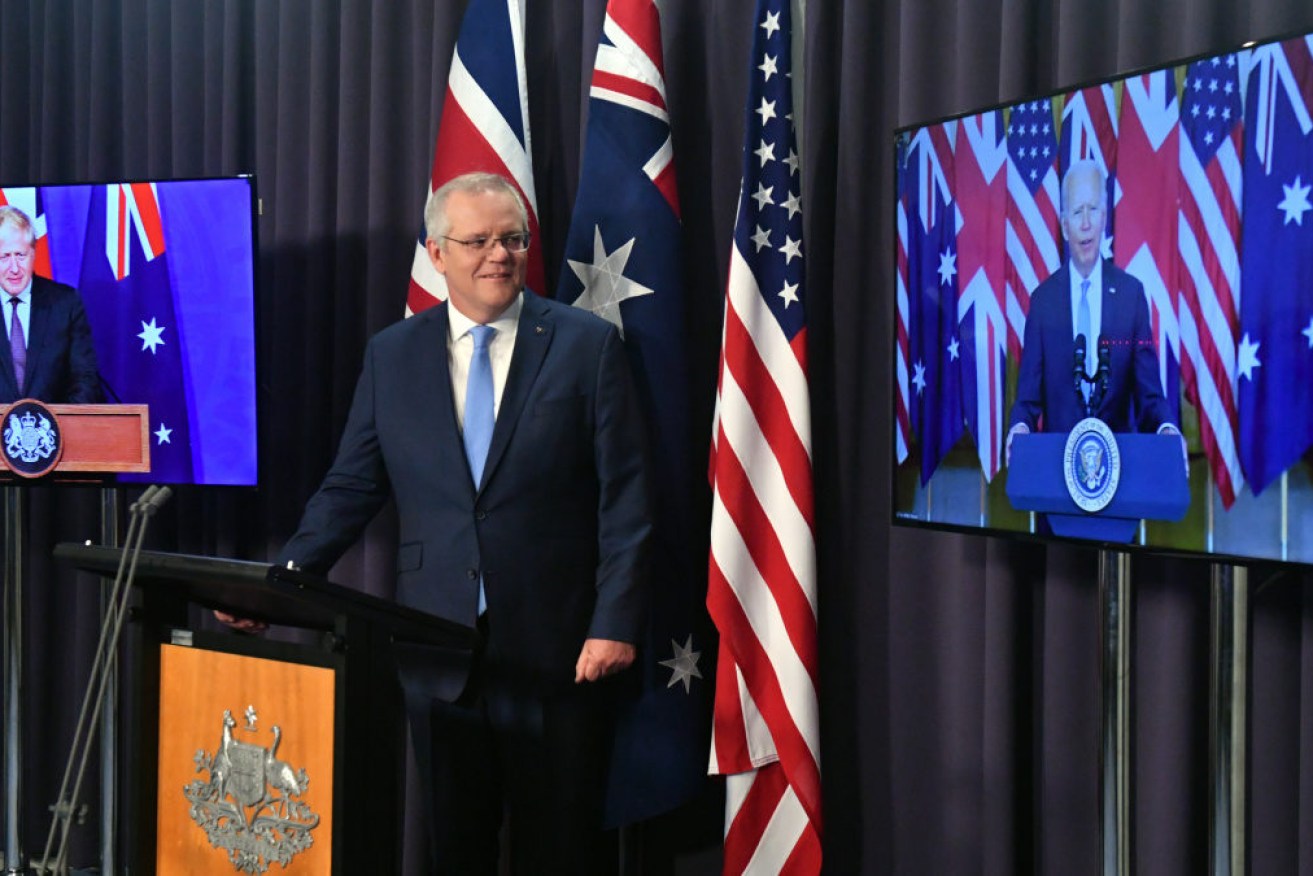
AUKUS, announced by then PM Scott Morrison, was kept entirely secret during its development.
The AUKUS agreement is a trilateral security partnership between Australia, the UK and the US. It was negotiated in secret in 2021. Scott Morrison negotiated the deal furtively, keeping his cabinet in the dark and lying to the French.
He is no longer in office. Neither are the other leaders involved, Joe Biden and Boris Johnson. Though we voted Morrison out, there has been no parliamentary scrutiny in Australia of his deal. It is still shrouded in secrecy, despite the high stakes and eye-watering projected cost.
Retired major-general Michael Smith described it as “the worst defence decision since we relied on Britain to defend us in World War II”. Polls confirm the Australian public has very little information about AUKUS. They also show the community doesn’t like what we do know about the deal.
Aiming to promote informed discussion, the Australian Peace and Security Forum convened a Public Inquiry into the agreement. It set out to consider the fundamental questions: Would AUKUS keep us safe? At what cost? The inquiry has been conducted by five distinguished community leaders, headed by Peter Garrett, lead singer of Midnight Oil before becoming a cabinet minister.
It has been an extraordinary exercise in public involvement. More than 1000 written submissions were received. Hundreds of people gave presentations to the hearings in eight major centres.
Individuals, trade unions and community groups contributed over $200,000 to finance the inquiry. It heard from two former prime ministers, several former ministers and senior defence figures, as well as community groups and concerned citizens.
Some things were already known before the inquiry began. The government has budgeted the unbelievable sum of $368 billion for eight submarines: Three second-hand Virginia Class US boats, due to be supplied in the 2030s, and five of a new nuclear-powered submarine, to be based on a British design incorporating US technology.
The government web site says the UK will build some new submarines at Barrow-in-Furness for delivery in the late 2030s, while Australia will also build some in Adelaide for delivery in the 2040s. Given those timescales and the fact that the submarines have not yet even been designed, many presentations to the inquiry argued that the final cost would certainly be even more.
The AUKUS agreement also commits us to managing the radioactive waste the submarines would leave behind. Nobody knows what that would cost, because the countries that have operated nuclear submarines for decades still have not worked out how to manage their waste.
The 2015 South Australian Nuclear Fuel Cycle Royal Commission estimated that building and operating a storage facility for the radioactive waste from nuclear power stations would cost about $180 billion in today’s money.
Even if the estimates could be taken at face value, an obvious question the inquiry has investigated is whether that scale of funding could be more usefully applied elsewhere.
Since the discussion of AUKUS was so secret that Morrison had to lie to the French government, there was probably no systematic assessment of the alternatives. Submissions to the inquiry by highly-regarded defence experts argued that much more effective ways of defending Australia could be secured for a fraction of the estimated cost of AUKUS.
Some presentations raised questions about our sovereignty and independence. Would the AUKUS arrangement move Australia away from being an independent middle-sized country like Japan or Indonesia, locking us into the US war machine and increasing the risk of being dragged into great-power conflict with China, our major trading partner?
Some presentations argued that AUKUS would make Australia a nuclear target.
All these questions have been considered by the public inquiry, which will report its findings at the National Press Club on Wednesday. The event will be broadcast by the ABC. It will give us the evidence for an overdue reexamination of the AUKUS agreement.
Ian Lowe AO FTSE is an emeritus professor in the School of Environment and Science at Griffith University and co-president of the Australian Peace and Security Forum
AUKUS probe will answer some tough questions