Britain has told its citizens to gather emergency supplies. Australians should do the same

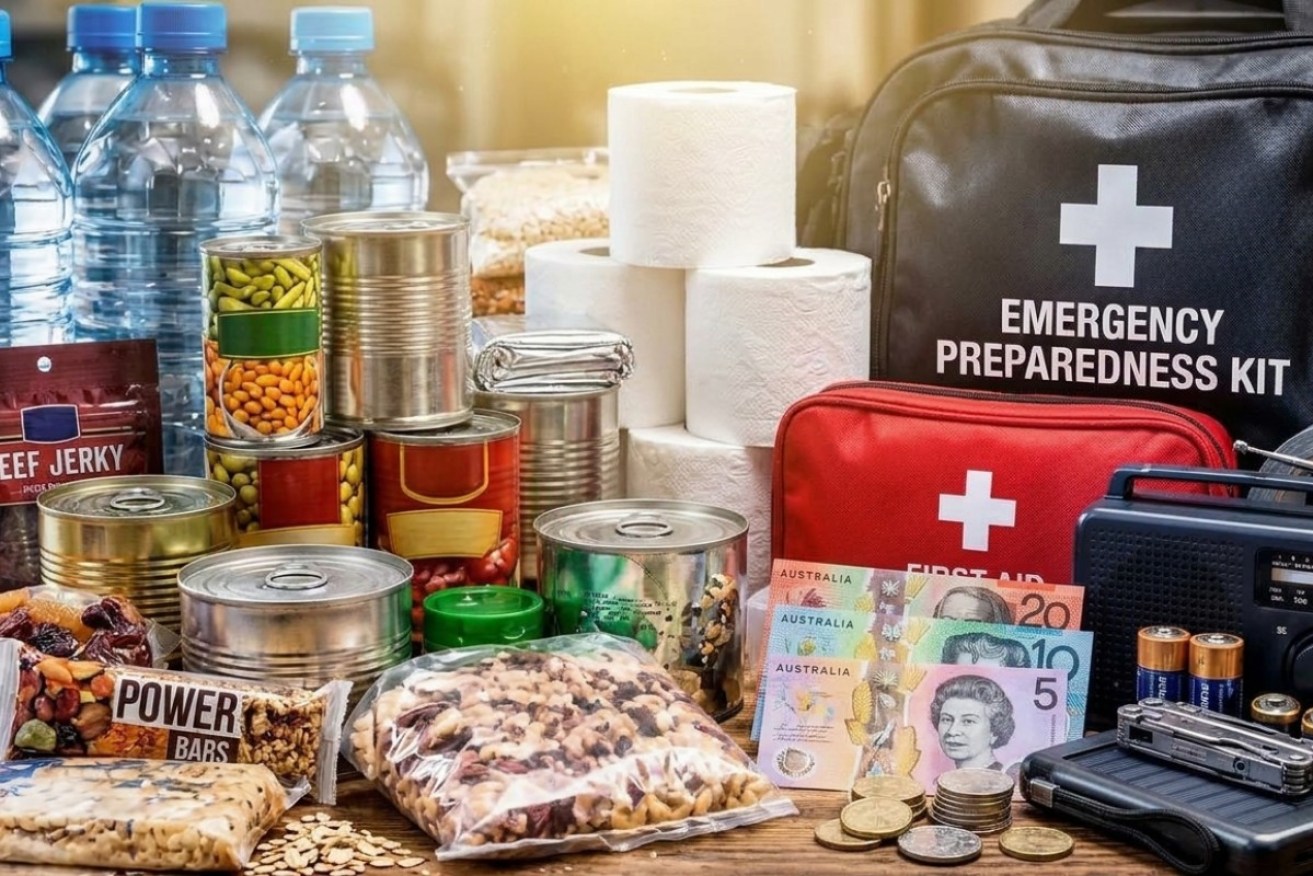
Britons are urged to gather at least three days of emergency supplies. Photo: TND/Gemini
Sales of tinned goods, bottled water, torches and radios have spiked in Britain following official government advice to stockpile three days’ worth of emergency supplies.
Pointing to increasing cyber attacks and more frequent extreme weather, the UK government’s Be Ready campaign urges Britons to stockpile at least three days of emergency supplies.
“It’s not about panicking … It’s about just taking sensible measures to have enough in the house to tide you over should there be a difficult situation,” Prime Minister Andy Burnham said last week.
Despite the advice against panicking, shelves have been stripped of baked beans and bottled water, along with other staples, in supermarkets across the country.
The move is in line with similar advice in other European countries including France, Ireland and the Netherlands.
The UK defence secretary added that Britain should prepare for the threat of “state-sponsored terrorism” by Russia or other hostile powers targeting everyday infrastructure.
Governments have long encouraged residents to retain enough supplies to survive a significant disruption. Australia, of course, is no different.
Australia’s official preparedness advice targets natural disasters: Fires, floods and other forms of extreme weather.
As climate risks accelerate and a hot summer approaches, many ordinary Australians are actively preparing disaster kits and emergency plans.
Prepping is a sensitive word, associated with sovereign citizens and conspiracy theorists – but is it becoming mainstream … and even sensible?
We’ve interviewed parents and carers in parts of Australia that have experienced severe climate disasters. Several, unprompted, raised the desire to start prepping and learn more about it.
They were motivated by having evacuated their homes in potentially fatal situations. As one told us:
I never thought I’d ever be like a doomsday prepper, but it’s in the back of my mind. I’m almost going to start, like, collecting food and stuff because I’m so paranoid about what’s going to happen.
What should Australians prepare?
Australian government advice on preparing for disaster differs slightly based on geographical context, with a variety of state-based guidelines.
It’s generally recommended that households store 72 hours’ worth of supplies in case of emergencies.
Much of the guidance is consistent – a supply of shelf-stable food, clean water, at least a week’s worth of essential medicines, a first-aid kit, torches, batteries and communication devices.
More detailed plans suggest keeping aside important documents like passports, birth certificates and property deeds, ready to take if needed. You might want to keep some cash, a full tank of fuel and bedding in case of evacuation.
Parents should also keep a bag of child-specific supplies, including nappies, wipes, formula, bottles, toys and even more spare clothes. Companion animals require specific plans, allowing them to be evacuated and cared for.

It’s generally recommended households store 72 hours’ worth of supplies. Photo: Pexels
In Australia, disaster preparedness has been affected by the privatisation of services and infrastructure.
Traditional copper landlines can continue operating during local power outages, such as bush fires, because power is supplied through the telephone network itself. But many contemporary telecommunications services, like mobile phones and laptops, depend on mains electricity and mobile towers.
These shortcomings in public infrastructure, particularly in emergency settings, are a concern.
Climate anxiety and prepping
The dominant motivation for prepping in Australia reflects our official government advice.
It’s not international conflict, super viruses or AI, but climate change. This results in a distinct style of prepping, generally less ideological, violent and extreme than stereotypes might suggest.
Many Australian preppers probably don’t see themselves as preppers at all. In some cases, they are simply following government advice – though others are less optimistic about the government’s ability to help in a crisis.
The increased interest in prepping among the general public can be seen in the significant growth and visibility of prepping consumer products, from bush fire kits to more generalised survival kits), in specialty online stores.
It can also be seen in the rise of electric cars and solar house batteries. In July this year, nearly a third of new cars bought in Australia were electric.
The Clean Energy Council reported a fourfold increase in rooftop solar batteries installed in the second half of last year, compared to the previous year.
These measures are partly about building household resilience. Of course, they represent significant costs (and installing solar batteries usually requires owning your home). This means the wealthy are more protected.
Preparing versus prepping
In Australia, people are encouraged to prepare for power outages, supply chain disruptions to food and fuel, and disruptions to essential communications technologies.
Absent from these warnings are the kinds of conspiracy-based concerns commonly associated with “preppers”.
Many people who prepare for disasters understandably reject the name “prepper”, due to its stigma.
Those who tend towards more radical or conspiracy-oriented forms of prepping vary widely in their characteristics and beliefs, but often share two features.
The first is a commitment to self-sufficiency: generating their own electricity, storing food or securing independent water supplies. Many people value self-sufficiency as a practical response to uncertainty.

Australian volunteers are no stranger to emergency supplies. Photo: AAP
But for radical or conspiracy-minded “preppers”, it forms an important part of their identity, shaping how they understand their place in the world.
Their preparations are less about future risks than a belief that many of the disruptions they anticipate are already emerging. They often view themselves as being better positioned than most to recognise and respond to these changes.
These more radical preppers also hold concerns about government surveillance, control, or institutional power. They often lead to efforts to maintain independent means of communication and access to information, outside official systems.
Overwhelmingly, though, prepping in Australia is an everyday practice, undertaken by all kinds of people who simply want to feel prepared for the kinds of upheavals they think are likely in Australia – like bushfires and floods.
“I’m feeling a lot more prepared for other situations,” one parent who’d evacuated during a climate disaster told us. “I think I’d be able to deal with it a little bit better and [be] a little bit more practical.”
Another said: “I wouldn’t describe myself as a prepper, but just a little bit more prepped than I was.”
Some of the parents we spoke to discussed the banality of basic prepping, in contrast to exaggerated media stereotypes.
For these survivors of climate disaster, prepping is not about elaborate conspiracies or radical political ideologies. It’s about basic essentials that help in difficult times.
Preparing is not paranoid
This basic preparedness is not paranoid or eccentric behaviour.
Given the frequency and severity of natural disasters and the current El Nino phase – predicted as “strong to very strong” by the Bureau of Meterology) – it’s not surprising Australians’ “prepping” is often motivated by the climate crisis.
We should all, as a bare minimum, be prepared according to government guidelines for what could be a dangerously hot summer.
Jordan McKenzie is an Associate Professor and Fiona Whitelaw is an Associate Lecturer at the University of Wollongong
This article is republished from The Conversation under a Creative Commons licence. Read the original article

'Very stupid debate': We're being played for mugs
Hanson doubles down on controversial super policy