AUKUS has a major waste problem, and it’s not just money

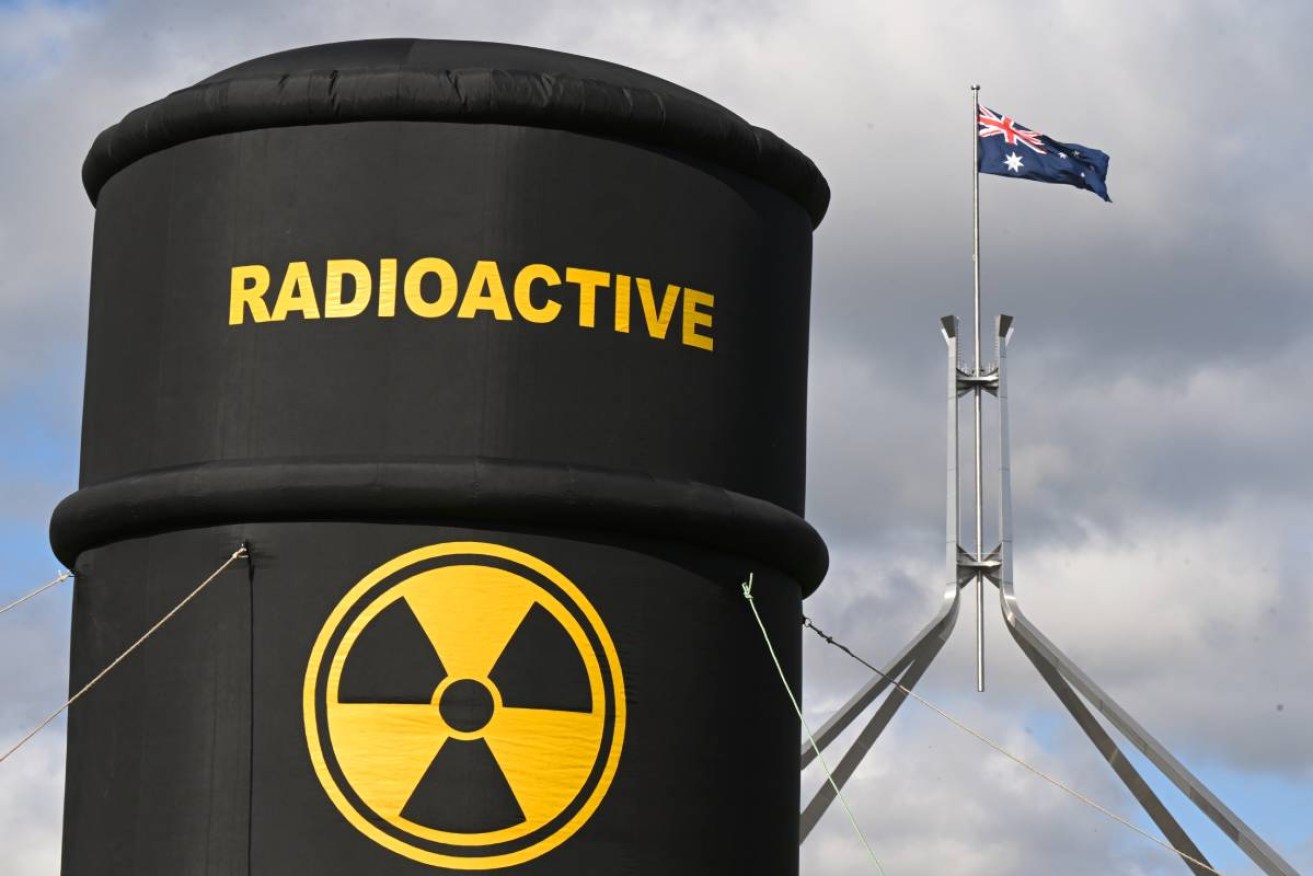
Under AUKUS, we must manage the nuclear waste produced by the submarines. Photo: AAP
Many people are shocked by the price of the AUKUS agreement. The government has budgeted a staggering $368 billion, hundreds of times the cost of a new hospital.
But hidden in the fine print is a further huge cost. If the proposal goes ahead, we will have to manage the nuclear waste produced by the submarines.
Nobody knows what that will cost. The US and Britain have operated nuclear submarines for more than 50 years, but still have not worked out how to manage the intractable radioactive waste.
The decommissioned boats are sitting alongside docks, with British and American scientists trying to work out what to do.
We can get some idea of the possible extra cost from the work done 10 years ago by the South Australia Nuclear Royal Commission. I was a member of the expert advisory group for that inquiry.
It commissioned a study of what it would cost to build and operate a facility to store radioactive waste from nuclear power stations in Asian countries.
It came up with a figure of $145 billion, in 2016 values. Scaled up to 2026 dollars, it is equivalent to $190 billion – half as much again as the budget for the submarines.
That figure is almost certainly an underestimate because the royal commission was considering management of waste from nuclear power stations.
The proposed submarines use highly enriched uranium, weapons-grade material. The resulting waste is much nastier. It also poses serious security issues.
At the end of its life, the reactor in a Virginia class submarine still has enough enriched uranium for about 20 bombs. So the waste management facility will need military guarding to prevent misuse of the uranium.
It is also unclear how our government expects to find an acceptable site for waste storage.
There have been three attempts to find a place to store the comparatively benign low-level waste from nuclear medicine and industrial applications.
All have foundered because of opposition by the affected First Nations groups. They have not forgotten the harm done by British testing of nuclear weapons on their land.
The government has made vague suggestions about Defence property, but it is hard to see how it could obtain free prior informed consent from the Indigenous people whose land would be used.
There are also questions about whether acquiring nuclear submarines powered by highly-enriched weapons-grade uranium would be a breach of the Nuclear Non-Proliferation Treaty.
Some Pacific Island leaders have expressed concern, arguing that it would certainly not be consistent with the spirit of our treaty obligations.
The fundamental problem is that the AUKUS agreement was negotiated in secret in 2021 by the leaders of the three countries involved, Australia, Britain and the US.
Not one of those leaders is still in office. There has been no parliamentary scrutiny of the deal in Australia.
It continues to be shrouded in secrecy, despite the high stakes and eye-watering projected cost. Retired major-general Michael Smith has described the arrangement as “the worst defence decision since we relied on Britain to defend us in World War II”.
A public inquiry into the agreement is being conducted under the auspices of the Australian Peace and Security forum.
It is considering the fundamental question – would AUKUS keep us safe? At what cost?
The inquiry is headed by five distinguished community leaders, headed by Peter Garrett, who was lead singer of Midnight Oil before becoming a Cabinet minister.
The critical question is whether owning and operating eight nuclear-powered submarines would actually enhance our security.
I participated in a one-day seminar run by the Submarine Institute of Australia well before the AUKUS agreement was negotiated. The submariners were clearly divided about the question of whether the next generation of submarines should be nuclear-powered.
While they could operate away from base for longer periods and at greater depth than conventional submarines, their size would prevent them operating in the comparatively shallow waters around Australia’s northern coastline, making them less useful for defending our territory.
That observation poses an obvious related question about sovereignty and independence.
Would the AUKUS arrangement move Australia away from being an independent middle-sized country like Japan or Indonesia, locking us into the US war machine and increasing the risk of being dragged into great-power conflict with China, our major trading partner?
Some observers fear that AUKUS could actually make Australia a nuclear target. Given that China is our major trading partner, it seems bizarre to imagine that we need to protect our ocean-going trade from the Chinese navy, but that has been proposed as a reason for acquiring nuclear-powered submarines.
All these questions are being considered by the public inquiry, which is receiving submissions from the community and holding a series of hearings in major cities.
Its October report should provide the basis for a serious re-examination of the AUKUS agreement.
Ian Lowe AO FTSE is an emeritus professor in the School of Environment and Science at Griffith University and co-president of the Australian Peace and Security Forum.
Want to see more stories from The New Daily in your Google search results?
- Click here to set The New Daily as a preferred source.
- Tick the box next to "The New Daily". That's it.

Pork barrel rolls out again – it's time for a change
Long-awaited migrant plan reflects needs and fears