If climate talks cannot stop new coal and gas, what are they for?

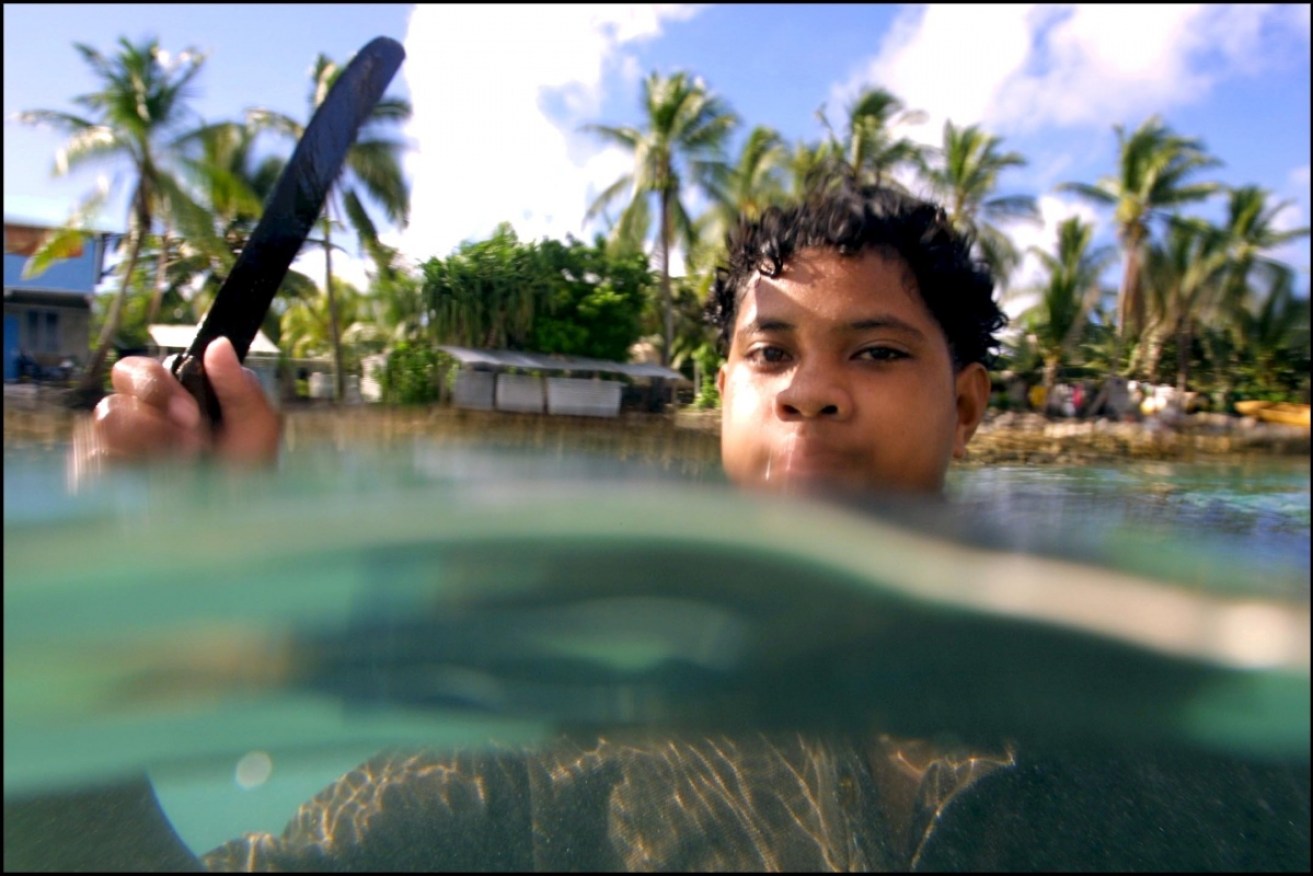
For Pacific Island nations, any debate about climate change is over – and the threat to their liveability is already very real. Photo: AAP
For many years, the annual United Nations climate conference, known as the COP, has represented something profoundly important: The hope that the nations of the world might recognise a common threat and act together in the interests of our shared future.
For countries such as Kiribati, Fiji, Vanuatu, Tuvalu, the Marshall Islands and many others across the Pacific, this has never been merely an environmental issue or a diplomatic exercise.
It is about whether our children and grandchildren will continue to call their islands home. It is about whether freshwater remains safe to drink, whether food can continue to be grown, and whether our nations remain habitable in the years ahead.
There have been moments when the COP process has risen to this challenge. At its best, it has reminded us that climate change respects no borders and that no nation, however powerful, can solve this crisis alone. It has encouraged greater ambition and reinforced the principle that our future is ultimately interconnected.
Yet we must also acknowledge an uncomfortable reality.
The science has been clear for many years. Indeed, some of the earlier projections of the Intergovernmental Panel on Climate Change have proven to be too optimistic. Earlier assessments suggested that many low-lying Pacific islands might remain habitable through the end of this century. More recent assessments indicate that the timeline may be much shorter. We are plainly not on track to fulfil the commitments made in Paris in 2015, and the aspiration of limiting global warming to 1.5 degrees is rapidly slipping beyond our reach.
The evidence is now all around us. Extreme heat, floods, fires, storms and prolonged droughts are no longer warnings of a future threat. They are symptoms of a crisis that is already unfolding.
Nowhere is this more evident than in the polar regions. Scientists continue to warn of the instability of major ice systems, including the Thwaites Glacier in Antarctica. For many, projections of sea-level rise may seem distant or abstract. For low-lying Pacific nations, they are neither. They translate directly into flooded land, contaminated freshwater, damaged homes and growing uncertainty about the future of entire communities.
And yet, despite the urgency of the situation, the international processes established to address climate change have not yet succeeded in addressing its fundamental cause.
This raises an important question.
Can we honestly speak of transitioning away from fossil fuels while continuing to approve new coal and gas developments?
It is difficult to reconcile support for climate action with investments that lock the world into decades of additional greenhouse gas emissions. Equally, it is difficult to ask those already experiencing the consequences of climate change to wait for another conference, another process or another promise of action at some point in the future.
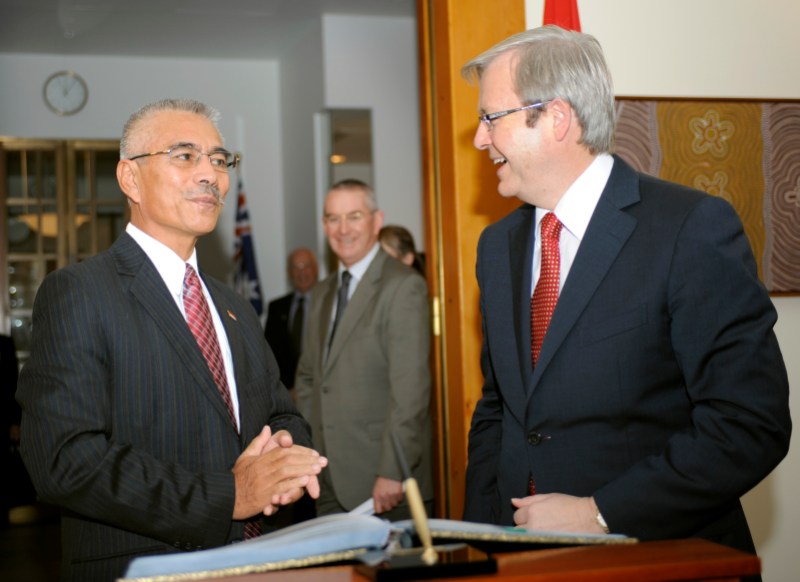
Anote Tong with then PM Kevin Rudd at a meeting in Canberra in 2008 to discuss climate change. Photo: AAP
For many vulnerable communities, particularly in the Pacific, time is becoming an increasingly scarce resource.
This is why the pre-COP meetings being held in Fiji and Tuvalu this week ahead of COP31 are so significant. They provide leaders with a valuable opportunity not only to discuss climate change, but to witness firsthand the realities faced by some of the world’s most vulnerable communities.
These meetings must be more than symbolic. They must help create the momentum necessary for meaningful action.
COP31 should be remembered as the moment when the international community demonstrated that it understood the scale of the challenge before us and accepted the responsibility that comes with that understanding.
As president of COP31 negotiations, and as a valued member of the Pacific family, Australia has a unique opportunity to provide the leadership that Pacific nations, and indeed the wider world, have long been calling for.
At COP28, governments agreed to transition away from fossil fuels in a just, orderly and equitable manner. Those words must now be translated into action. Future generations will judge us not by the statements we adopt, but by the choices we make.
We must also be honest about the limitations of measures that allow emissions to continue while claiming progress elsewhere. Carbon offsets may have a role to play, but they cannot substitute for reducing emissions at their source. The atmosphere does not recognise accounting mechanisms. It responds only to the volume of greenhouse gases we continue to release.
Equally, we must recognise that powerful interests continue to influence international negotiations. Delayed decisions, weakened commitments and continued expansion of fossil fuel production benefit some in the short term, but they do so at growing cost to the rest of humanity.
If COP31 cannot demonstrate credible leadership on implementing the commitment made at COP28 to transition away from fossil fuels, then difficult questions will inevitably arise about the effectiveness and credibility of the COP process itself.
It is perhaps not surprising that other initiatives are beginning to emerge. Earlier this year, the first Conference on Transitioning Away from Fossil Fuels brought together countries seeking to advance these discussions in a different setting. Such efforts should complement, not replace, the United Nations process.
The COP remains essential because it is one of the few global forums where all nations, regardless of their size or wealth, can participate as equals. In a crisis that affects us all, every voice matters.
But the relevance of any institution depends on its ability to respond to the challenges of its time.
The true measure of success at COP31 will not be the length of its final declaration, nor the number of speeches delivered. It will be whether governments are prepared to accept a simple truth: That continued expansion of coal and gas is incompatible with a safe and liveable future.
The COP process has achieved much over the years. Yet we must remain open to new pathways and new partnerships that can help us succeed in this common endeavour. Because failure is not an option.
The future of our children, our grandchildren and generations yet to come depends on the choices we make today.
May God guide us all in this shared responsibility and in our collective effort to safeguard the future of our common home.
His Excellency Anote Tong was the president of the Republic of Kiribati from 2003-2016. He is a member and current chair of the Pacific Elders Voice group, comprised of former national, academic and diplomatic leaders from the Pacific region

China and housing: Two things we may have missed