‘Hard to describe in words’: Where did Labor’s ideas go?

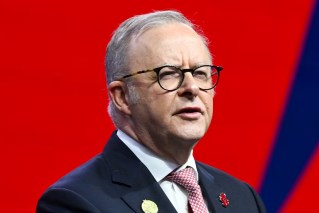
Anthony Albanese started strongly but appears to now be in permanent caretaker mode. Photo: Mike Bowers
One of the right’s cliched critiques is that left governments privilege “ideology” above “reality”. That social welfare policies, such as universal health insurance, might work well in a fantasy land, but they do not work in the real world where things cost money. (This was Matthew Yglesias’ bugbear in a recent guest essay for the New York Times, for example.)
It’s a critique that is both typically meaningless and a way for the right to imply that their own policy ideas are “rational” and “objective”.
But in order to make this clichéd critique, you have to first assume that the left government you’re talking about at the very least has some distinct ideas.
Despite him having governed Australia as its 10th longest-serving Prime Minister, it is still very hard to describe in words the ideas of Anthony Albanese – or his government. It is a government that keeps its ideological cards to its chest, as if to deter any attacks from the right that it is “ideological”. Where the Labor Party long ago embraced – or at the very least flirted with – socialism, labourism, unionism, and chartism, the -isms that the Albanese government confesses admiration for now are professionalism and pragmatism.
Nonetheless, is it possible to describe and categorise the Albanese government’s policy agenda as an ideology? Rob Manwaring and Emily Foley, in an article for the Political Quarterly last year, have described it as “thin labourism” (this is in contrast to “thick” ideologies like socialism and social democracy).
For Manwaring and Foley, “thin labourism” imagines the citizen as a “wage earner”, and is largely aimed at improving wages and working conditions.
Unlike socialism, it does not involve a critique of capitalism, nor does it propose any policies for a post-market future (for example, a universal basic income). And unlike social democracy, it has little recognition for citizens who do not earn a wage (consider unemployed, disabled and elderly Australians). “Thin labourism” aims its reforms at the dead centre of Australia’s society and economy: At those already employed, at those already healthy, and at those already enfranchised.
Which is not to say that the Albanese government has achieved nothing, nor that it has zero goals. Its recent reforms to the capital gains tax discount and negative gearing have already had remarkable effects on the national housing market.
But its long-term goal, as Treasurer Jim Chalmers recently put it, is to get more Australians “into the housing market” – that is, to make more Australians petty-capitalists, rather than to make housing secure for all, which might include government provision or stronger renters’ rights. This is a limited idea of what citizenship can and should be in Australia.
Labor governments were not always like this. When Gough Whitlam was elected prime minister in 1972, his reform agenda aimed to expand the possibilities of citizenship. His government reached out to women, to the working class, and to Indigenous Australians – groups who had been, both implicitly and explicitly, excluded from participating in civic life – to offer them the opportunity to pursue new avenues in education, work, and politics. This was a participatory form of citizenship, influenced by contemporary social democratic discourse and energised by the new nationalism of the era.
In its early years, the Albanese government clearly had its eye set on remaking citizenship, too. The Voice referendum in 2023 was an attempt to introduce a form of direct democracy into the legislative process for Indigenous Australians. But after its failure, Albanese seems to have retreated into a permanent caretaker mode, as if it were possessed by the spirit of the meek Jim Scullin government of 1929-32.
Not all governments need to, nor should, be the Whitlam government, but its mode of reform can be an inspiration. Whitlam responded to a changing moment in Australian and global economics, in which the postwar economic boom and Keynesian consensus was coming to an end. Bold times made for bold ideas.
Albanese faces a similar moment. If the spruiking of Silicon Valley is to be believed, the global economy faces an even more transformative moment with the widespread dispersion of AI software throughout working life. Service jobs, including legal and medical professions, will be either augmented or replaced by AI software that can produce the same output at quicker speeds. Even capitalists, whose investment decision-making processes could be mimicked or out-competed by AI, may have to look for new sources of income.
“Thin labourism” will not be able to respond to this transformation. There will be fewer and fewer wage earners in a post-AI economy, and the split-second decisions of AI investors will take us further away from traditional understandings of a marketplace.
Reform centered on marginal tax reform and investment opportunities will seem timid a decade from now. Bold times need to make for bold ideas again.
James Watson is a postdoctoral research fellow at The Australia Institute
This article was originally published on The Point. Read the original article
Republished under Creative Commons — Attribution-NoDerivatives 4.0 International — CC BY-ND 4.0

'Hard to describe': Where did Labor’s ideas go?