 Subscribe

What it’s like to live on the Age Pension
Most Australian retirees receive at least some government support, but the difference between a comfortable retirement and a financially constrained one often comes down to housing.


- The full Age Pension pays singles $32,180 a year, leaving little room for unexpected expenses.
- A retiree with around $219,000 in super could receive nearly $50,000 a year when combined with Age Pension benefits.
- Single renters relying on the full Age Pension could spend more than $30,000 annually on essentials, leaving less than $40 a week for anything else.
Most of us want to live the dream when we retire.
Few feel inspired by the vision of life on an Age Pension, with money constraints ruling our every decision. But for millions of Australians, that is already a reality.
The full Age Pension pays a single person $32,180 a year, or about $619 a week. And while this may seem a remote possibility for those still working, two in three Australian retirees currently receive a full or part pension.
Our super system is maturing and reducing this ratio, but slowly, with around one in two Australians projected to receive pension benefits by 2066.
So what’s it really like to live on a pension? And could you make it work? The answer depends largely on your overall situation, with homeownership as the key factor.
What does living on the Age Pension actually cost?
Living on the Age Pension looks very different for renters, homeowners, homeowners with a mortgage, and single or partnered people.
The Retirement Affordability Index (RAI) charts the spending of six retirement groups, or ‘tribes’, based on Australian Bureau of Statistics household expenditure data.
It breaks down how much different retirees spend on housing, food, transport, healthcare and other essentials.
For a single renter relying on the full Age Pension, the numbers are particularly tight.
Of their $32,180 annual income, an estimated $30,114 would go toward essentials, nearly the entire amount.
That leaves just $2,066 a year, or less than $40 a week, for anything else.
Housing accounts for 38 per cent of renters’ spending, compared with 21 per cent for homeowners. Food takes another 17 per cent and transport 8 per cent.
Healthcare accounts for just 5 per cent of renters’ expenditure, compared with 11 per cent for a better-off homeowner. But this isn’t necessarily good news.

Matt Grudnoff, co-creator of the RAI and senior economist at The Australia Institute, told The Money Edition that cash-strapped retirees often spend less on healthcare because they simply cannot afford it.
“This is not because they’re healthier than other tribes, but because the largest part of health spending is on private health insurance, and cash-strapped tribes simply can’t afford it.”
He said they are also more likely to miss doctors’ appointments or leave prescriptions unfilled, ultimately leading to worse health outcomes.
Even those who own their homes outright face considerable costs.
Speaking with The Money Edition, Greg McEwen, a former Centrelink Financial Information Service officer and now a finance educator, said that living on the full pension is difficult.
“Even if you’re a homeowner, you are up for rates (say $3500) and probably house insurance (say $2500) — that’s a $6000 slice off your income before you even get to cover food, medical, transport and energy.”
How much difference can super make?
Let’s consider a typical single female retiree, Sally, age 66, with median savings of $217,000, earning $55,000 a year, who plans to retire next year. Her savings are projected to reach $219,118 by the time she retires.
Most of us would find it difficult to project these savings into retirement income, given the mix of super, the Age Pension and the impact of inflation indexing.
I used the Industry SuperFunds retirement calculator to do the sums for Sally through to age 92, then checked the results with McEwen.
Assuming she has no other financial assets, Sally qualifies for a partial Age Pension, although her deemed income from super puts her just above the threshold for the full payment.
Her initial Age Pension entitlement is estimated at $31,673 a year.
Combining pension benefits with withdrawals from super gives Sally a projected annual retirement income of $49,271.
That’s not far off her current earnings of $55,000.
Importantly, it gives her greater spending flexibility than someone relying entirely on the Age Pension.
She has money beyond the bare essentials, whether for travel, entertainment, unexpected bills or other discretionary spending.
For a renter with little or no super, the picture is very different.
Who qualifies for the Age Pension?
Since you are likely to receive an Age Pension benefit at some point, it helps to know the rules.
You need to be 67 or older, an Australian resident (normally for at least 10 years), and meet both the income and asset tests.
These can seem complicated, but here are the basics, remembering your primary home is generally an exempt asset.
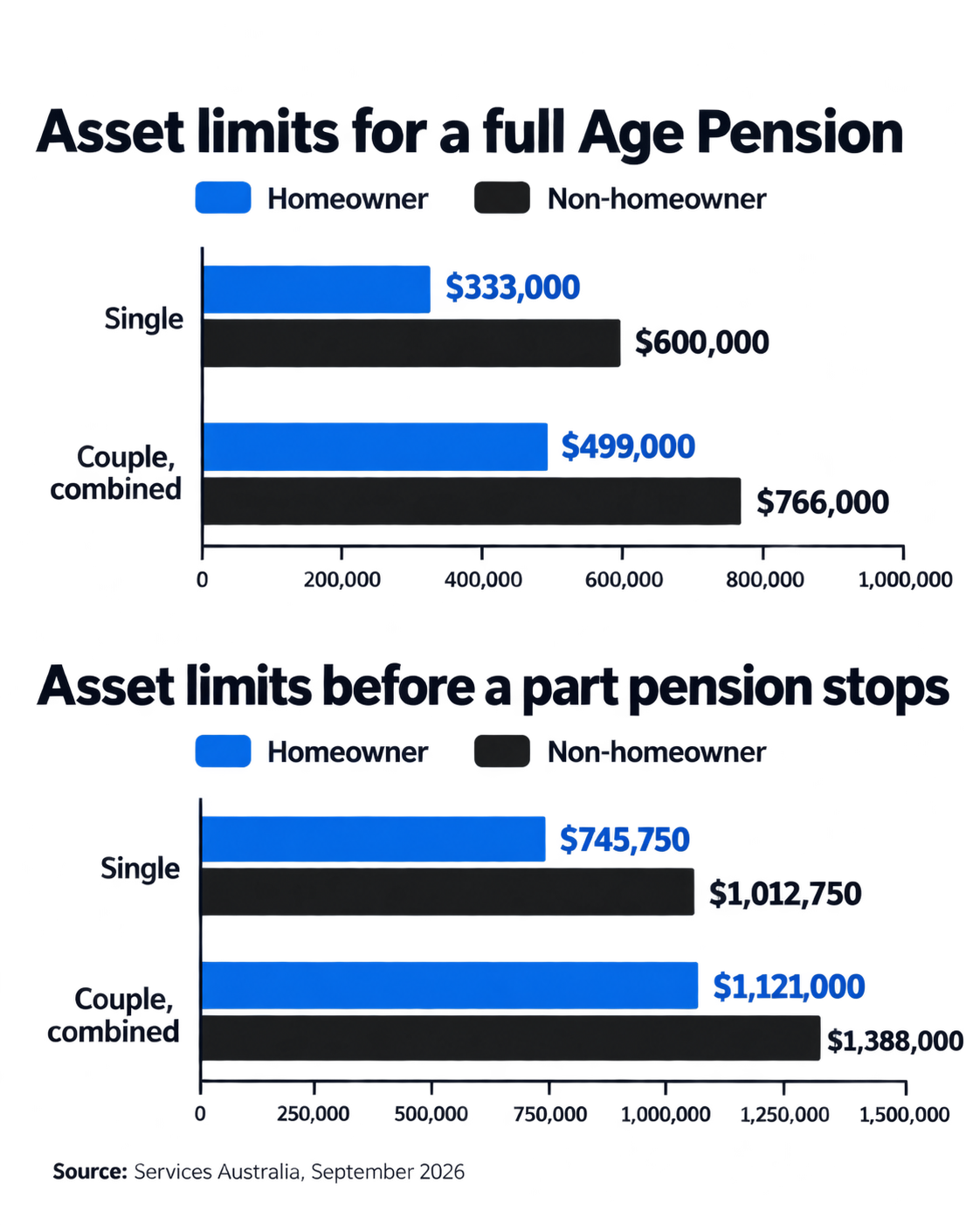
The full Age Pension, including supplements, pays singles $32,180 a year and couples $48,516 combined.
Income limits also apply. Singles have their pension reduced by 50 cents for every dollar of assessable income above $226 a fortnight.
For couples, each person’s payment reduces by 25 cents for every dollar of combined assessable income above $396 a fortnight.
An additional Work Bonus may apply for those who continue working.
Private renters who qualify can also receive Commonwealth Rent Assistance, providing some extra income to help meet housing costs.
Will the Age Pension still be around when you retire?
A common concern for pre-retirees is that there will be no Age Pension when they reach retirement.
But Treasury projections in the Intergenerational Report show Age Pension spending as a proportion of GDP is low and decreasing over time, so this is not a realistic fear.
The more relevant question is how much of your retirement income will need to come from the Age Pension, and whether it will be enough.
One positive feature of our pension system is that payments are reviewed against inflation and wages every six months, providing at least a degree of relativity to ordinary incomes.
But indexation doesn’t remove the pressure of paying for housing, healthcare and other essentials on a limited income.
If you’re unconvinced you could lead a reasonable life on $32,000 a year, pre-retirement is the time to heed the wake-up call.
Do the maths now and work with your fund or an adviser to maximise your savings to meet your retirement income needs.
Retirement day can arrive sooner than any of us expect.
Topics: Age Pension, Retirement