 Subscribe

The very real cost of the Bank of Mum and Dad
The Bank of Mum and Dad is helping more Australians into home ownership, but parents who dip into their savings could be putting their own retirement at risk.

- New research finds that nearly six in 10 parents whose children bought a home in the past five years provided financial or housing support.
- Parents across all income levels help their children through cash gifts, loans, loan guarantees, and rent-free accommodation.
- A $50,000 withdrawal from super could mean forgoing more than $180,000 in retirement savings over 20 years, highlighting the long-term cost of helping children buy a home.
My mother, Betty, may not have known it, but she was a trailblazing lender for the Bank of Mum and Dad.
In the late 70s, when my brother and I bought a flat in Melbourne’s South Yarra, we had to cobble together the money from a bank mortgage and a personal loan, with a $3,000 top-up from Mum.
We paid her back first, with interest. It worked well for her and even better for us, as I doubt such asset-poor mid-20-somethings would have made it over the line any other way.
Times have changed, home ownership is even tougher, and now the Bank of Mum and Dad (BoMaD) is one of the country’s biggest lenders.
The Bank of Mum and Dad has become so widespread that it is variously ranked as Australia’s fifth- to ninth-largest lender. But as gambling ads remind us, there’s a cost to consider. How much could helping your children now hurt your retirement income later?
There are many false assumptions about these intergenerational loans. One is that only wealthy retirees lend to their kids. But that is not the case; BoMaD transfers happen at all income and asset levels.
Curtin University Professor Rachel ViforJ has been researching intergenerational housing concerns for years.
Her most recent findings, from a 2025 survey, reveal surprising detail about this form of lending. First, the different ways parents help.
Whether the support is cash or in kind, it usually comes at some financial cost. ViforJ’s survey highlighted six different types of support, by home ownership. The numbers don’t add to 100% because many parents help in more than one way.
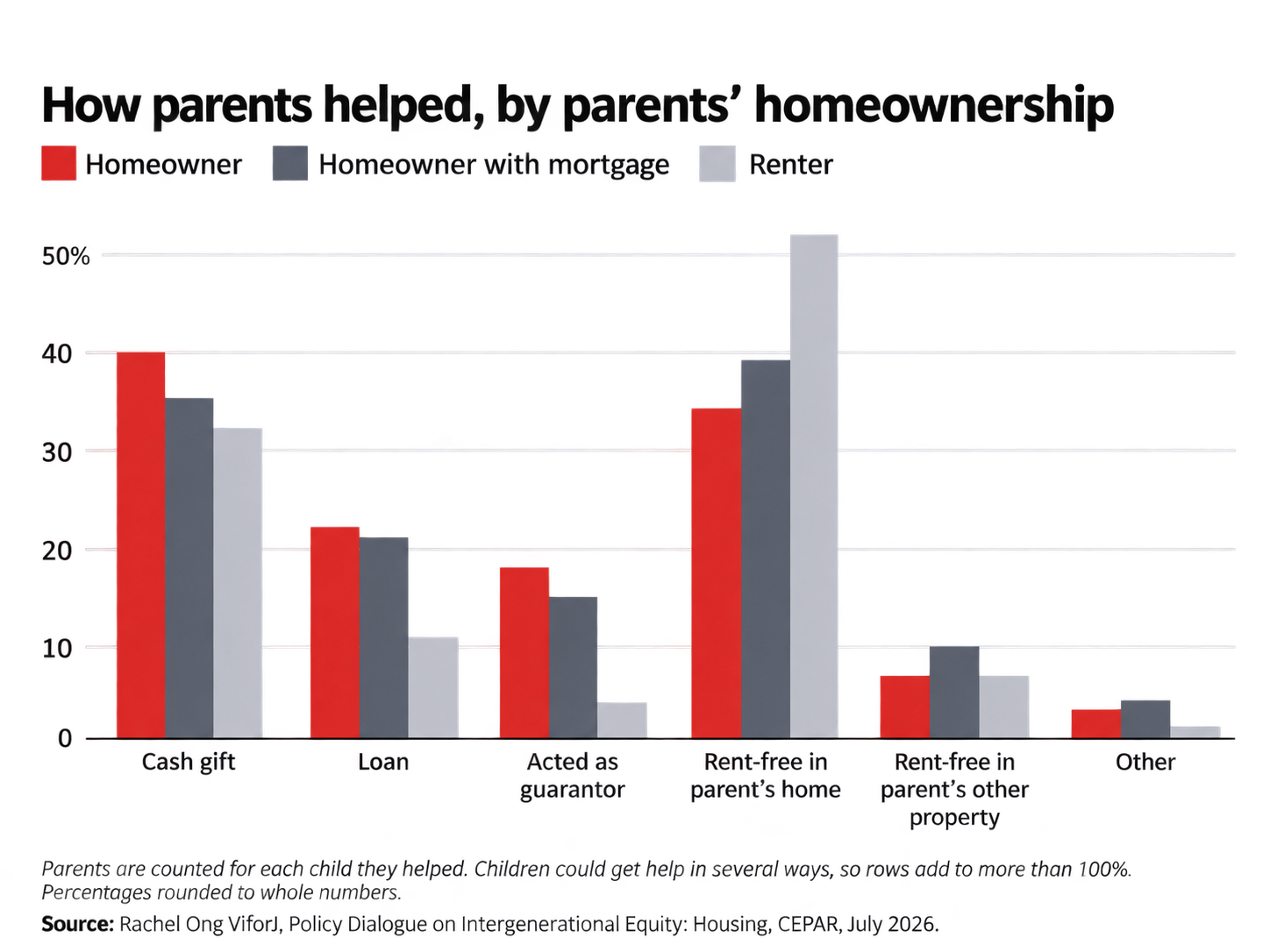
While these types of support vary by the benefactor’s socio-economic status, the giving is constant.
For instance, more than one in two retiree renters will help by letting their adult offspring live rent-free in their home (which is significant, given they probably spend 40% of their income on housing), while more than 60% of homeowners will give or loan money.
Regardless of how they support their parents, the following table shows that parents at all income levels give a lot.
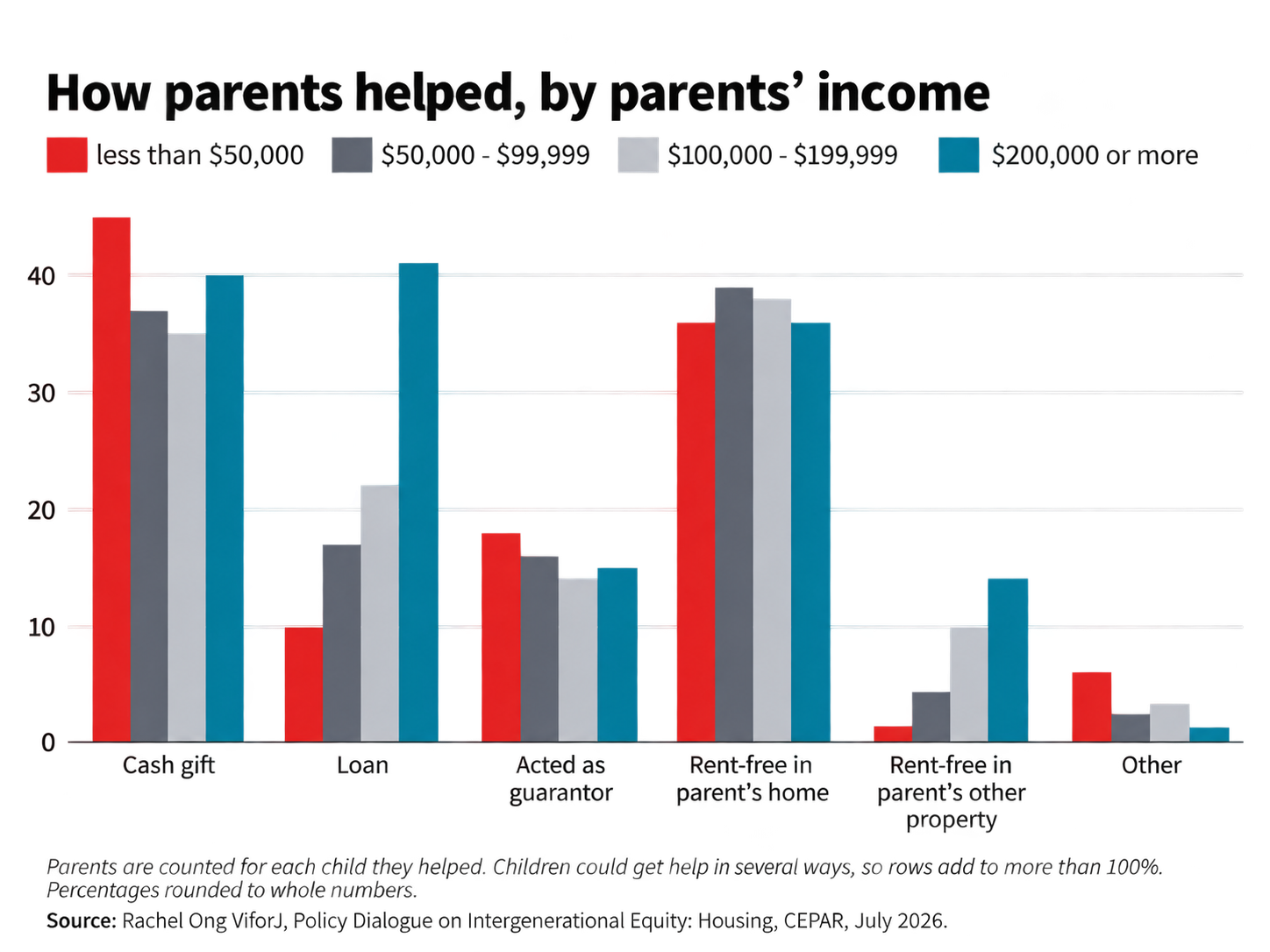
Interestingly, parents with incomes under $50,000 were more likely to give cash, while parents with incomes over $200,000 preferred to lend.
Perhaps the most notable finding from ViforJ’s research is that, among parents with a son or daughter who purchased a home within the last five years, a hefty 58% (994 of 1,725 respondents) helped out in at least one way.
How much is changing hands?
Because most of these loans or gifts are “off market,” reliable data to evaluate an average or median BoMaD contribution is limited.
Independent investment and advisory group Jarden’s 2023 projections (which used mortgage brokers’ data) suggested an average parental loan or gift of $70,000.
So how might this largesse affect the standard of living in retirement for BoMaD parents?
Well, it depends entirely upon the parents’ retirement income situation.
- Those on a full Age Pension cannot receive higher income, so they will have lower assets and potentially less financial flexibility.
- The effect on those on a part Age Pension will vary depending on the amount they give and when they give it. It may increase their Age Pension entitlement, but that depends on their overall income and asset situation. Super returns will be lower if they withdraw a lump sum.
- Self-funded retirees may, over time, qualify for a pension, which could mean higher guaranteed income, but with reduced super savings.
Such gifts or loans mean that the retirement nest egg has been reduced, so earnings will be punished over time.
A part-pensioner who withdraws $50,000 from their super as a lump sum to help their offspring will, if that money were compounded (using a very conservative 7%) over 20 years, have foregone $180,830. That’s one heck of a hit to your retirement options.
So much for spending the kids’ inheritance – they’ve spent it for you!
Before you jump in
If your Age Pension entitlement is likely to be an issue, it’s worth understanding that Centrelink limits how much you can hand over. If you give more, Centrelink still counts it as an asset and assumes it earns income for means testing.
And no matter how much you trust your offspring and their partners, family dynamics can change.
It’s important to manage everyone’s expectations by being clear about what’s on offer and formally recording it. This includes whether it is a gift or a loan, whether interest will apply and the repayment schedule.
Most of us love our adult kids so much we’d give them the shirt off our backs. But it’s worth evaluating whether your unstinting generosity will be a happy gift, or the cause of ongoing resentment or financial hardship.
“People helping kids shouldn’t feel guilty about also prioritising their own needs,” ViforJ said. “They will face health and ageing risks and need to plan for this as well.”
Topics: Retirement, superannuation