 Subscribe

Inflation is soaring, but rents aren’t. Here’s what’s holding landlords back
Rental growth is easing as more Australians share homes and investor demand weakens, giving tenants some breathing room after years of sharp increases.

- Australian rents are rising by an average of 0.30 per cent per month this year, down from 0.32 per cent in 2025, despite accelerating inflation.
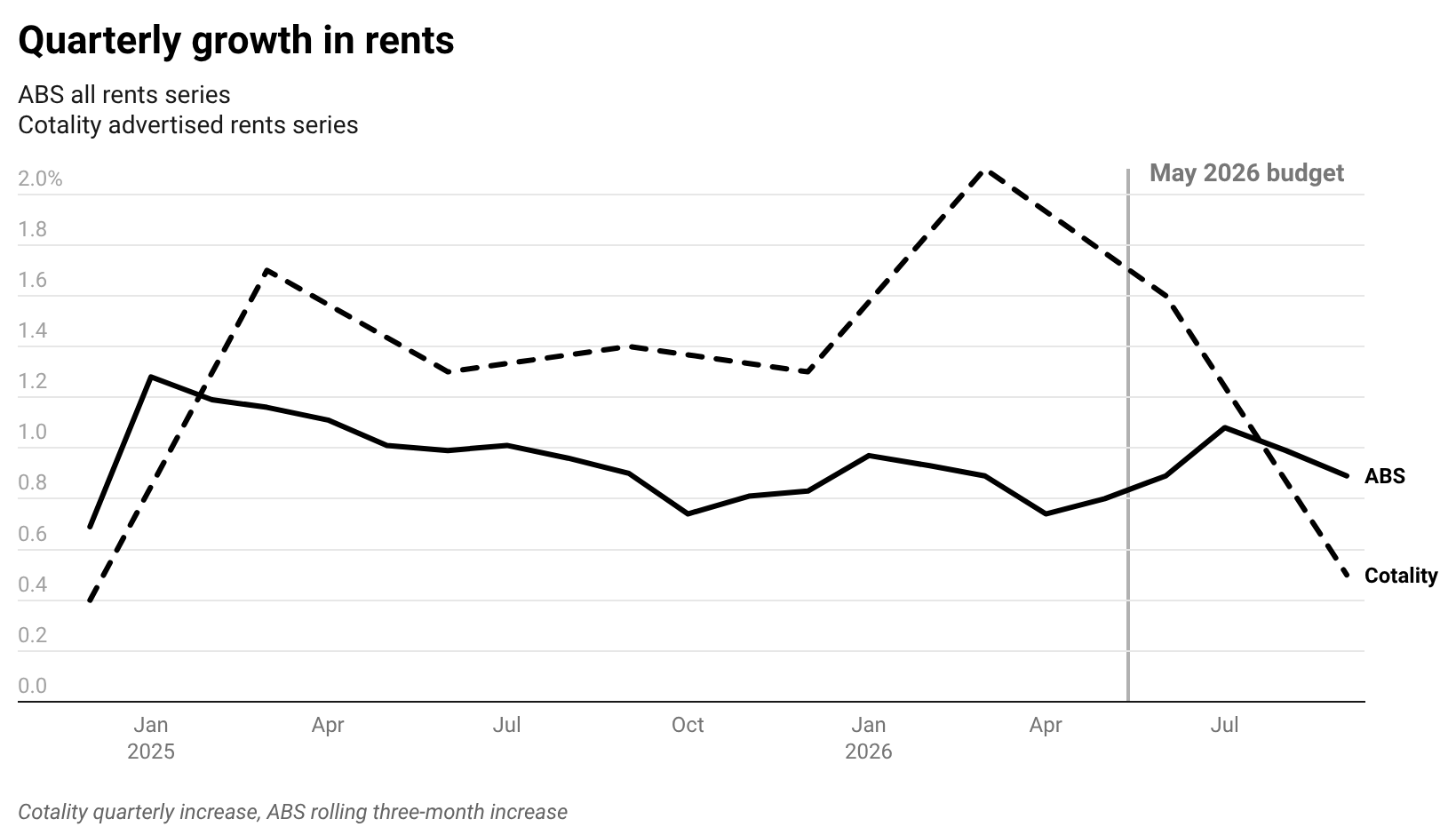
- Cotality figures show advertised rents increased just 0.5 per cent in the September quarter, down from 1.6 per cent in the June quarter.
- More Australians are living with family or sharing homes, reducing demand for rental properties and limiting landlords’ ability to raise prices.
Buried in all the news about soaring price growth in the latest Bureau of Statistics update on inflation was good news about one price that isn’t accelerating at all.
It’s rents — the money about one in three households pay their landlord each month.
Last year, rents grew at an average monthly rate of 0.32 per cent, which worked out to 3.8 per cent per year, about the same as overall inflation.
So far this year, rents have grown more slowly, at 0.30 per cent per month, or 3.6 per cent per year, well below overall inflation.
There is, however, some reassurance for renters.
The average monthly rent increase remained steady at 0.30 per cent in the four months after Treasurer Jim Chalmers’ May budget, matching the pace of the preceding four months.
It suggests that, at least so far, the budget hasn’t added pressure on rents. And there were all sorts of forecasts that it would.
With negative gearing denied to most new investors and capital gains taxed under a new, less generous formula, investors were expected to be more wary about becoming landlords. Fewer properties rented out would mean more rent per property, or so the argument went.
Investors are indeed more wary of becoming landlords.
The latest lending figures from the Bureau of Statistics (quite old; they are being updated next week) show lending to property investors slid 10 per cent in the three months to June, while lending to first home buyers remained little changed.
So why isn’t rental growth climbing? One broad-brush answer is that as investors shy away from buying existing homes (they haven’t shied away from buying newly-built homes, which remain tax-preferred), first home buyers will buy them instead.
Some of those first-home buyers would otherwise have rented, meaning that as investors depart and reduce the supply of rental properties, renters leave, reducing demand for those rentals.
It’s too neat an answer, because first-home buyers often haven’t rented. They’ve been living with their parents.
And first-home buyers aren’t exactly storming into the market right now. Even with the government’s 5% deposit scheme, many are holding back, waiting until interest rates come down.
Why fewer Australians are choosing to rent
What seems to be happening is more subtle. Australia’s average household size, that is, the number of people per household, is climbing again after falling to a long-time low during COVID.
This means more of us are sharing by living with our parents or in group houses. It means more of us are avoiding renting.
You can think of this as consumer power: people who would have rented saying no after years of rent increases well above inflation.
It’s also possible to see it as renters simply unable to pay what is being asked, sleeping on spare beds not because they want to, but because they have no other choice.

Renters market
Whatever the reason, rent pressure is easing, and far more than the Bureau’s inflation figures suggest.
The Bureau estimates changes in rents paid by all renters, sourcing data paid on 480,000 properties directly from real estate agents.
Real estate advertising firm Domain and the property data firm Cotality instead report on far fewer advertised rents.
While unrepresentative (most rent adjustments happen without a property being advertised), advertised rents tend to point to what will happen to overall rents down the track.
And what they find is awful for agents hoping to squeeze more out of tenants, and good for tenants looking for breathing space.
Cotality reports that advertised rents climbed just 0.5% in the September quarter, a dramatic slowdown on the 1.6% increase in the June quarter and the 2.1% increase in the March quarter before the May budget.
Domain says combined capital city rents for houses have remained unchanged for five consecutive quarters, the longest run of unchanged capital city house rents in a decade.
It says combined capital city apartment rents have been unchanged for two quarters, the weakest performance in half a decade.
Perhaps for reasons unrelated to the budget, the balance of power between renters and landlords is shifting.
As much as landlords may want to raise rents to cover the extra costs the budget imposes on them, they can’t do so as easily as before.
If they leave and aren’t replaced by another landlord, the property they were renting out will be sold to an owner-occupier instead, which the government said it wanted to achieve.
In the budget papers, the Treasury said its measures would help turn an extra 75,000 Australians into owner-occupiers.
It also said they were likely to push up rents by “less than $2 per week for a household paying the current median rent,” a forecast that for the moment is looking like an overestimate.
Topics: Consumer, Cost of Living, Housing, Renters, Rents