 Subscribe

Fewer branches, fewer staff: Are we getting less from our banks?
Australia’s major banks are investing heavily in technology and automation, reshaping how customers manage their finances and access support.


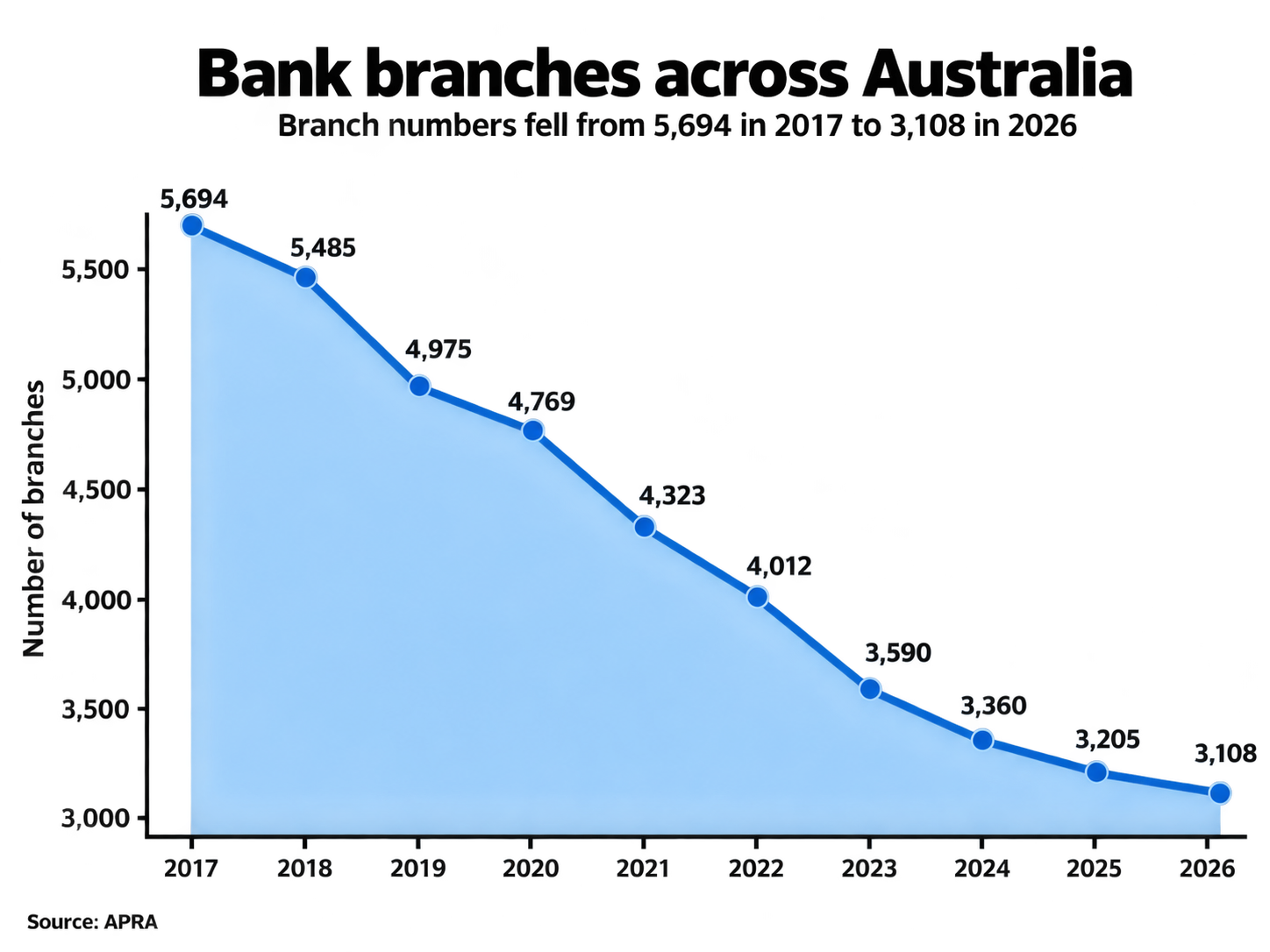
- Australia has lost more than 2,500 bank branches since 2017, with just 3,108 remaining nationwide as of June 2026.
- Banking and finance complaints rose 23 per cent to 66,971 in 2025-26, raising questions about customer service as banks cut costs.
- Experts warn that while digital banking offers convenience, customers still need human support for complex financial decisions, fraud and hardship.
Walking into a local bank branch to handle your financial business is becoming a thing of the past as banks deploy AI agents, lay off staff, and close branches across the nation.
The overwhelming majority (99.3 per cent) of customer-bank interactions now occur via digital channels, according to the Australian Banking Association. This means banks need fewer people, with three of the four major banks having laid off around 7,000 staff over the last 12 months.
Most routine banking now happens in an app, but surveys still show many people use a branch at least occasionally, Professor of Finance and Deputy Dean, Research & Innovation at RMIT University, Angel Zhong, told The Money Edition.
“One survey of 1,000 Australians found 82 per cent had used a branch in the past year, but only 21 per cent went monthly, and deposits and cash were the main reasons. That tells me that branches have become a place people go for specific, often stressful tasks, not a weekly habit.
Despite mass layoffs in the banking sector, the decision announced by the National Australia Bank to slash a further 2,500 jobs (around 6% of its workforce) raised legitimate questions about whether customer service would suffer.
Human help
The million-dollar question is: ‘Are customers getting a worse customer experience?’
NAB has previously said layoffs will bolster efficiency and help it respond to a tougher economy, explaining that the redundant roles are corporate functions and will not affect customer service in branches.
NAB chief executive Andrew Irvine said in an October statement that the decision was made because fewer customers are using branches to do their banking.
“These changes are expected to improve outcomes for customers by reducing duplication and speeding up decision-making,” Irvine said at the time.
His comments follow a Reserve Bank of Australia report last year that found digital transformation in the banking sector can actually improve customer service delivery while also conceding that digitisation introduced vulnerabilities that could threaten the stability of the financial system.
These include cyberattacks, technological outages, and reputational risk if data integrity is compromised.
“The shift towards digital banking services has contributed to a decline in physical bank branches in Australia, reducing service availability for individuals who are not active participants in the digital economy,” the report reads. “Residents in regional areas have been particularly affected by branch closures.”
But customers may have a different story.
APRA’s latest figures show branch numbers fell 3 per cent in the year to June, while AFCA reported a 23 per cent increase in banking and finance complaints to 66,971 in 2025-26.
Most complaints centred on claim-handling issues, service quality and claim rejection.
Stiff competition
No one is denying that banks may need to rein in costs somehow, but the fact is that banks are still making a decent profit.
Late last year, KPMG calculated that Australia’s Big 4 banks recorded a combined annual profit after tax of $29.8 billion as technological improvements bolstered efficiency and more customers were served online.
Bank satisfaction levels measured in surveys conducted by Digital Finance Analytics are mixed, according to principal Martin North.
“At the top level, customers feel that banks are charging too much for mortgages and are not passing on the higher rates on savings accounts, and they especially hate the tricky special offer rates which drop back to lower rates under inertia. This has become more extreme as rates have risen in recent times,” North said
At the service level, digital natives are comfortable with banks offering services online, though concerns are rising about data security and privacy, he added.
“Other household segments who are more inclined to use branches are not happy, as the recent spate of closures and reduced access to cash are making their lives more difficult, with longer travel times to the branches which remain open. Use of cash is actually rising, and the recent changes to the surcharging on cards are making this worse.”
Between specific banks, the big four show little difference, but some smaller regional banks and credit unions get higher satisfaction scores for both ease of use and accessibility, the bank surveys reveal.

The technology revolution has certainly changed the face of banking, but banks are no more customer-centric than they were a decade ago.
“Their focus is on cost savings and margin protection, not providing superior customer experiences. And the AI boom will push this further, because people costs within the banks are one of their biggest expenses…. Thus, expect more branch closures, more digital, and more price gouging,” North said.
Professor Zhong also pointed out that whether someone is experiencing financial hardship, dealing with fraud, buying a home or planning for retirement, human judgement and empathy remain incredibly important.
“The key lesson for banks is that customers don’t measure service quality solely by speed,” Zhong said.
“They also care about being understood, receiving accurate guidance and knowing that support is available when they need it. AI can improve efficiency, but trust remains a fundamentally human issue.”