 Subscribe

What the RBA’s rate hike means for every generation
From young Australians to retirees, the impact of five rate hikes in a calendar year will depend on your life stage and financial situation. Here's how it affects you.


- The Reserve Bank of Australia (RBA) has lifted rates for the fifth time this year, but not everyone will be feeling the pain.
- From young Australians to retirees, the impact of five rate hikes in a calendar year will depend on your life stage and financial situation.
- A rate hike is not a universal bad thing — but there is one generation that will cop the brunt of yesterday’s increase.
For hundreds of thousands of households, yesterday’s interest rate hike would have left a bitter taste in their mouths.
But not every generation, and not every financial situation, suffers or gains after an interest rate rise.
From renters to retirees, here’s who cops the brunt of fighting inflation, and who actually gains.
Young Australians (first-home buyers and renters)
The nation’s youngest members will likely barely bat an eyelid at central bank moves, but interest rates can have a profound flow-on effect for anyone renting or looking to buy a home.
As Ron Hodge, CEO of digital wealth platform InvestSMART, told The Money Edition, an interest rate hike is a “mixed bag” for young Australians.
“A higher cash rate helps accelerate the growth of a first-home deposit safely parked in a savings account,” he said.
“On the other hand, the broader economic reality works against them: surging inflation dilutes purchasing power, borrowing capacities shrink with every rate rise, and a tight rental market swallows any spare cash.”
If you’re looking to buy, a rate hike will impact your borrowing capacity.
According to Canstar analysis, for a couple both earning the average full-time wage, yesterday’s rate hike stripped $21,500 more from their borrowing power.
In total, five rate hikes wiped $116,200 off a couple’s borrowing capacity since the start of the year.
If you’re renting, you won’t feel any immediate effect from a rate hike, but your landlord will.
Interest rate hikes tend to flow through to renters over time as contracts are renewed (and rents increased) in 12-month intervals.

Mid-life Australians (Borrowers)
If you’re a few years into your career and paying off a mortgage, there is some bad news: You’re bearing most of the brunt of the RBA’s moves.
“Mid-life Australians are bearing the brunt of the Reserve Bank’s inflation fight, particularly those juggling mortgage repayments, childcare and everyday living costs,” Hodge explained.
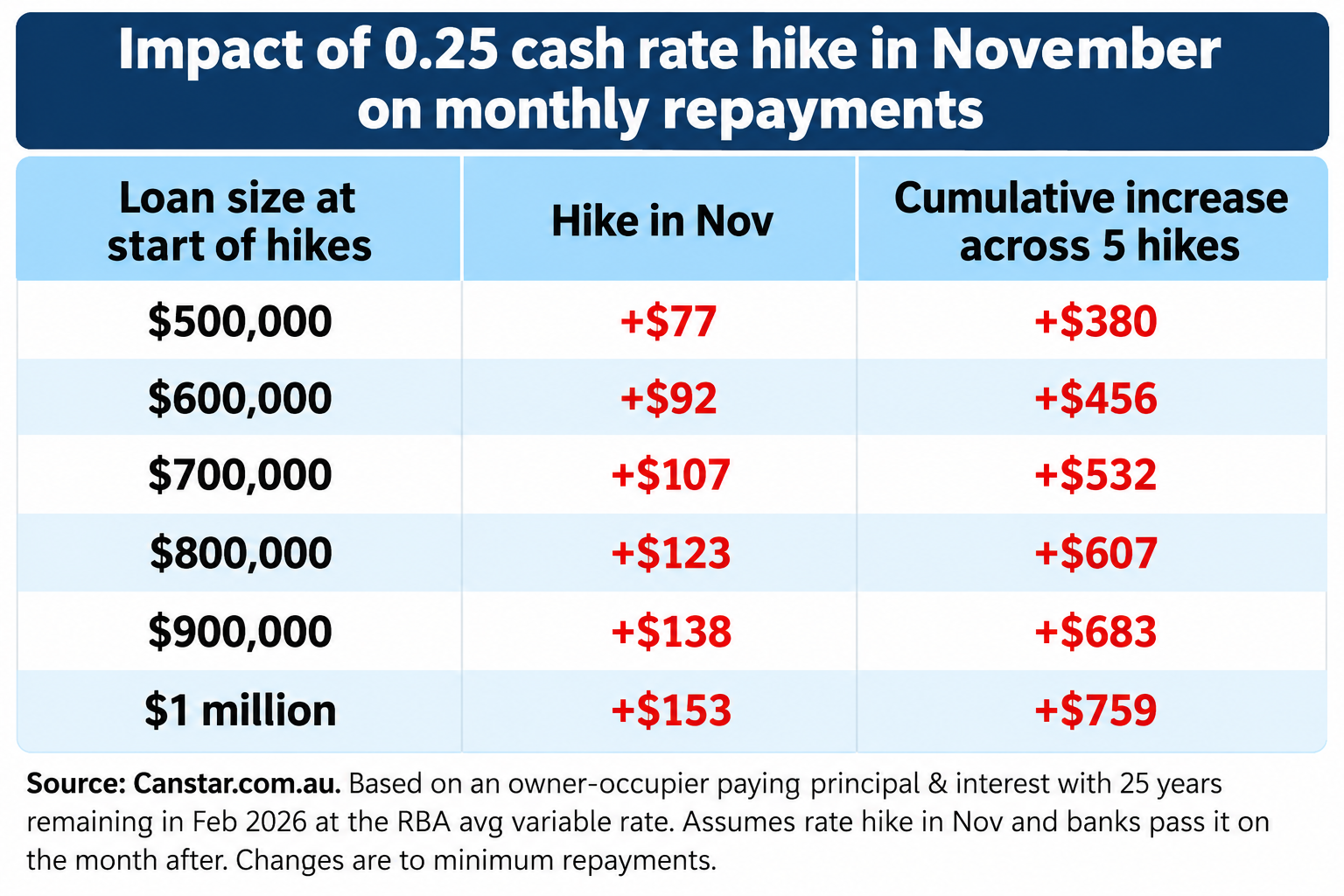
“A 0.25 per cent rise on a $600,000, 30-year variable loan adds roughly $100 a month to repayments.
“Every extra dollar going towards the mortgage is money that can’t be used to save or build wealth.”
You are also the cohort most statistically likely to have children, which require additional living, schooling and transport costs.
Around 3.3 million or 35 per cent of households held a mortgage, according to data from the Australian Bureau of Statistics (ABS).
Just under 3 million, or 32 per cent, of households owned their own property while the remaining 31 per cent were renting.
Pre-retirees (50–65)
For slightly older households, where Australians are looking ahead to retirement, this might be your financial sweet spot.
If you had children, they are likely older and less of a cost burden by now, and if you maintained career progression, you would likely have a strong salary or, alternatively, a lower-stress career with considerable experience meeting your household bills.
For this cohort, a rate hike presents an interesting dilemma: Do you race to pay off your home, or inject more cash into your retirement?
“For Australians approaching retirement who still carry a mortgage, rate rises bring into focus a common dilemma: pay down debt or boost super,” Hodge said.
“There’s no one-size-fits-all answer; it depends on how much debt is left and how comfortably it’s being serviced.
“Those under mortgage stress should generally focus on reducing the loan, while those managing repayments comfortably may be better off building their super, which can later be used to help clear the mortgage once they retire.”

Older Australians (Savers)
For the oldest cohort, an interest rate hike might actually be a blessing in disguise.
Many Australians in this life stage likely have no mortgage, are retired, and are focusing on making their savings stretch as far as possible while still living a relaxing life.
“Older Australians with substantial savings and little or no mortgage debt are generally the biggest winners from another rate rise,” Hodge said.
“Higher rates can boost income from savings accounts and term deposits, but with inflation still high, those returns may not
stretch as far as they seem.
“And with many Australians living well into their 80s and 90s, it’s important not to overlook investments that offer long-term growth,” he added.
Topics: Interest Rates, RBA