Cast in bronze: Proof that today’s politicians choose the wrong battles

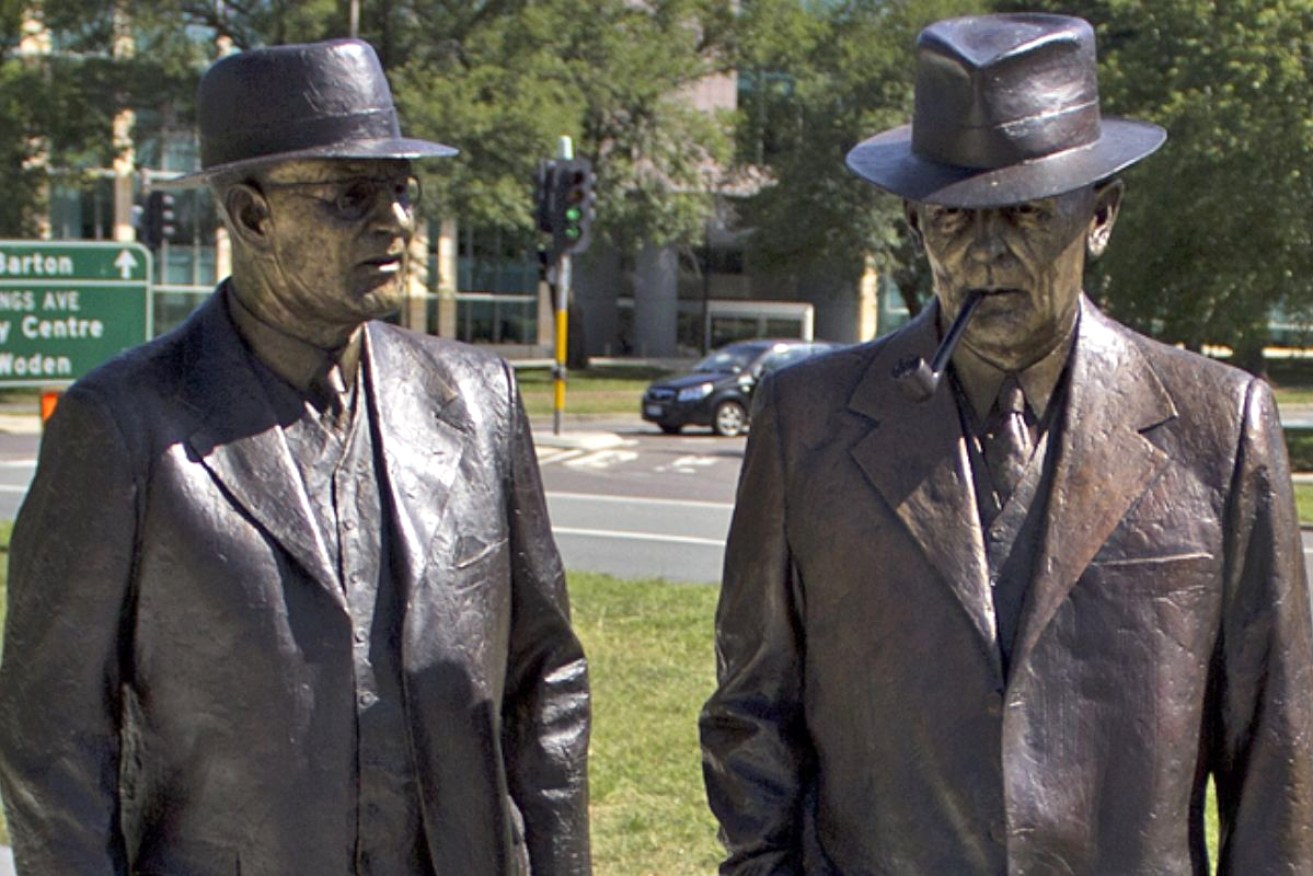
John Curtin (left) and Ben Chifley, forever locked in conversation on their way to work. Photo: Wikimedia Commons
One of the best sculptures in Canberra depicts John Curtin and Ben Chifley mid-stroll on their way to Old Parliament House.
The pair would walk from the Hotel Kurrrajong to parliament and talk about the day ahead, and the sculpture captures one of those moments. Curtin has just finished speaking, and Chifley, pipe in mouth, is considering his response.
It’s a tiny piece of history captured in bronze. It represents not just the strong relationship between Curtin, Australia’s wartime prime minister, and his treasurer and confidant, Chifley, who would go on to lead Australia’s post-war reconstruction following Curtin’s death, but another time.
The Kurrajong, started life as Hostel No.2. It was the Labor MP accommodation of choice, while conservative MPs stayed in Hostel No.1, now known as the Hotel Hyatt. Both places were considered informal party rooms for their corresponding residents. Chifley stayed at Hostel No.2 as prime minister, instead of The Lodge, in the same room he had lived (and died) in as treasurer and opposition leader. This period in politics is considered the stuff of Canberra legend.
Chifley stayed at Hostel No.2 as prime minister, instead of The Lodge, in the same room he had lived (and died) in as treasurer and opposition leader. This period in politics is considered the stuff of Canberra legend.
Labor MPs and the few conservatives who also stayed at Hostel No.2, instead of the sister building on the other side of the triangle where their colleagues stayed, would get into arguments over breakfast, and debates over post-parliament dinner and drinks.
It was Curtin who began Australia’s pivot to America – not because of an unquestioning love of the United States, but because of the simple truth that Australia’s trust and faith in the British empire was a fool’s errand and lopsided, especially given Winston Churchill’s disgraceful attitude towards Australian troops during the war.
As leaders, Curtin and Chifley were pragmatic for Australia’s sake, not necessarily their own. And perhaps, more importantly, unquestionably led by their values.
Curtin instigated the background briefings that are now ubiquitous in corporate politics – he’d started them because he wanted a direct conduit to the nation’s media, during the war, about Australia’s military strategy and official thinking from the highest level, to reduce misinformation finding its way into the media and to maintain trust with the public and media proprietors during the war (and to restrict the information that newspapers were publishing about Australian troop movements, to protect the troops’ lives).
The statue of Curtin and Chifley encapsulates everything about that era, and it is so life-like that it often prompts double takes from passers-by.
And driving past the sculpture of the two men forever in conversation, engaging in the most ordinary of tasks – walking to work – you can’t help but think about their modern counterparts.
And the very different path they have chosen.
Modern Labor leaders are willing to lose elections in order to maintain power and respectability within the status quo. How else do you explain Labor’s constant choice to deal with the Coalition in the Senate, while ignoring other ways to pass legislation, purely because it wants to be able to do the least possible?
Anthony Albanese’s “dramatic” intervention on refugee numbers this week does not mean Labor won’t be cutting migration to try to soothe potential One Nation voters, just that Albanese doesn’t see political gain in having a fight over which groups will be targeted.
As predicted, we heard this week that gas will play a major role in AI data centres – purely because Albanese and Labor don’t see the political gain in having any sort of fight over something they won’t begin legislating until next year. Plus, having a fight with the Northern Territory over gas for data centres would bring Beetaloo into the conversation, and Labor doesn’t want that.
It’s why Western Australian Labor didn’t question installing a gas lobbyist in a byelection race, and then campaigns without her when it turns out a love for Woodside doesn’t also drive voters in the same way it drives WA Labor.
Why you can cut a disability support system your party built and claim it’s just economic rationalism. Why a government will tie Australia to a failing empire ever tighter, all so it doesn’t have to have a domestic or diplomatic fight. Why criticism of Israel and its genocide is limited to specific and isolated cases and not to the nation’s desire for this country to stand for human rights and international law. Why saving the environment is reduced to questions of whether or not it can be monetised.
It’s why Labor is dealing with One Nation in the way it feels most comfortable – ignoring it publicly, sending the unions onto the frontlines to talk about Pauline Hanson’s hypocrisy, while wooing the weak links in One Nation privately.
One Nation MP David Farley is finding Labor to be among his most helpful parliamentary colleagues these days. Tony Burke and Albanese take time to have chats with him in the House, and Labor has helped ease his transition to parliament with helpful tips about procedure and an open door policy. When Farley was talking migration numbers on Insiders recently, it was Labor numbers and Labor breakdowns he had in his head. The game is afoot within Labor’s backrooms – if Farley goes independent it will be a win. But all of this is occurring without Labor having to reckon with One Nation’s appeal directly and in public.
Like all modern corporate politicians, Labor’s leaders now use off-the-record briefings to manage messages and wage their own propaganda wars – the strategic placement of focus group results and polling in newspapers, and warnings from “internal sources” to try to spook party members who look like they’re not toeing the party line.
The fights the government has and doesn’t have are always a choice. And while most are focused on a future election play, there is also the bigger battle being fought by the larger establishmentagainst a changing world, like a structural King Canute.
And for many political leaders, that is the fight they are focused on. And the nation is poorer for the path they’re choosing.
Amy Remeikis is a contributing editor for The New Daily and chief political analyst for The Australia Institute

Double standards from groceries to a 'shrug emoji'