The Stats Guy: Australia was much easier to govern in 2006. By 2046, it will be harder still


In 2006, Australia was close to enjoying a sweet spot.
Inflation remains stubbornly high and drives up costs of living dramatically. This forces the Reserve Bank of Australia to keep raising interest rates.
Economists calling for significant government spending cuts rightfully argue that reducing public demand would take significant pressure off inflation and thereby lower interest rates.
As a demographer, I naturally want to know much government can realistically cut under current and future demographic circumstances?
Let me spoil the column for you right away – Australia is demographically becoming more expensive to govern, regardless of who is in power.
Not all populations cost the same
Imagine you were the treasurer tasked with designing the ideal population for your federal budget.
You would want as many healthy, highly educated, well-paid workers aged between 25 and 60 as possible.
These people pay lots of income tax, spend money in the economy, and generally require fewer taxpayer-funded services than children or elderly Australians.
You would want high workforce participation, low unemployment, and few people relying on welfare payments.
For each individual budget, you would prefer few children needing education and few elderly residents requiring expensive care.
From a purely fiscal perspective, this would be close to the perfect population.
Of course, such a society couldn’t survive for long. Today’s children become tomorrow’s taxpayers, while today’s taxpayers become tomorrow’s pensioners.
Still, this simple thought experiment helps us understand why some demographic profiles make balancing a government budget easier than others.
 Not all populations bring the same revenue
The other half of the equation concerns government’s ability to raise revenue.
A prosperous population with strong employment generates more tax revenue than a population characterised by low wages, unemployment and economic inactivity (see my NEET column).
As a treasurer, you’d wish for a large tax-paying population – you, of course, hope to see mostly high-paying jobs so you can extract more income tax.
Further, you’d hope for low unemployment, super-high female workforce participation, high productivity, a migration system that takes in high-earners filling just the right skill gaps. Of course, you also want people to retire at a very advanced age.

The ideal fiscal demographic profile combines strong tax revenue with relatively modest spending obligations.
And this brings us to Australia’s changing demographic fortunes.
The demographic sweet spot of 2006
In 2006, Australia was close to enjoying such a sweet spot.
The Howard government was running substantial budget surpluses, Commonwealth net debt had been eliminated and unemployment was relatively low.
The government’s fiscal performance certainly deserves credit. The Coalition had maintained a disciplined fiscal framework, managed economic shocks and benefited from economic reforms that had strengthened Australia’s competitiveness over preceding decades.
However, it also enjoyed two considerable advantages that today’s political leaders can only dream of.
The first was the mining boom.
China’s industrialisation was driving extraordinary demand for Australian iron ore, coal and other commodities. Rising export prices boosted company profits, government tax receipts, employment and household incomes.
Managing the windfall wisely required political decisions, but having the windfall in the first place was enormously helpful.
The second advantage was demographic.
Australia had a large working-age population and relatively few elderly residents.
The baby boomers were largely still working, paying taxes and accumulating superannuation. They had not yet begun placing pressure on the aged-care system.
Our demographic profile was generating substantial revenue without the expensive care obligations that would arrive decades later.
The government of 2006 did not create this favourable age structure. It inherited it.
Whether we like it or not, the demographic bill is now presented to us.
In 2026, 20 years on, Australia’s age structure looks very different.
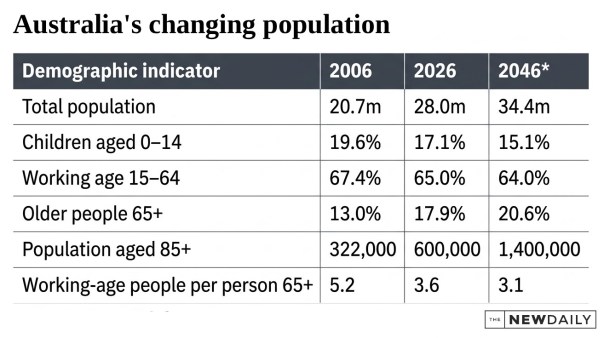
2046 figures are projections. Figures rounded. Sources: ABS, AIHW and Treasury’s 2026 Intergenerational Report
The critical number is in the final row. In 2006, Australia had approximately 5.2 people of traditional working age for every resident aged 65 or older.
Today that old-age-dependency ratio has fallen to 3.6. By 2046, it will sit at a mere 3.1 (or lower if migration was to decline significantly).
These aren’t necessarily employed people, nor does everyone aged 65-plus stop working or paying tax. Nevertheless, the direction of travel is unmistakable. Australia is moving away from its most favourable demographic circumstances.
Consider the dramatic expansion of the oldest age groups. In 2006, only about 322,000 Australians were aged 85 or older. Today there are approximately 600,000.
By 2046, Treasury expects 1.4 million. People in their late 80s and 90s are substantially more likely to require assistance with everyday activities, residential aged care and hospital treatment. These services require skilled workers, specialised facilities and lots of public funding.
Unlike certain administrative functions, providing physical care cannot easily be automated or delivered at zero marginal cost. We will need hundreds of thousands of additional carers, nurses and healthcare workers over time.
The costs are not optional in any meaningful political sense. Australians expect their elderly relatives to receive appropriate care.
Government spending is changing shape
Australia’s latest Intergenerational Report offers a revealing picture of these changing obligations. I criticised parts of the report in a recent column but since I broadly agree with its demographic reasoning, a fascinating pattern emerges.
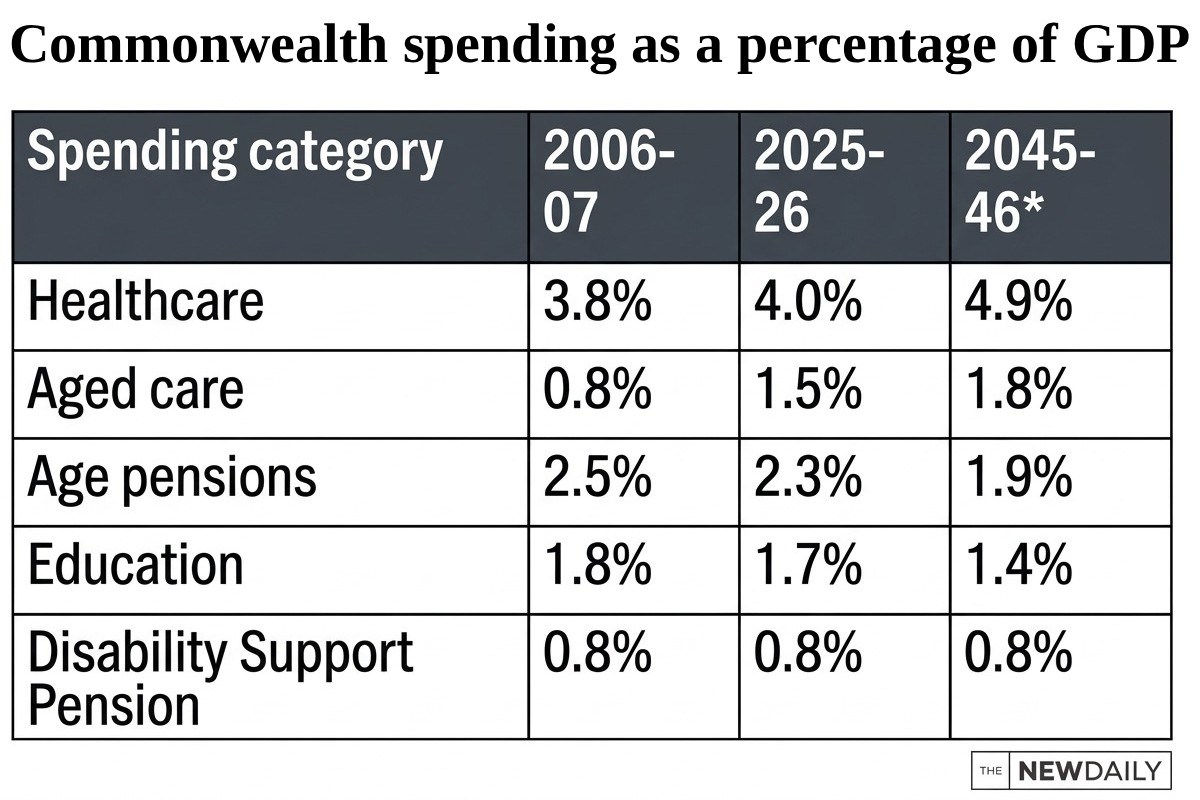
Historical estimates and projections from the 2007 and 2026 Intergenerational Reports. Categories and accounting treatments have changed, so the comparison is imperfect but indicative
The demographic profile of Australia leads to less spending on education, while healthcare and aged care absorb a growing share. Older people are growing much faster as a share of the population than children.
This does not mean we can simply close schools. Treasury still projects the number of children aged under 15 to increase from 4.8 million today to 5.2 million in 2046.
Education spending must also be maintained to support the productivity of tomorrow’s workforce.
The relatively favourable outlook for Age Pension expenditure is owed to our superannuation system. We established a forced saving scheme because we knew that pension payments would increase.
So, despite population ageing, spending on pensions is projected to decline relative to GDP. This is a genuine policy achievement, although superannuation tax concessions also represent substantial forgone government revenue.
The real fiscal challenge of ageing lies increasingly in healthcare and aged care rather than simply pension payments.
Of course, not all increases in government expenditure are demographic. Defence commitments, debt interest, infrastructure choices, government efficiency, and the generosity of individual programs also affect spending.
Our national demographic profile mustn’t be used to excuse every new expenditure initiative – it does explain, though, why cutting spending is harder now than it was in 2006, and why it will be harder still in 2046.
This distinction is important when economists demand that governments slash spending to combat inflation.
The argument for fiscal restraint is sound. When the public sector increases demand for labour, construction and services in an economy already operating near capacity, inflationary pressures can intensify.
Reducing unnecessary expenditure can therefore complement monetary policy, rather than leaving mortgage holders to carry the burden. Demographic spending pressures complicate the task though.
Cutting wasteful procurement, reducing poorly targeted subsidies and improving administrative efficiency are very different propositions from reducing access to hospitals or withdrawing essential aged-care services.
A government serving a population with 600,000 residents aged 85-plus simply faces different obligations from one serving 322,000 – by 2046, the care challenge becomes even larger.
Governments should still pursue efficiencies relentlessly. Better preventive healthcare, improved technology, stronger workforce participation, and carefully designed services could generate meaningful savings.
But we should not confuse the increased cost of serving an ageing population with fiscal incompetence.
Three different Australias, three different budget challenges
The comparison between 2006, 2026, and 2046 illustrates how dramatically the task of governing is changing.
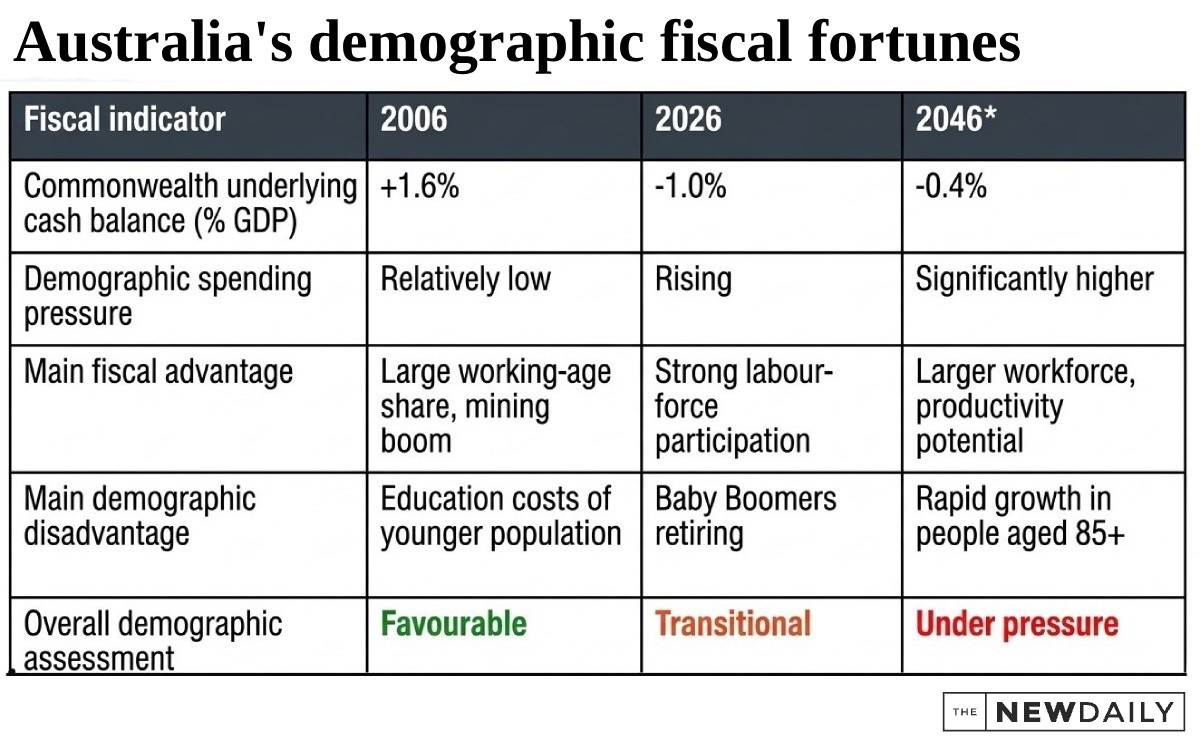
2026 and 2046 budget balances are projections from Treasury’s 2026 Intergenerational Report, not outcomes determined by demographics alone.
In 2006, the government enjoyed an unusually favourable combination of demographics and economics. Strong commodity prices lifted revenues while a relatively young population kept age-related costs manageable.
In 2026, the working population remains sizeable, but the baby boomers have largely entered retirement and care costs are increasing.
By 2046, Australia will have an even larger economy and workforce, but that workforce must support vastly more elderly Australians.
There are some demographic grounds for optimism. Higher female workforce participation, older Australians working longer, continued skilled migration and improved productivity could all ease the fiscal burden.
Indeed, Treasury projects a smaller Commonwealth deficit in 2046 than today, reflecting these and other economic and policy assumptions. But such projections shouldn’t be confused with demographic destiny. Governments will need to work harder to achieve those outcomes.
The lesson is not that the governments of 2006 deserve no credit for their surpluses, nor that today’s governments should be excused from difficult budget decisions. It is that the economic and demographic circumstances facing governments are fundamentally different.
Good government mattered in 2006. It matters even more in 2026. By 2046, Australia will need exceptionally effective government simply to maintain the services Australians have come to expect.
Simon Kuestenmacher is a co-founder of The Demographics Group. His columns, media commentary and public speaking focus on current socio-demographic trends and how these impact Australia. His podcast, Demographics Decoded, explores the world through the demographic lens. Follow Simon on Twitter (X), Facebook, or LinkedIn.