Double standards from supermarkets to an uncomfortable ‘shrug emoji’

Source: WA Labor
Double standards are pretty standard in Australia – so standard that the past couple of weeks has been full of them in politics and barely an eyebrow has been raised.
After a week of conservative economists and establishment brown-nosers losing their minds over a proposal from the Greens think tank for nationalised grocery stores (an idea put forward by a think tank whose job it is to think of policy ideas and inspiration but, like all think tanks, has no power to force policy change), the supermarket giants raising their prices for paper bags and essentials like water largely went unnoticed.
Apparently the billion-dollar profits posted by Australia’s major supermarkets make it just too difficult for Coles or Woolworths to absorb increased costs. So they are passed on to Australians already suffering under a cost-of-living crisis, and that is business as usual.
But the idea that anyone might come up with proposals to challenge the monopoly “just doesn’t stack up”.
As indie media Lamestream also pointed out, we have had a year of almost unchallenged political “debate” about cuts to migration – with very little, until recently, examination of what that would actually do to the economy. But an idea to challenge a duopoly was immediately squashed, despite not being actual policy.
But, then again, One Nation is running Australia’s policy debates. That’s why we have the two major parties creating migration policies – it’s not answering an actual question or solving any issues, it’s just providing cover for a political debate.
Perhaps if One Nation had raised the prospect – as it has, previously, for a “people’s bank” (which didn’t receive anywhere near the same level of hysterical response as a people’s supermarket) – we would still be talking about it.
But no. Arbitrary immigration cuts are “sensible”. Trying to inject any new ideas into our duopolies – ridiculous. Outrageous. Nonsensical.
Just as the gas industry deciding the parameters of a gas reservation policy seems business as usual, any policy that would actually benefit Australians – like a gas tax, which is not just easy to implement, it’s hard to game – is basically ignored.
You’ll hear plenty more from people like Madeleine King – a Resources Minister so captured by the industry she makes Matt Canavan’s stint seem almost oppositional – that the need to protect the industry for Australia’s future is paramount. You’ll hear plenty from the industry itself too, along with the usual warnings that, without more exploration and more gas fields, Australia will be in danger of falling short.
But you’ll hear very little about reports that China has joined Japan in creating an gas export market of its own, from excess Australian gas it is importing but doesn’t actually need. So you’ll hear more about “China’s warnings”, as a key market for companies extracting Australian gas, against any sort of intervention in our own gas market – but not because China is making bank from on-selling that gas.
Australian media will run opposition to Israel’s genocide as “Jew hate”, despite court findings that criticism of Israel and its genodical policies is not antisemitism (and note, we have moved from antisemitism straight into “Jew hate”). But it will ignore pro-Israel groups’ embrace of One Nation.
You’ll also hear nothing about One Nation senator Malcolm Roberts’ views, which have previously been condemned by Jewish leaders, because his party leader, Pauline Hanson, openly supports Israel.
Which shouldn’t be a surprise, given Angus Taylor has continued the Coalition’s one-eyed support for Israel, despite every piece of (ongoing) evidence of its genocide. Taylor felt comfortable enough to tell the parliament on Monday with his full chest:
“Even today, there are those who deceitfully accuse Israel of genocide and yet turn a blind eye to groups and regimes with real genocidal intent. Such perversions of the truth and lack of moral clarity help to fuel antisemitism and make it permissible. The fight against antisemitism is therefore a fight for the truth – a fight that continues on our soil too – and the fight for the truth is about acknowledging and combating all forms of antisemitism, especially Islamist extremism.”
There was no pushback. No acknowledgement of facts – that the world’s leading genocidal scholars, human rights groups, including those in Israel, international law experts, the United Nations and anyone with eyes – have called a genocide, a genocide.
You cannot make these sorts of declarative sentences unless you’re slavishly devoted to the dominant power. For everything else, you must show your work – and, in Australia, you’ll still be dismissed.
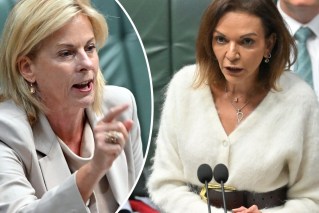
Then we get to the complete “shrug emoji” response to LNP MP Angie Bell, saying, in a prepared speech (as opposed to off-the-cuff remarks in a debate or question time) that Small Business Minister Anne Aly – famous for being Muslim and Egyptian – should be “stoned and shamed in the square”. This is from the same party that led a culture war over satire involving Gina Rinehart as “violence against women”.
And the same political class that jumped on Anthony Albanese labelling One Nation “dangerous” for Australia as making Hanson unsafe and subject to death threats.
But aiming a racist trope against a brown Muslim woman in the parliament, who said she found the comments “racist and misogynistic”, that’s a nothing-burger apparently. Move along.
“I don’t think they were racist or misogynistic,” said Bell’s colleague Kevin Hogan in a ABC interview. He’s happy with the comments being withdrawn and considers that the end of the matter.
Bell faces a very serious preselection challenge for her Gold Coast seat and is responding in the time-honoured manner of trying to make yourself as appealing as possible to the people who want you gone.
But she can also make these comments because the standard is on her side. One of the reasons these double standards are accepted is because the political class refuses to acknowledge them and there is very little mainstream pushback. That doesn’t just limit the debate – it limits how we move forward from any of it.
Amy Remeikis is a contributing editor for The New Daily and chief political analyst for The Australia Institute

Double standards from groceries to a 'shrug emoji'