It’s not just the economy, stupid – it’s everything else as well

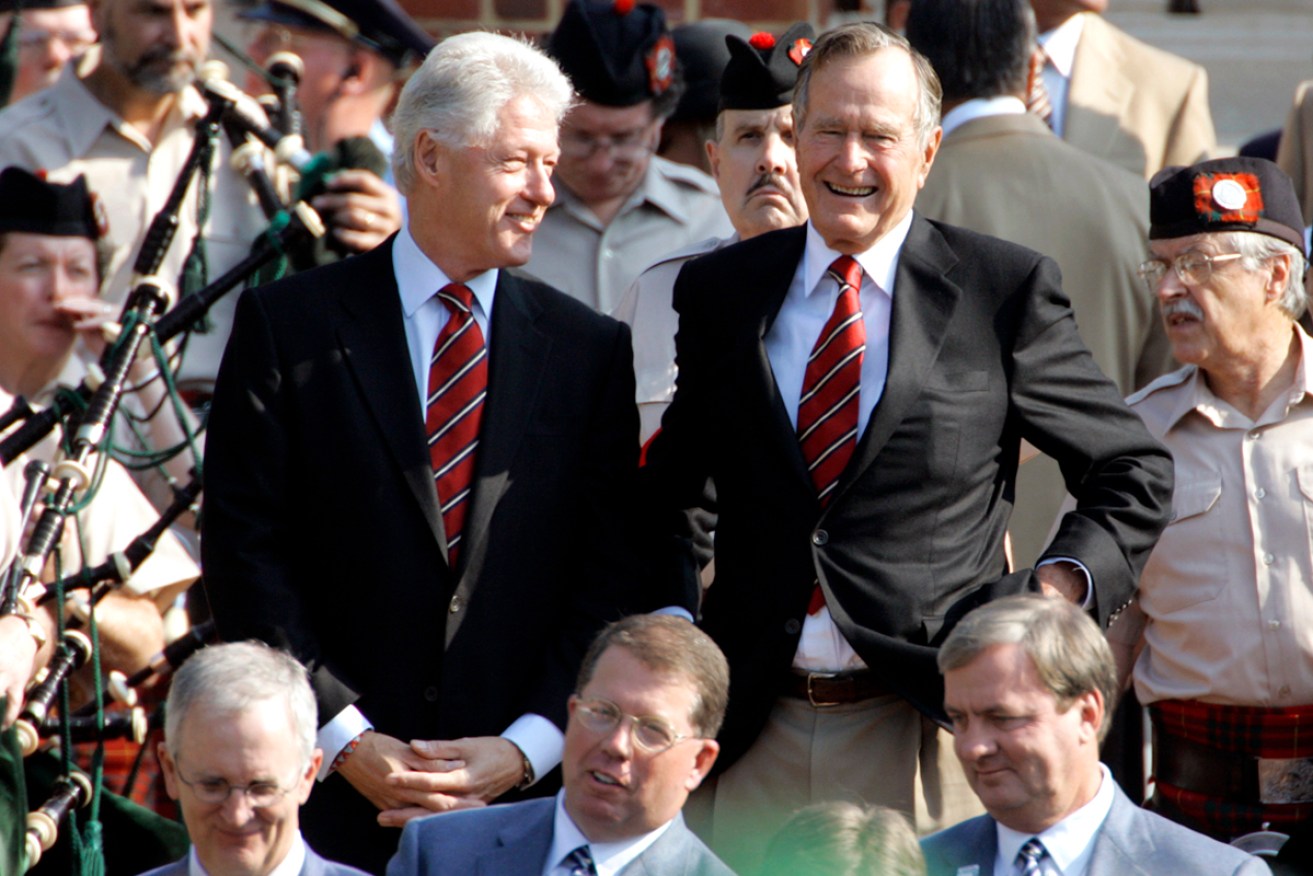
Bill Clinton, seen here with George Bush senior in 2005, started a long way behind in the 1992 race for the White House. Photo: AAP
When Bill Clinton ran against George Bush in 1992, he started from behind. The senior Bush had started the campaign on a high, with his approval polling in the 90s on the back of yet another American war in the Middle East (this one in Kuwait) and Clinton was considered, at least at the beginning, a long shot.
This was back when America was happily divided between conservatives and corporatists and Donald Trump was still partying at Mar-a-Lago with Jeffrey Epstein and making cameos in Home Alone 2.
America had been watching either a Bush or a Clinton run in their elections since 1980 but 1992 was the first (and ultimately only) time they went head to head. In what is now the stuff of legend, political strategist James Carville hung a sign in Clinton’s Little Rock campaign headquarters with three reminders for staff: 1. Change versus more of the same. 2. The economy, stupid. 3. Don’t forget health care.
The campaign successfully reminded Americans of the recession and Clinton waltzed into the White House.
Don’t be surprised if you see Labor start to take notes from 1991-922 into 2027-28. It’s the economy stupid, but it’s also health. And it’s happened, to borrow from Hemingway, in two ways – gradually and then suddenly. We’ve known about it for decades but, because of the economy, it’s going to be an even bigger issue.
It’s not just the economy, stupid. It’s what happens when that economy becomes so unequal the cracks can no longer be covered up.
Economic pressure can exploit existing prejudices, of which Australia has many. And it’s very easy, when people are feeling the pressure of economic strain, to shift then into punching down. Tell someone who feels they are missing out that it’s because someone else is getting something and half the battle is won for you.
People who claim money does not inoculate societies often point to the semi-socialist Scandinavian nations, which have also seen the rise of the far right, despite having strong government services and safety nets. But that analysis misses the decades of groundwork far-right networks laid in nations like Denmark from as early as the 1970s, poisoning the well against migration, particularly from Muslim nations.
People were told their generous welfare system was being abused by migrants, paving the way, decades later for what became known as “welfare chauvinism” – the populist far-right idea that only native-born citizens of the dominant ethnic group should be entitled to the state’s support. In Australia, we narrowed that down to “lifters and leaners”. We are doing it again, just a little more nakedly this time.
It’s not helped by a government that refuses to shift its own message from one of restraint and resignation, when other options are available.
While the right in Australia runs away with the populist, fatalistic idea that there are not enough resources for all of us, so punching down is the only way forward, the Labor government still can’t get out of its own way.
Much like Scandinavian centre-left parties, Labor has shifted its policies to try to address the far right’s attacks, which only legitimises it. The US and Britain, which are further down this rabbit hole than we are, are starting to see a small amount of pushback from their (self-proclaimed) centre-left mainstream parties – Barack Obama has begun to embrace the Democratic Socialists of America, despite establishment Democrats’ continued attacks, campaigning with the renegade (at least to the establishment) candidates, and British Labour has flirted with the idea of fighting the right as hard as it fights the Greens (we are coming from a very low base here).
But in Australia, we continue to see the same binary debates, as if there is no grey, as if there is no other way.
It’s one reason why the Australian Resilience Index, the result of a collaboration between Zurich, Mandala and Redbridge and Accent Research, is so important. Australia’s political media class need to see, in black and white, where the ball has been dropped.
It’s the economy, stupid, is not the end of the sentence – just the beginning. It’s the economy, stupid, yes, and it’s long-term failures, short-term fixes and oppressively binary thinking. It’s economy and that young Australians (15-34) have housing stress and unstable employment. It’s the economy and that the sandwich generation (35-49) has low or very low social resilience, with a lack of belonging to community.
It’s the economy, and that older Australians have more money but poor health resilience. It’s the economy, and that three-year electoral cycles focused on marginal and noisy electorates have resulted in huge disparity in access to services and resources. It’s the economy, and all the individual and different issues that are being exploited by a general lack of understanding and a commitment to one-size fits all solutions.
We are not a healthy nation. If Australia were a person, it would be the angry old white man muttering under his breath at the pub, abusing anyone who orders anything other than a beer on tap while also asking to bum a ciggie.
Private insurance does nothing for people in regional, rural and outer suburban centres because they don’t have access to the specialists it allegedly subsidises. But the $12 billion a year those direct and indirect private subsidies cost could probably pay for public specialists and hospitals in areas that need them.
It’s the economy, stupid, belongs to another time – the time that created many of the issues we all deal with today. Australia doesn’t need slogans, it needs actual solutions. At least 150 different ones.
That might seem overwhelming but, in reality, it’s an opportunity. For something different. It’s not just the economy, stupid. It’s the way we treat people within it and the issues we insist on leaving unaddressed.
Amy Remeikis is a contributing editor for The New Daily and chief political analyst for The Australia Institute
Not just the economy, stupid – everything else too




Listen, deliver, rebuild trust to quiet the populist right