Don’t look here, look over there: The dangerous game that unites our politicians

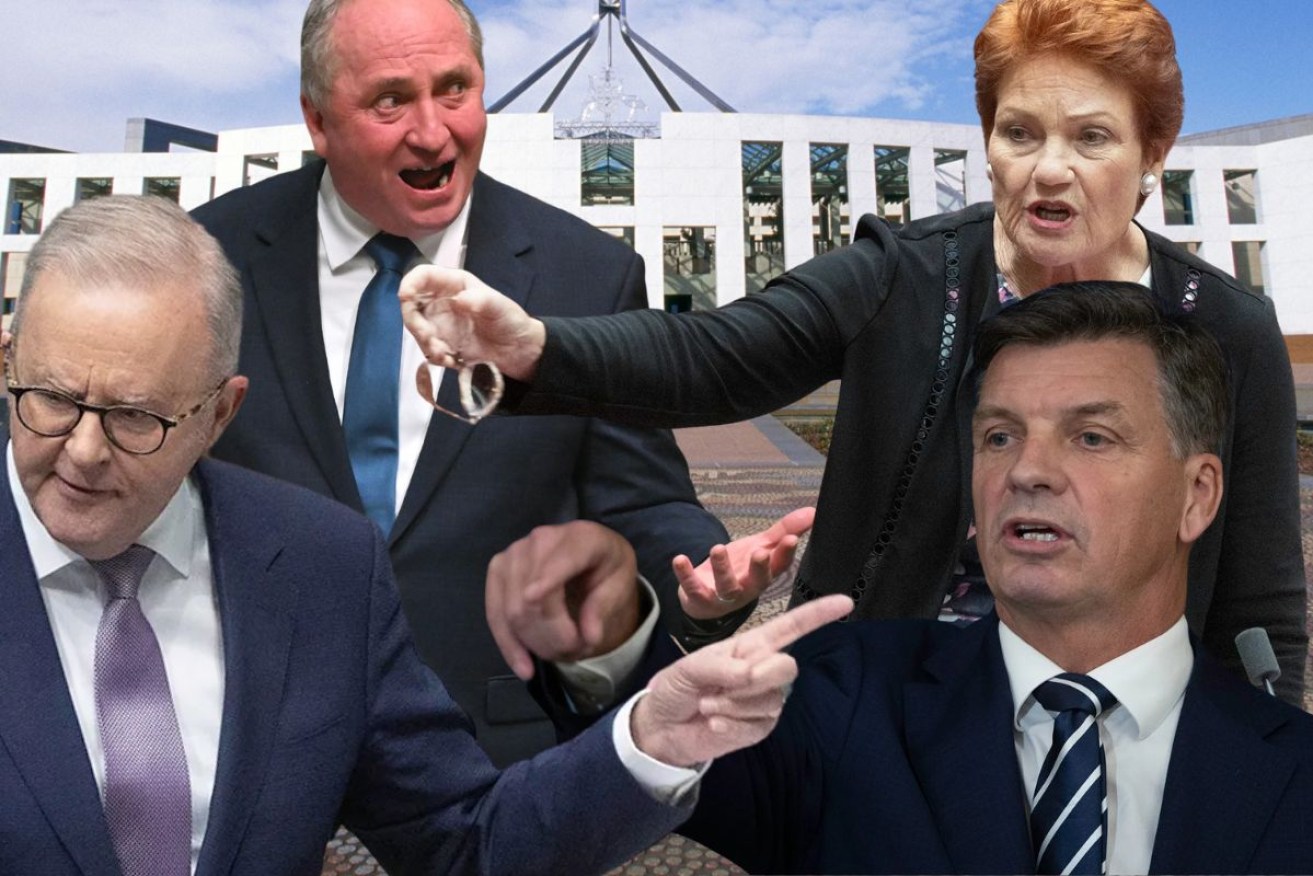
One thing so many of our politicians have in common is a desire to distract from important issues. Photo: TND
So much of our politics is a distraction. And deliberately so. Fake fights over nuclear – no one in mainstream politics actually believes nuclear would ever happen, but both Labor and the Coalition are happy to fight over it, because it gives both a point of difference in an increasingly political monoculture.
Pauline Hanson doing a podcast with a documented fascist and criminal might make the news, and there will be titters at her addressing an almost empty room at the Liz Truss-led CPAC UK love-in.
But what is not really examined is that Hanson’s (and Bridget McKenzie’s, and Barnaby Joyce’s) attendance at these conservative events – including ARC, or the Alliance for Responsible Citizenship, as well as CPAC – gives them even more access to the billionaire donors backing US President Donald Trump and those cheering on the backsliding of democratic nations across the Western world.
It doesn’t matter who Hanson was speaking to in the room – that’s the distraction. It matters who she was speaking to behind closed doors.
Angus Taylor takes selfies with Dave Hughes to be deliberately provocative (and if there is a bad political decision to make, Taylor will dive in head first) and the Prime Minister’s Office will make sure every journalist knows just how much Anthony Albanese “led” on AI, while not actually announcing much more than a commitment to keep looking at it.
Distraction though, works. And well. Cuts to media organisations mean sushi train journalism – just grabbing what comes round as it passes you – is often all editors want.
That, in turn, drives the media cycle. Politicians know journalists will jump at what is on offer, and then the next 24 hours is spent making incremental news breaks designed to indicate to other journalists that you have better contacts.
Whether or not it actually matters in the scheme of things isn’t the point. The point is, you’ve shown your contacts are better at telling you things most politicians want you to know.
At the same time, we tend to pay very little attention to things that materially matter.
The Joint Standing Committee on Aboriginal and Torres Strait Islander Affairs has been holding an inquiry into racism directed towards Indigenous people. This has only increased since the Voice referendum failed, and the Labor government backed away from supporting Indigenous self-determination and First Nations issues in response.
Albanese won’t even attend Garma this year, despite having promised to attend every year he was Labor leader. His decision would not surprise Indigenous leaders, who have noted how fast Labor walked away from anything related to Aboriginal people the moment the Voice referendum began to cost it politically. But it should be more of an issue than it is.
Just as it should be just as important that the Queensland and Northern Territory governments have snubbed a Commonwealth inquiry into racism against Aboriginal people.
The NT’s conservative government is one of the most punitive in the nation. Its secrecy, wilful disregard of human rights and flagrant embrace of power should receive as much attention, if not more, than photos of Hanson on holiday with Gina Rinehart (which, to be clear, is an actual story).
That it, and the Queensland government – which has embarked on a campaign to remove Indigenous people from boards in a campaign dubbed “Project Invisibility” – are refusing to answer questions about systemic racism that usually only get attention when someone dies is a national outrage. But, of course, it’s not. Because it’s reality, not a distraction, and a reality most politicians know Australians are happy to ignore.
You can usually see what media organisations consider to be important by how long an article sits “above the line”. By that, they mean what is visible as soon as you open a news website.
Anything that sits below two scrolls is not something that will get much attention from readers. Some editors use this to claim an issue wasn’t popular with readers, but news organisations curate the news cycle by choosing what to promote. They then use the numbers behind the stories they have elevated to claim it is all people are interested in. But decisions have been made about what is important. And around and around the news sushi train goes, powered by its own self-importance.
It’s not like people aren’t trying to do the work – journalists like Amy McQuire have spent years reporting on issues the nation and its leaders like to ignore.
But journalists like McQuire refuse to play the distraction game. And their work is usually along the lines of what politicians want people distracted from.
Because it’s never want politicians want you to know that matters. It’s what is actually going on behind the news sushi train that counts.
At the moment, Australia’s mainstream parties are breathing a little easier – they have experienced the mid-winter bounce that comes with not hearing a lot from politicians (the more people hear from politicians, the less they like them), and from being able to curate the news a little more easily than usual (hence the mostly glowing “Albanese did it! He ‘led’!” AI coverage, rather than “there are still no answers here” reality).
Labor is heading into its conference having already silenced most of the discontent, so it can present a united front on contentious issues – reality, again, be damned – and Taylor is making his way around the country, one pub meal selfie at a time.
That’s not reality, but it is more palatable. In this climate, that’s what gets you attention. And they know it.
Amy Remeikis is a contributing editor for The New Daily and chief political analyst for The Australia Institute

Who owns intimacy? When govts regulate love