‘A village solution’: Help for parents and boys in the age of the manosphere

The manosphere's appeal is driven by a vision of masculinity built around dominance over women. Photo: AAP
Dozens of parents exchange nervous pleasantries inside a converted warehouse on a warm Wednesday night.
Belongings are dropped at the back of the space and each introduces themself to the person next to them.
Members of the group begin sharing their high school music tastes and celebrity crushes, spanning generations and genres from Kylie Minogue to Blink-182.
After taking a seat, two facilitators discuss why everyone is gathered.
“Village problems need a village solution,” The Man Cave’s chief experience officer, Al Green, said.
“Tonight we are opening up our pantry of tools for teen boys that work.”
The Man Cave is a preventative mental health and emotional literacy charity that has worked with more than 100,000 teen boys in schools and communities since 2014. It leads information sessions for parents to help them connect and communicate with their boys at home.
About 95 per cent of perpetrators of all violence are male, and boys aged 15-19 have the highest police-recorded sexual assault offender rate of any male age group, education and project manager Lucy Barrat tells the group.
At the same time, one in two teen boys say mental health is their biggest concern – Barrat says they feel alone, out of control, without purpose, hard done by and not valued.
In response, boys are turning to online spaces such as “the manosphere” for validation and guidance; they are “numbing out” by using alcohol, drugs and gaming or trying to find control within their relationships, she says.
“There’s almost no spaces where teen boys walk into and someone says ‘thank God you’re here’,” Barrat says.
“There are these four themes that often come up when boys are talking about their parents: One, they don’t feel listened to; two, they feel misunderstood; three, they feel interrupted; four, they are given unwanted advice.”
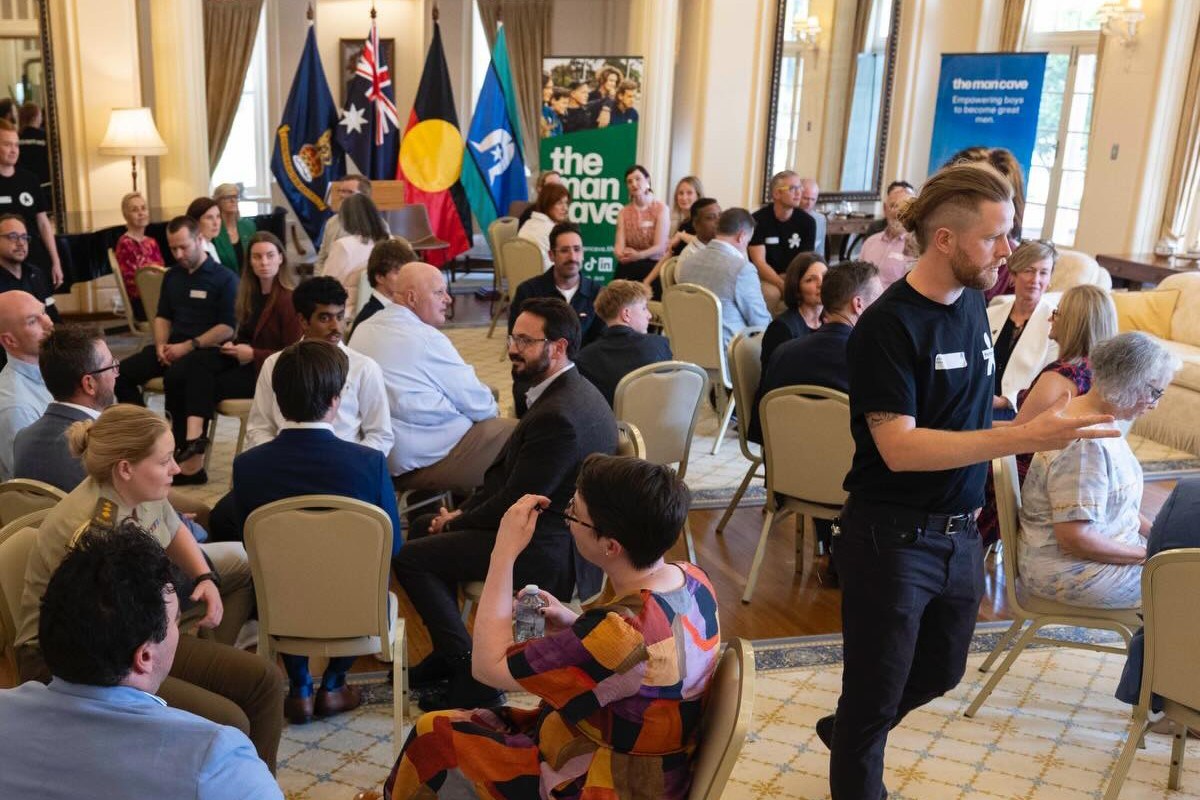
Green (standing) and The Man Cave team visited Canberra last year. Photo: The Man Cave
Green introduces one of the charity’s tools to the parents. Known as the “check-in”, it aims to create a psychologically safe space to encourage boys to share.
“Teenage boys kind of joke among facilitators that sometimes [parents] go around circles; school’s good, footy’s good and that might be it,” he says.
“Are we actually setting boys up to fail in the expectation that we want them to communicate with us but they haven’t actually seen us do these things at all?”
The parents split into groups of three and each is asked to offer a “check-in” from their internal world. It could be something challenging or frustrating or something they are proud of.
One parent shares they had been made redundant from work, another reflects on their mortality after going to a loved one’s funeral.
A second round of check-ins uses a listening tool, with parents encouraged to use somatic and cognitive empathy to understand how the other person feels.
“The person doing the listening tool will say, ‘it feels to me like you’re feeling like this’ or ‘what I heard was this’, and you give an example,” Green says.
“Show that you understand what they’re going through and then you can say, ‘is that right?’.”
The parents then discuss the tool’s effectiveness and whether they will use it at home.
Ears prick up as one mother says they often ask their teen boy: “If your day was a movie, how would you describe it?”
In the final activity, the parents are encouraged to share something a boy has done for them that positively contributed to their lives.
From acknowledging how they help at home with their siblings to recognising accomplishments at school or in sport, the parents spend time chatting about their boys’ achievements.
“We are hearing that boys are not feeling valued, so go home and tell that to your young person,” Barrat says.
The workshop was created as a trial as part of the charity’s theories of change, which target boys, teachers and communities around them.
“Originally this was intended to provide parents tools to be able to connect better with their young people,” Green said.
“But across pretty much all of the sessions, the parents noted the therapeutic benefit of sharing struggles with other parents … to realise they’re not alone.”
The sessions’ interactive nature has helped many parents understand the importance of trying to communicate and connect with their teenage children.
“It’s not just giving them information; parents don’t need any more information,” says Green, a father of two.
“What we need is the ability to go, ‘Here’s the tool, I’m actually going to help you through this and I want to make this as accessible as possible for you to go home and do it’.”
The charity recently released a guide to the manosphere for parents, developed with Teach Us Consent.
It includes a glossary of terms such as “mogged”, meaning better-looking or bigger than someone else, and “soy boy”, used as an insult for men seen as soft, emotional or progressive.
Monash University professor Steven Roberts, who has researched the manosphere’s impact on boys, encourages parents to stay curious and keep the conversation open.
“Ask what he’s watching, what he finds interesting and what he thinks about the messages he’s encountering,” Roberts says.
“Keep the conversation on the table fairly frequently but without making it feel like an interrogation or turning every interaction into a lesson about misogyny.
“You don’t need to agree with everything he says but you do want to remain someone he feels comfortable talking to.”
Roberts says the manosphere’s appeal is driven by a vision of masculinity built around dominance, status, control and power over women – attitudes that must be challenged at home.
“It also means modelling the kinds of relationships we want boys to develop: Relationships characterised by respect, equality, care and emotional openness,” he says.
As masculinity work grows, philanthropic organisation Snow Foundation has committed $10 million over five years, open to organisations that work with boys, young men and the adults around them to prevent violence.
Funding applications close on December 11.
Last Wednesday, the federal government announced an extra $217.6 million to help end violence against women and children, including to expand services and programs promoting healthy masculinity.
1800 RESPECT 1800 737 732
Lifeline 131 114
Men’s Referral Service 1300 766 491
-AAP


Gen Z yearns for a romance it has never known

Who owns intimacy? When govts regulate love
Nurturing new breed of father takes time, support

Phero-maxxing: 'Gross' trend doesn't pass sniff test