 Subscribe
Falling house prices bring new risks for homeowners and buyers

- Australian property prices have enjoyed nearly six years of growth, but the run is over.
- Falling property prices could hit new borrowers the hardest, with fears of negative equity growing.
- Rising interest rates won’t just hit borrowers, they could also hit renters too.
From the beginning of the COVID-19 pandemic until early this year, Australian property prices were on a runaway train.
In March 2020, the average dwelling price in Australia was $690,000, according to the Australian Bureau of Statistics (ABS).
Fast forward to March of this year, and that average has risen to $1.1 million, representing a six-year jump of almost 60 per cent.
This means someone who bought a $690,000 property in March 2020 could have sold early this year for a cool $400,000 profit.
Several tailwinds influenced this momentum, including low interest rates, household savings, and government stimulus. However, those tailwinds began to ease in February.
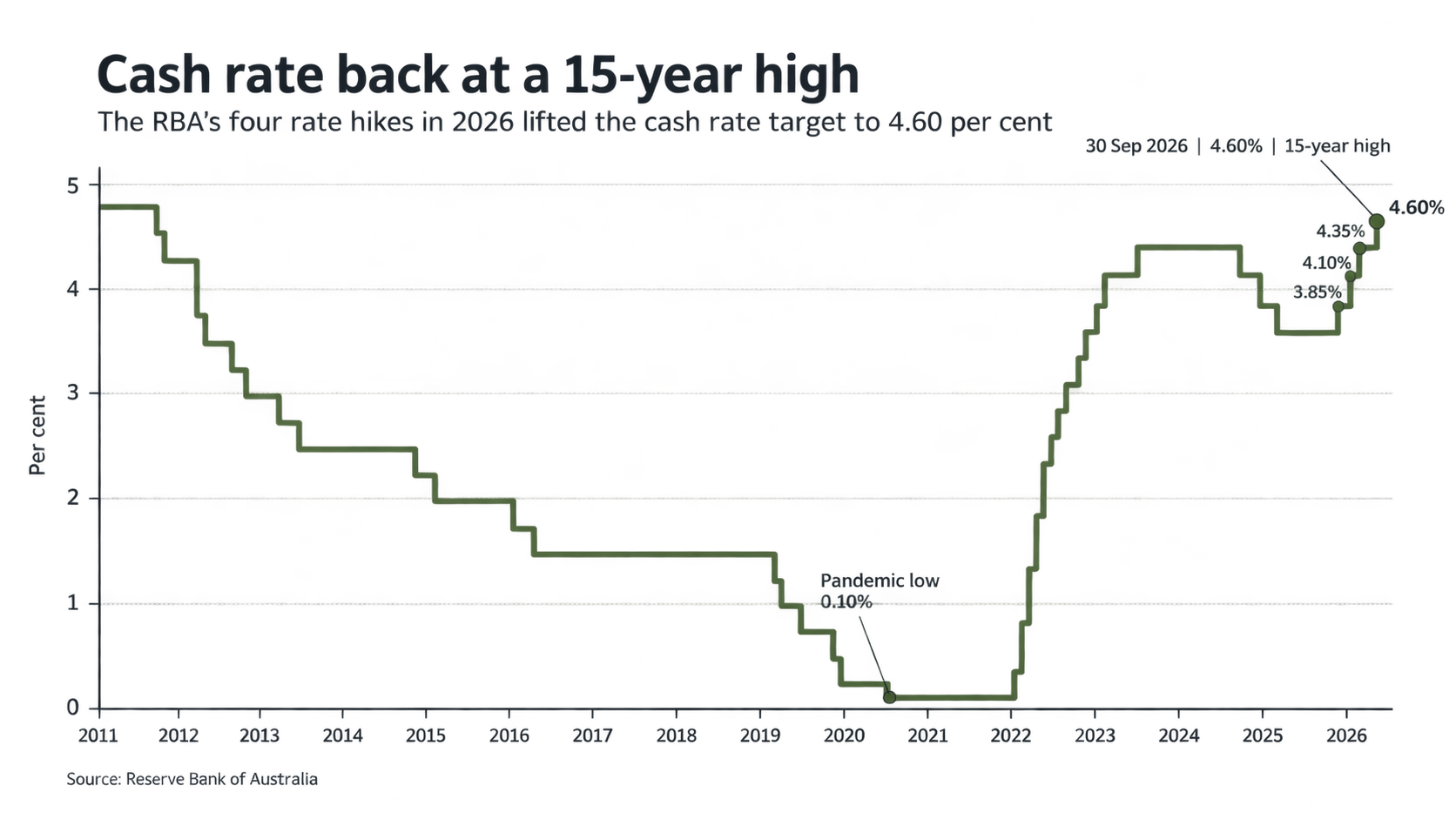
The first step in this reversal was when the Reserve Bank of Australia lifted the cash rate in February, followed by a second hike in March and a third in May.
The RBA’s latest decision in late September marked the fourth rate rise in 2026, with the official cash rate target now at a 15-year high of 4.60 per cent.
How does the cash rate impact property prices?
The cash rate is the interest rate on unsecured overnight loans between banks. It is the (near) risk-free benchmark rate (RFR) for the Australian dollar.
In simple terms, it essentially acts as a benchmark for banks and financial institutions when setting interest rates on loans and other financial products, including mortgages.
Changes in the cash rate therefore impact borrowing costs for households, which can influence demand for property and, consequently, property prices.
The RBA has taken this target from 3.60 per cent at the end of 2025 to 4.60 per cent by September 2026. However, between 2020 and 2022, it sat as low as 0.10 per cent.
This has contributed to Australian housing values falling for six consecutive months, according to data from research firm Cotality.
On a national basis, dwelling values are now 5.2 per cent below their record highs from March 2026.
So what’s the big picture?
It may feel like a simple equation: When interest rates increase, property prices fall – but the relationship between the two is not so simple.
From domestic cost-of-living pressures to major geopolitical tension such as the war in Iran, there are a combination of factors that could see the cost of lending money become less attractive to investors.
Since late February, the conflict in Iran has led to disruptions in global oil supply chains and shipping through the Strait of Hormuz.
Because Australia imports most of its refined fuel, the conflict has pushed up local petrol and diesel prices, increasing transport costs for households and businesses.
Higher fuel and shipping costs then flowed into the prices of goods and services, adding to Australia’s cost-of-living pressures and inflation.
High inflation, cost of living and high interest rates all influence Australians’ ability and appetite to take on debt (a mortgage). Interest rates, while a major factor, aren’t the only factor affecting a borrower’s ability to service a mortgage.
How does a drop in property prices impact owners?
It’s important to understand that the cash rate target set by the RBA isn’t automatically mirrored by banks.
However, when the RBA raises its cash rate target, banks often pass on these hikes to customers, as it increases their own cost of lending.
A scan of current mortgage rates shows that Aussies are paying well over 6 per cent in many cases.
For example, CBA’s lowest variable home loan rate is hovering around 6.3 per cent.
Borrowers with variable rate home loans have now seen their repayments increase significantly throughout 2026.
To illustrate how this influences homeowners and the cost of living, let’s look at a hypothetical example.
Imagine a homeowner has $500,000 remaining on their mortgage with 30 years left to repay.
At a 4 per cent interest rate, their monthly principal-and-interest repayment would be about $2,387.
At that same interest rate, 6 per cent, the monthly repayment would rise to about $2,998.
This means the homeowner would need to find around $611 more each month, or about $7,332 more per year.
Many Australians have experienced this type of increase over the last 12 months.
Looking at other key stakeholders, the RBA estimates there are 2.3 million individual housing investors. Meanwhile, 2.4 million households rent from private landlords.
Cash rate decisions affect both parties, as landlords may pass on mortgage rate increases to tenants through rent increases.
For retirees who own their homes outright, falling property prices may have little immediate impact on their day-to-day finances, particularly if they have no plans to sell.
However, older Australians with mortgages or those relying on property wealth to supplement their retirement income could face greater financial pressure as borrowing costs rise and housing values decline.
The key takeaways
Key cost-of-living metrics like inflation and the RBA cash rate target, along with geopolitical conflict, have changed the property market’s economic landscape.
As a result, property prices have dropped for six straight months from record highs in March.
A key date for Australians to watch will be 28 October 2026, when the Australian Bureau of Statistics releases the September quarter Consumer Price Index (CPI) inflation figures.
This is one of the metrics the RBA uses to set the cash rate target.
The next RBA official cash rate announcement, and the board’s second-to-last meeting of the year, will be on November 3.
Topics: Housing, Interest Rates, Property