 Subscribe
Why Australians feel broke even as the economy keeps growing

- A new consumer confidence survey has revealed what many believe: Australian households feel they are enduring the toughest economic conditions in years.
- Many polled households were pessimistic, feeling more glum about the economy than during COVID-19 or the GFC.
- But Australia is not in a technical recession. The real reason may lie in our pay packets: our wages are actually going backwards, even if the economy isn’t.
Last week’s Melbourne Institute consumer confidence survey was a shocker.
It revealed that the confidence of Australian consumers was sitting at 80.4. To give you an idea of what it means, a result of “100” is regarded as neutral.
Since the survey began in the mid-1970s, the index has been above 100 roughly half of the time and below 100 roughly half of the time. It’s where the number of optimists balances the number of pessimists.
Any result below 100 means pessimists outweigh optimists. Any result deeply below, like the latest, means pessimists way outnumber optimists. It means we are feeling the worst we’ve felt in years.
But we are feeling much worse than that. The survey that produced 80.4 was conducted over four days that straddled the end of September and the start of October.
As it happened, the Reserve Bank announced its decision to jack up interest rates on September 29, right in the middle of the four-day period.
When researchers at the Melbourne Institute compared responses before the RBA decision with those after, they found a cliff. Before the rate move, we were merely fairly pessimistic. After the move, we felt awful.
The after-the-move reading was 67.2, the worst since the early 1990s recession, much worse than during COVID or the Great Financial Crisis.
More than half of those surveyed said their family finances had deteriorated in the past 12 months. But that doesn’t mean it’s true. People responding to pollsters would have been shocked. The Reserve Bank had just pushed up rates.
What the data says
The most straightforward way to gauge what’s actually happened to our standard of living is real wages – the extent to which our wages have increased by more (or less) than consumer prices.
The Bureau of Statistics said that over the year to June its wage price index climbed 3.2 per cent, which sounds like a pretty good pay rise.
That is until it is set alongside the Bureau’s consumer price index, which climbed 4 per cent, meaning real wages – or how far your money stretches – went backwards.
But it’s not the full story. What happened to your wage depends on what you do.
The Bureau says wages in the health care and social assistance industry climbed an average of 3.8 per cent, almost as much as prices. Wages in the finance industry rose much less, by 2.7 per cent, leaving workers in that industry well behind.
And there’s another way in which it’s not the full story: Australians change jobs.
Last year, 1 million of us switched employers, and a good many more of us stayed with the same employer but changed our job classification, usually by getting a promotion.
The Bureau’s wages measure doesn’t take into account the way we change positions – it measures the wage paid per position, not person.
As best as we can tell, taken together, our wages have increased by more than the wage price index.
But that doesn’t mean we are getting as much of them. Here’s the other wrinkle that works in the opposite direction.
Every time we get a pay rise, even a small one that does no more than keep pace with inflation, the increase gets plonked into our highest tax bracket.
It means we suffer “bracket creep” even if we don’t change tax brackets.
All of our old pay gets taxed across a mix of brackets, while our new pay gets taxed at the top one.
Here’s how it would have worked in 2025-26 if you were on $80,000 and you got a pay increase of 3.2 per cent, which was the increase in the wage price index.
By my calculations, your after-tax wage would have increased by just 2.7 per cent, which is not just a bit less than the increase in prices, but a lot less.
From time to time governments give us back some of this bracket creep, and the government has done it again this financial year.
But it means the increase we are told we are getting isn’t necessarily the increase we get. And the price increases we are told we are facing aren’t necessarily those we face.
One peculiarity of the CPI is that it includes rents (so if you are a renter, it probably paints a pretty good picture of what you face) but doesn’t include mortgage payments.
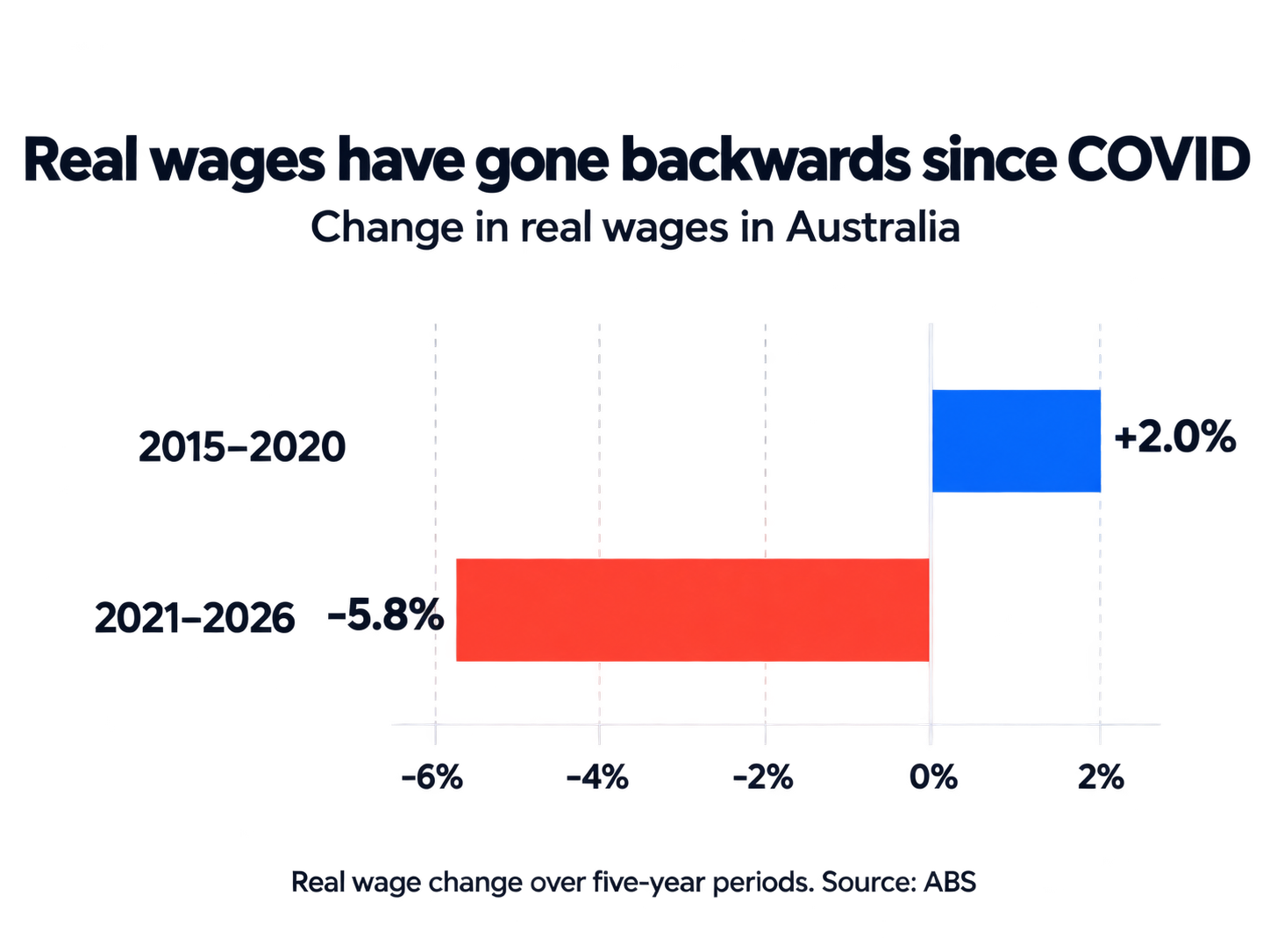
What we can say is that real wages aren’t increasing like they used to. In the five years leading up to COVID, the Bureau’s measures gave us a (historically low) real wage increase of 2 per cent.
In the five years since, we have had a real wage cut of 5.8 per cent.
The big economic measures, GDP and employment, are for the moment doing just fine. We are not in a recession.
But it’s easy to see why it feels as if we are.
Topics: Australian economy, Recession, wages