 Subscribe
What’s global volatility doing to your retirement?


- Australia’s super system is expected to reduce retirees’ reliance on the Age Pension over the coming decades.
- Long-term super returns remain strong despite short-term market volatility.
- Retirees and pre-retirees can still improve outcomes through contribution, investment and spending decisions they can control.
With unstable politics, volatile markets, climate events and rapid developments in AI, global uncertainty increasingly feels like the norm.
But while markets and household finances can be unpredictable, the fundamentals of retirement planning have not changed.
Late last month, the Treasury released its most recent Intergenerational Report (IGR). Now published every three years, the IGR projects overall trends in the Australian economy for the next 40 years.
Australia’s compulsory super system, now more than 30 years old, is also reducing retirees’ reliance on the Age Pension.
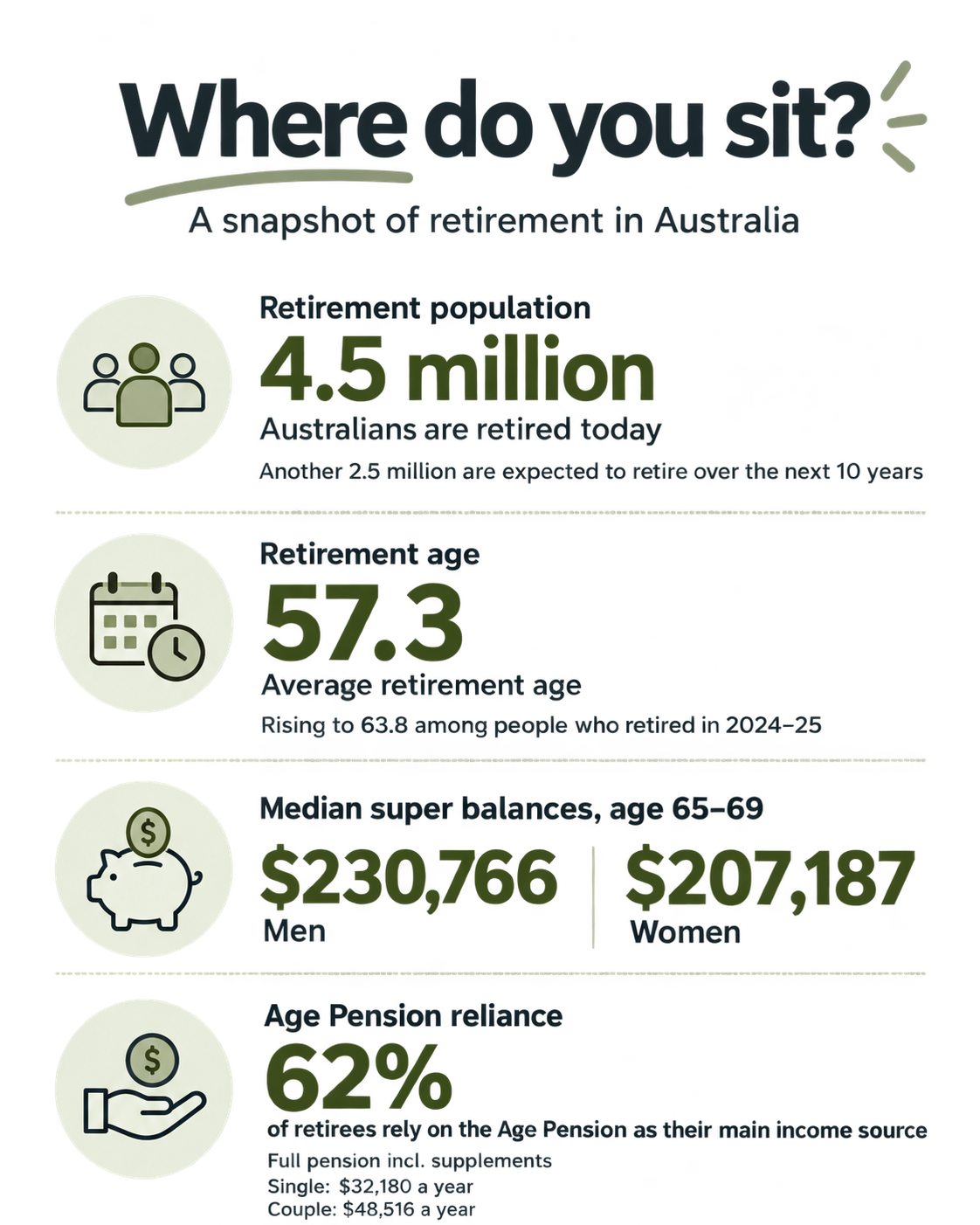
Higher super balances mean the share of retirees receiving a full or part Age Pension is expected to fall from 66 per cent in 2025 to 52 per cent by 2066, according to the report.
Stock markets can swing sharply from day to day, but super has delivered solid returns over the longer term.
According to SuperRatings, the median balanced accumulation fund returned 9.4 per cent in the year to June 2026 and 7.7 per cent a year over the past decade.
For pension funds, the median balanced option returned 10.2 per cent over the year and 8.6 per cent a year over 10 years.
Knowing where you stand can help you separate what you can control from what you cannot.
In control
Wars, trade disputes, supply disruptions and global energy prices are beyond an individual investor’s control. So too are inflation and the RBA’s interest-rate decisions at home.
It can help to think of global volatility as waves moving towards the shore.
Geopolitical shocks and global markets are the largest waves; Australian economic conditions sit closer to home, while household decisions are the smaller movements people can actually navigate. The point is not to ignore the bigger waves, but to focus most attention on the decisions within your control.
Still, you can improve retirement outcomes through decisions within your control. These include:
- Staying employable and adapting as technology changes
- Understanding your assets and whether your investment settings remain appropriate
- Knowing how your savings are likely to translate into retirement income
- Tracking spending and managing discretionary expenses
- Reviewing your mortgage and other debts as interest rates change
- Knowing where to find affordable, trusted financial guidance
Independent economic analyst Saul Eslake told The Money Edition that the impact of higher living costs and interest rates varies by a person’s retirement stage.
“Because the Age Pension is indexed, recipients are not going backwards in real terms,” Eslake said. “Pensioners shouldn’t worry too much about interest rates if they own their own homes.”
Renters are not directly exposed to higher mortgage repayments, while retirees with savings in term deposits may benefit from higher interest rates. Eslake also said rent inflation was slowing following measures announced in the May budget.
“Self-funded retirees are different,” Eslake said. “Typically they will have paid off the mortgage, in which case interest rates are not an issue.
Falling house prices could leave retirees with less money to fund aged care. However, those looking to downsize may be able to “buy better”, as they would be selling and buying in the same market, Eslake added.
For people approaching retirement, the trade-off between extra super contributions and paying down a mortgage can depend on tax treatment, borrowing costs and potential investment returns.
“For pre-retirees, super (over and above the 12% SGC) remains a good investment as it returns more (with a lower tax rate of 15%) compared to making extra mortgage repayments of 6% using after-tax dollars,” Eslake said.
Investment returns are not guaranteed, however, while extra mortgage repayments deliver a certain saving on interest.
“And for those worried about longevity risk, Lifetime Income Streams are a reassuring way to manage income needs, with a similar upside to the Age Pension when they are indexed.”
The information provided on this website is general in nature only and does not constitute personal financial advice. The information has been prepared without taking into account your personal objectives, financial situation or needs. Before acting on any information on this website, you should consider the appropriateness of the information having regard to your objectives, financial situation and needs.
Topics: Retirement