 Subscribe

Common investing mistakes to avoid in today’s volatile markets
Sharp swings on Wall Street and the ASX are testing investors' nerves, but experts warn that reacting to market turmoil could do more harm than good.

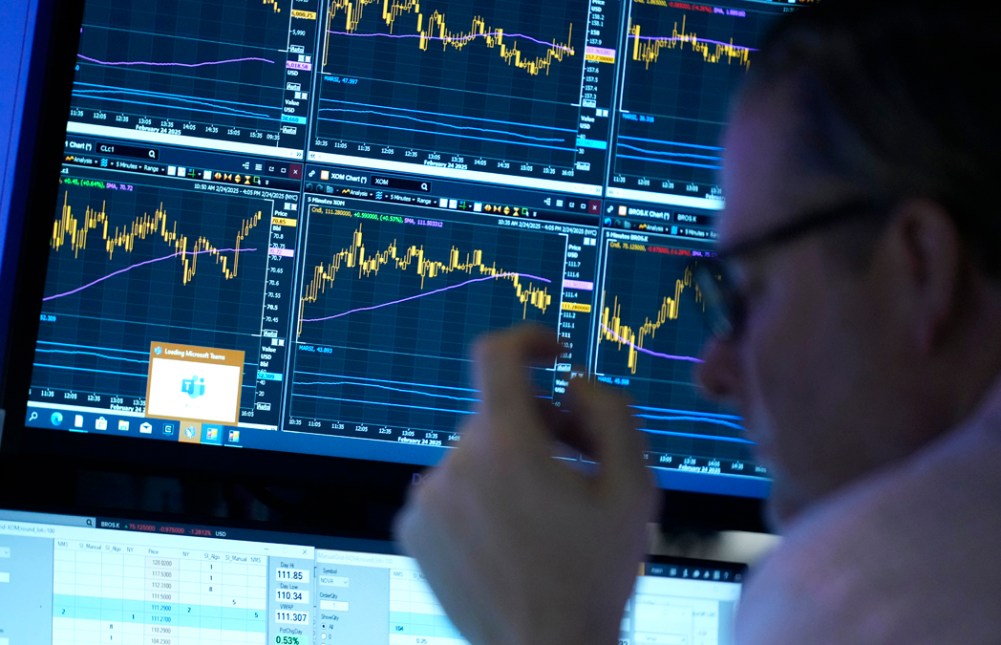
- Australian and US share markets have experienced sharp swings in recent weeks, fuelling concerns about further volatility.
- Experts warn that panic selling during market downturns can lock in losses and keep investors from participating in a recovery.
- Maintaining a cash buffer, diversifying investments and sticking to a long-term strategy can help weather market turbulence.
If you’ve been keeping an eye on the markets, you may have noticed some outsized daily stock price swings in recent weeks.
Here in Australia, the ASX 200 looked like it might be headed into correction territory — a fall of 10 per cent or more from recent highs — when the index fell 2 per cent on October 1. This saw Australia’s benchmark index down 7.1 per cent from early August.
But over the past six weeks the market has shaken off much of those losses, spurred in part by the 2.6 per cent gain posted by the ASX 200 at the start of this month.
US markets have been even more volatile, led by major daily swings in the big tech stocks.
Indeed, on November 5 the Nasdaq Composite Index plunged 5.5 per cent amid fears of an AI bubble and the sustainability of the massive global investment we’re seeing in data centres.
Days later, the Nasdaq jumped 2.7 per cent as those fears subsided.
Those big daily moves saw the VIX, which measures expectations of US stock market volatility, hit a more-than-seven-month high earlier this month, reflecting growing investor uncertainty and the risk of further sharp swings in share prices.
What’s an investor to do?
During times of increased volatility like these, it can be easy to let your emotions cloud your trusted investing strategies. But that’s almost always a mistake.
“The smartest move in choppy markets is usually the least glamorous, and that’s sticking with the plan you already had,” Josh Gilbert, lead analyst for APAC at eToro, told The Money Edition.
While sudden market falls can be unsettling, they are hardly unusual. Even prolonged periods of market growth are interrupted by corrections, and investors who sell during a downturn risk missing out when prices recover.
Romano Sala Tenna, portfolio manager at Katana Asset Management, said investors should expect these fluctuations rather than treat every downturn as a reason to change course.
“The time to ‘panic’ is before a crisis, not during,” he told The Money Edition.
“Understand that volatility is normal. Over the past 150 years on the ASX, the market has fallen 20 per cent of the time. That means the market declines in exactly one in five years,” he added.
“Forewarned is forearmed.”
The challenge for investors is separating short-term market movements from changes that genuinely affect their longer-term financial goals.
That’s particularly difficult when share prices are swinging sharply from one trading session to the next, creating pressure to act before losses mount or opportunities disappear.
Dale Gillham, chief analyst and founder of Wealth Within, said those emotional responses can prove costly.
“Volatility is often when investors react emotionally, buying and selling out of fear or greed,” Gillham said. “It’s also when many mistakes are made because investors fail to plan. Rather than embrace volatility, they fear it or react to it.”
The Nasdaq’s 5.5 per cent plunge on November 5, followed by a 2.7 per cent rebound on November 9, reminds us how quickly market sentiment can shift.

Investors who sell after a sharp fall can find themselves watching from the sidelines when markets recover, potentially locking in losses they might otherwise have avoided.
“The biggest mistake is reacting to market moves and headlines, because some of the market’s best days have come right after its worst,” Gilbert said.
“Over the long run, time in the market has historically mattered more than timing the market.”
That doesn’t mean investors should ignore market developments altogether.
But before buying or selling stocks or other assets, it’s worth considering whether anything has fundamentally changed about an investment or whether the decision is being driven by short-term price movements.
Fortunately, signs suggest many everyday Aussie investors are maintaining a disciplined approach despite the turbulence.
Research from eToro suggests most retail investors have continued putting money into their portfolios rather than withdrawing from the market during periods of uncertainty.
According to Gilbert, eToro’s Retail Investor Beat showed at least 60 per cent of Australian investors had kept their portfolio contributions steady every quarter since mid-2023, while more than one in four had increased them in each of the past three quarters.
Preparing for the next downturn
Sticking to an investment strategy is easier when investors have prepared for potential losses before markets turn volatile.
That means considering how long money can remain invested, how much risk is appropriate, and whether sufficient savings are available to cover unexpected expenses.
Sala Tenna recommended investing with at least a three-year time horizon and maintaining a cash buffer at all times.
Having money set aside for emergencies can reduce the likelihood of being forced to sell investments during a downturn.
It can also leave investors with funds available to take advantage of lower share prices if markets suffer a sharp correction, although identifying genuine bargains is not always straightforward.
Diversification is another way to manage the impact of market volatility.
Rather than relying heavily on a handful of individual companies, investors can spread their exposure across different businesses, sectors and asset classes.
Sala Tenna suggested exchange-traded funds (ETFs) and professional fund managers as options for investors seeking broader exposure and less reliance on individual stocks.
These approaches, he said, could help “reduce the impact of stock-specific volatility and provide a level of detachment from day-to-day fluctuations.”
The information provided on this website is general in nature only and does not constitute personal financial advice. The information has been prepared without taking into account your personal objectives, financial situation or needs. Before acting on any information on this website, you should consider the appropriateness of the information having regard to your objectives, financial situation and needs.