The warning from the US election that Australia hasn’t received as clearly as it should


Data centres are so unpopular in the US that Big Tech is looking for other "suckers". Photo: Pexels
There is nothing Australian political pundits love more than giving free advice to Australian politicians based on other countries’ elections.
Obviously, this column is not immune. And it’s not that there are not lessons there to be taken. Again, obviously, there are.
One Nation this week scrubbed its website of some Trumpiness. It didn’t do so because Barnson (Pauline Hanson and Barnaby Joyce) and co found themselves overcome with millennial optimism at the US “blue-nami”. It did it because its strategists immediately recognised the crossover – Donald Trump, and his MAGA policies, is poison with much of the working class.
It’s the same reason the Coalition has been playing dead on Trump and, by association, AUKUS. “Temu Trump” was toxic for the Liberals even back in 2025. AUKUS is toxic now.
One Nation and the Coalition don’t even have to oppose or criticise the US, Trump or the dud “strategic” deal that sees Australian pay the US and Britain to build their own submarines and command Australian territory for their own bases. They just don’t have to actively endorse it.
So, after this week’s blue-nami that swept the Democrats into seats they hadn’t been in sneezing distance of holding for 100 years, Call it selfie lament.
That brings us to the free advice. Because, among all the “can you hear the people sing?” think pieces from people who still think the Clintons are progressive, is a warning from the US election that Australia isn’t receiving as loud as it ought to.
Where data centres were on the ballots, Americans voted no – so comprehensively that just one of the 41 ballots passed. Anti-data centre messaging was a key component of big Democratic wins in red states, such as Ohio and Texas, where Republicans were cast as the “face of data centres” so successfully that voters elected Democrats as governors.
We know Australians don’t like data centres, but so far it’s not as all-encompassing a public issue.
But Australian governments have a history of being suckers to industry. We did it with fossil fuels and we have started doing it with AI companies. Now that the US has hit a stumbling block on approvals, Big Tech will start looking for the next good-enough sucker to keep their growth plans on track.
And Australia? Australia is primed to be that sucker. Not because the public wants it. Not because there are any demonstrable benefits to people. Certainly not because we have the resources to spare. And not because we’ll even own it. But because our governments love to be wrong in the “right” company.
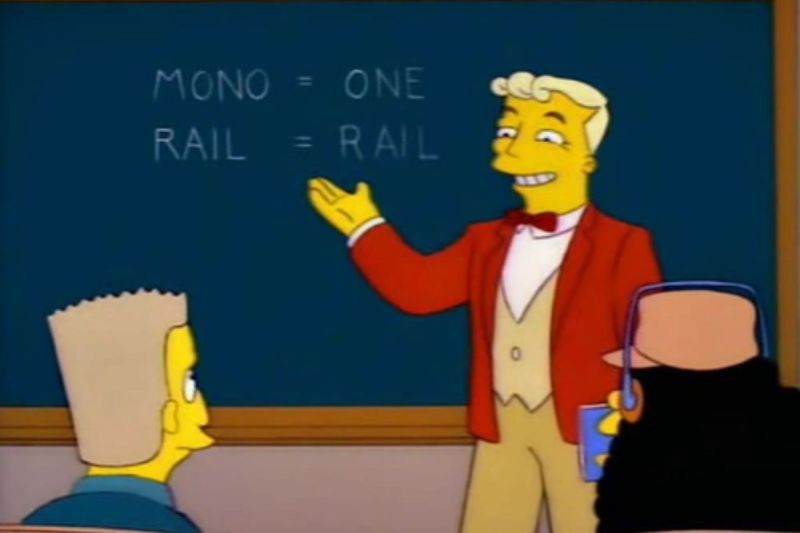
Infamous Simpsons con artist and monorail salesman Lyle Lanley. Photo: Simpsons Wiki
Australia’s leaders love a Lyle Lanley – but instead of a song and dance routine about a monorail, it’s a wine and dine about the inevitability of a tech that, at best, exists to replace the very workers governments are supposed to represent.
With data centre expansion in the US now facing road blocks, Australia becomes even more crucial to tech’s plans.
The playbook is almost exactly the same as fossil fuels – despite not contributing much, if anything, to the economic prosperity of Australian citizens (in fact, the opposite), the AI industry is presenting itself to Australia as the backbone of a future economy – it just needs subsidies, Australian resources and tax write-offs to one day have it recognised.
We’re not all in yet, but we don’t have a great history of standing up to these robber barons.
In America, you could see the shift happening as tech overlords worked out they need to care about some sort of social licence, with the focus increasingly on linking renewable energy with AI.
But renewables are good for the environment only if they replace fossil fuels. That part of the equation is never made as public as it should be in these conversations. It’s not hard to see where that shift ends up – renewable energy companies suddenly seeing potential in what were unviable projects if they promise to power data centres – with both taking the “reasonable” position that fossil fuels like gas will have to underwrite the project in the short term.
That’s a pretty intoxicating message for Australia’s leaders, who love nothing more than being told change means doing all of the same things.
In the US, the blue-nami hit so hard that creatures like OpenAI boss Sam Altman immediately began talking about how “people should always be in control of the future” and “people should not cede control of the future to superintelligence, and that requirement should ultimately constrain AI progress”.
Or – and stay with me here – governments working for people should constrain Big Tech, which is actively working against people. And the planet. Because that’s what people and the planet need.
Australia has a habit of having these conversations vertically, or top down, when they affect people horizontally – as in all of us, across the board.
If there is any lesson in that, it’s that it shouldn’t have to take something so obvious, to learn such an obvious lesson.
Amy Remeikis is a contributing editor for The New Daily and chief political analyst for The Australia Institute