: Doomscrolling is stealing the future-you, time for books to the rescue

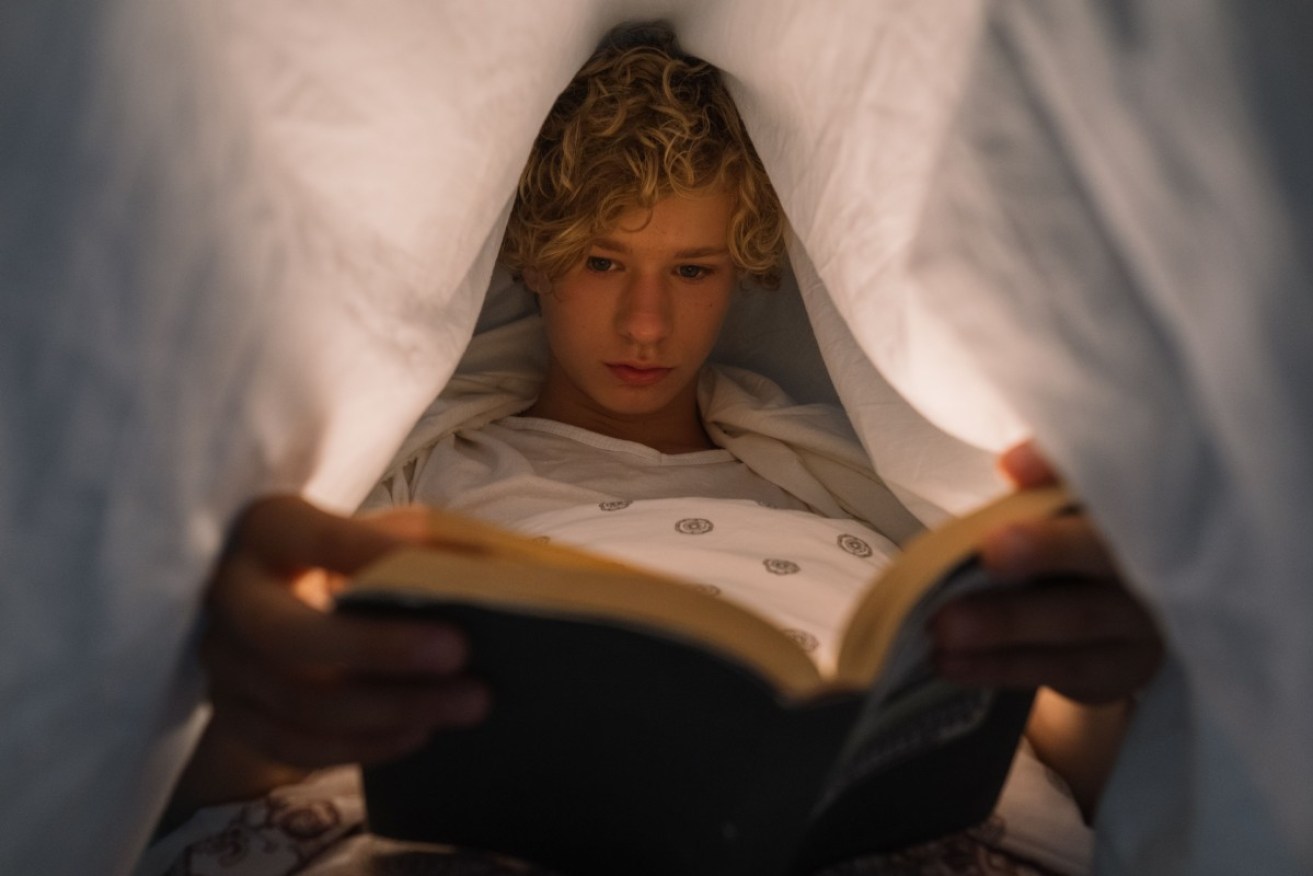
A book asks something of you that a social media feed does not. Photo: Pexels
There are few modern habits more pathetic, and I include myself in that assessment, than lying in bed late at night scrolling through content that makes you angry, anxious or stupid.
You tell yourself you are staying informed. You are not. You are feeding a nervous system that already had a long day.
You open the phone for one little check, maybe you are only setting the alarm. Suddenly you are 54 minutes deep into war updates, political rage bait, celebrity nonsense, AI panic, housing despair and a 19-year-old on TikToker explaining why everyone over 30 is morally obsolete.
This is the miserable genius of doomscrolling. It feels like information, it behaves like addiction.
Young people are the first generation to grow up with the world’s most sophisticated attention-extraction machine in their pocket.
Jonathan Haidt’s The Anxious Generation argues that the shift to a phone-based childhood from the early 2010s displaced sleep, play and in-person socialising, and coincided with a sharp deterioration in teen mental health.
Not everyone agrees with Haidt’s strongest claims. Some researchers argue the evidence is more complicated and sometimes overstated.
Screens are not evil. A Black Dog Institute report, for example, found that teenagers’ screen use aimed at communicating with people they already knew in real life was not associated with worse mental health.
But let’s not hide behind nuance to avoid the obvious. Endless passive consumption of short-form algorithmic content is not the same as calling a friend or learning a skill. Doomscrolling is not merely “screen time”. It is the industrialisation of anxious attention.
The cost is already showing up in the data. Every three years, the OECD’s Programme for International Student Assessment (PISA) tests the reading skills of 15-year-olds.
In 2000, Australian students averaged 528 points. In the 2025 round, released in September, they averaged only 491, Australia’s lowest score on record.
With roughly 20 points equal to a year of learning, today’s 15-year-olds are reading close to two years behind their counterparts from 2000. Only 55 per cent met the national proficient standard.
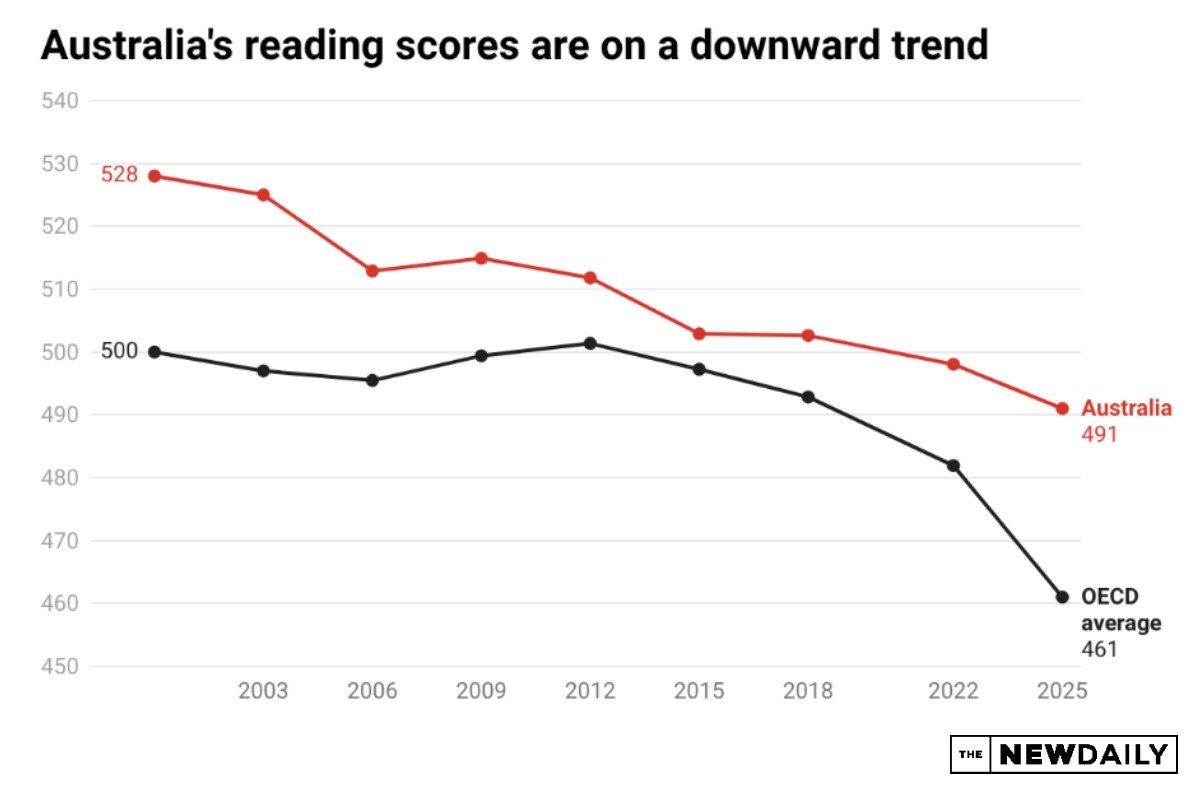
Source: Program for International Student Assessment 2025 – The Conversation
Before we blame TikTok, a dose of caution. Therese Hopfenbeck, a University of Melbourne professor who chairs a PISA 2025 expert committee, has pushed back on the “plunge” and “all-time low” headlines.
Australian teenagers still read well above the OECD average of 461 points and Australia ranked 11th in the world in reading.
The numbers, she argues, are a starting point, not the full story. The decline is also not a uniquely Australian phenomenon – OECD reading scores fell even faster than ours between 2022 and 2025.
PISA tells us reading is getting worse. It does not tell us why.
Fair enough. But the OECD itself lists rising screen time and falling reading for enjoyment alongside the decline, while stopping short of calling them proven causes.
You don’t need to settle the causation debate to see the problem. A generation that reads less, and less deeply, is exactly what you would expect when the feed keeps winning the battle for attention.
The question is what to do instead.
Here is my unfashionable proposal for young people – become a reader.
Not in a performative, linen-shirt, café-window kind of way. Not because books make you morally superior – they don’t. Some of the most annoying people on earth have impressive bookshelves.
Read because attention is now a scarce economic resource. Read because your future career will reward the ability to think deeply for long stretches of time.
Read because reading books is one of the cheapest ways of becoming more interesting, more useful and less easily manipulated.
Above all, read because habits compound.
Let’s run the numbers. One book per week sounds ambitious but not insane – an hour per day easily gets you there. That’s 52 books per year. Keep going for 19.2 years and you have read 1,000 books.
Now imagine two versions of future-you.
Version one spent the next 19.2 years feeding the algorithm: thousands of hours of outrage, gossip, panic and hot takes designed to evaporate the moment they were consumed. They know a little about everything that trended for 48 hours and almost nothing deeply.
Version two read 1,000 books. Novels, biographies, history, science, philosophy, poetry, trashy thrillers and the occasional massive brick of a book.
These two versions of you are not the same person.
One has been trained by interruption. The other has been trained by immersion.
One has practised being reactive. The other has practised being reflective.
This is where the mental health argument and the career argument meet. Reading is not just a wellness habit. It is attention training.
A book asks something of you that a feed does not – to remain with one argument, one story, one unfolding idea. At first, this can feel almost physically uncomfortable if your brain has been trained by infinite scroll.
You read three pages and reach for the phone without deciding to. That is not a character flaw. That is conditioning.
The good news is that conditioning can be reversed.
Reading rebuilds the muscle of sustained attention. The modern workplace is full of people who can respond instantly but think poorly. The worker who can sit with a complex problem, read dense material, synthesise ideas and write clearly is becoming more valuable.
AI will make this more important, not less. When everyone can generate passable text, the scarce skill is judgement. The most successful knowledge workers will know what question to ask, and have enough stored knowledge to notice when their AI produces confident nonsense. Books build that reservoir.
The benefits are not merely professional. Reviews of bibliotherapy, the use of books as a therapeutic tool, suggest that guided reading and self-help books can reduce depressive symptoms, particularly for mild to moderate conditions.
Then there is fiction, the gymnasium of empathy. A famous 2013 study by David Kidd and Emanuele Castano found that reading literary fiction improved performance on tests of theory of mind, the ability to understand others’ emotions and intentions.
The finding has been debated since, as good research should be, but the basic idea holds. Stories let us practise being other people – empathy is a deeply human skill that remains essential for a truly good life.
There is even evidence linking book reading with longevity. A Yale study of 3635 older adults found that regular book readers had a 20 per cent lower risk of dying over 12 years than non-readers, even after adjusting for education, wealth, health and marital status.
Let’s be careful, though. Books are not magic. A miserable person reading Dostoevsky at 2am may not be on the fast path to serenity. Obviously, people need therapy, medication, social connection or simply more sleep before they need a reading list.
But as a life strategy, replacing doomscrolling with reading is about as close to a free lunch as personal development gets.
The barrier is not intelligence. It is friction.
If you want to become a reader, do not begin with a 900-page Russian novel. Begin with pleasure. Crime, romance, fantasy, sport biographies, history, whatever gets you turning pages. The goal at first is not to impress dead professors. It is to make reading as easy as scrolling.
Put the phone in another room. Read physical books in bed. Delete the worst apps from your home screen. Read on the train. Read badly if you must. Read three pages. Then five. Then ten.
Don’t wait until you “feel like reading”. That is not how habits work. You create the conditions, repeat the behaviour, and eventually the identity follows.
About 15 years ago, I found myself reaching for my phone mindlessly hundreds of times per day. I established a rule that I had to read in a book app before I was allowed to jump on social media or my sports apps. I worked myself through several classics this way.
This matters because young adulthood is not just a phase of life. It is an investment window. The habits you normalise early become the rails your life runs on later.
A 20-year-old who reads a book a week will be a different 40-year-old. Not because they know more facts. They will have lived inside more minds and visited more centuries. They will have built an attention span in a society busy dismantling it.
Doomscrolling gives you the illusion of knowing the world. Reading gives you a fighting chance of understanding it.
That is the choice. Not between phones and books. Phones are here to stay. The choice is between two versions of future-you.
One has spent 19.2 years being shaped by whatever the algorithm decided was most clickable that day. The other has read 1,000 books.
Choose your future self carefully.
Simon Kuestenmacher is a co-founder of The Demographics Group. His columns, media commentary and public speaking focus on current socio-demographic trends and how these impact Australia. His podcast, Demographics Decoded, explores the world through the demographic lens. Follow Simon on Twitter (X), Facebook, or LinkedIn.



Rate rises and a recession we don't have to have

Albanese's Labor 'unable to get out of its own way'