How sovereignty has become a calculated issue-by-issue choice

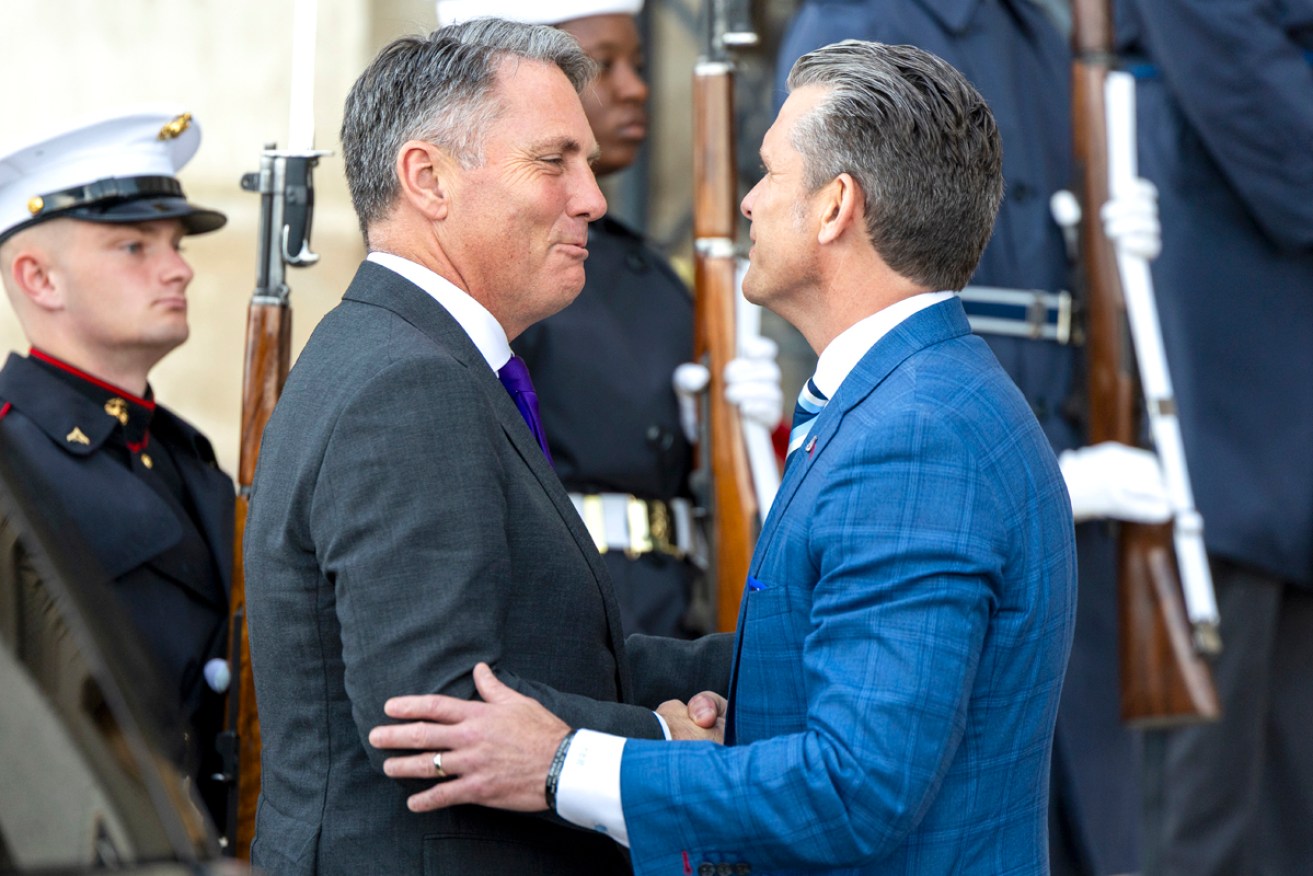
Richard Marles meets US Defence Secretary (and former Fox host) Pete Hegseth on his recent US visit. Photo: AAP
Sovereignty is one of those words that gets thrown around when politically expedient, but without the gravity it actually deserves. It’s basic definition is about a country having the ability and power to be controlled by its own government.
Legally, it’s a little more complicated, but it boils down to supreme authority within a territory.
Politically, it’s whatever works best.
Sovereignty should be on the minds of most Australians, but it’s not – mostly because politicians don’t want it there. But it matters more than politicians would like us to think about.
It was on my mind recently, because it’s popped up across a few issues and our answer as a nation has been different each time. That’s not how sovereignty is supposed to work, and yet, for political expediency, it does.
We keep hearing that the AUKUS deal will ensure Australia’s sovereignty – that we need to pay the US to build its own submarines, so we can have eventually receive access to our own. But while Australia has handed over access to half of our military bases to the United States, and is setting up to allow more, we can not even guarantee that we will control the US submarines if (and it is a big if) we ever receive them.
Defence Minister Richard Marles all but admitted it during his most recent lollygag around Washington, beaming as he was led around by a former Fox News host who most recently made headlines for body-shaming Canadian military cadets.
Asked why Australia thought it would receive any submarines when the US couldn’t meet its own needs, Marles said:
“Because what AUKUS is doing is providing more sea days for the Virginia class fleet for the United States Navy, and more sea days’ worth than a single submarine.
“The establishment of the Submarine Rotation Force West at HMAS Stirling, as well as the establishment of the Henderson Defence Precinct offers the opportunity for US Navy submarines to undergo maintenance much closer to their critical area of operation, which creates sea days for the United States Navy, and that’s ultimately why this is such an important agreement from the United States point of view.”
ABC global affairs editor Laura Tingle picked it up – not many more did. Marles was saying that the US sees this as a good deal because the US gets more from it. And for some reason, Australia doesn’t see this as an issue.
So we don’t maintain sovereignty in AUKUS, but we do make ourselves more of a target in the event of a dispute between the US and any power in our region.
But then we get to the Albanese government’s plan to deal with social media feeds – not because of any moral imperative, but because it is now impacting democracy in a way the government can not ignore. The budget response spooked the government in more ways than one – the misinformation, disinformation and malinformation (basically fancy, not defamatory ways of saying lies) that immediately spread and took hold scared senior members of the government and the Labor Party writ large, so that it began to look to do something about it.
Never mind that the government saw this happen with the Indigenous Voice and with climate – now it’s hitting them.
It’s also a vote winner. Everyone wants to have more control over their socials, and so the government is enforcing sovereignty – not by forcing social media giants to regulate, but by forcing social media giants to give users choice.
Europe is looking at similar regulations, but the end result is the same – the US, which sees itself as controlling much of the world, openly now – is annoyed. Because it, and the oligarchs that prop it up, benefit from the discontent right-wing social media controls spread across the world.
Tech oligarchs are openly working to destroy democracy. They work with Donald Trump. Trump doesn’t like to lose any control, so he has sent out a warning to allies that the US will respond to any attempt to impose “digital services taxes, fines, and other forms of extortion on America’s leading technology sector”.
So the US is trying to control what its allies regulate. Or, in the most simple terms, control what is and isn’t allowed to happen in other countries.
We are happy to hand over that control when it comes to defence it seems – even expect it – and yet seem shocked when it is extended to domestic policies. But it all boils down to the same thing. The Albanese government, at this point in the cycle, doesn’t see a downside to having a fight picked for it with Trump that it knows will play well in the public. But it can’t see how AUKUS does the same thing.
And then we get to the Israeli threats that if Australia enacts trade sanctions over illegal Israeli West Bank settlers, then it can expect similar “repercussions” to what the UK saw.
On Tuesday, foreign minister Penny Wong told the Senate:
“I can announce Australia is pursuing further targeted measures in co-ordination with international partners to deter illegal settlements and settler violence. Australia is not, at this time, pursuing a blanket-style import ban.
“We have concerns about the implementation of a blanket ban and unintended consequences for Australian businesses, for Palestinians and for Israelis, and we will continue to work with partners to protect the prospects of a two-state solution.
“Australia continues to call on Israel to take urgent steps to address the situation on the ground, including to stop settlers from destroying properties, displacing families and beating, torturing, sexually assaulting and killing Palestinians.”
Wong went on to condemn Hamas, which is not in the West Bank, because those are the rules the government has set for itself – never criticise Israel without also criticising Hamas, even when the two are unrelated.
So the Foreign Minister can admit in the parliament that the government is concerned with “settlers” (in any other instance, we would call them terrorists) “destroying properties, displacing families and beating, torturing, sexually assaulting and killing Palestinians” but not actually enact any meaningful sanctions.
Even though the International Court of Justice ruled two years ago that the settlements were, indeed, illegal. Even in the face of escalating violence of Israelis against Palestinians and even as other allied countries provide cover. We’ll do something, but nothing much.
And even in the face of the absolute bare minimum, Israel still issues a “warning”.
Sovereignty should be about Australia’s national interest. But also encompass what are supposed to be Australia’s values. The Australian government will probably stand up to Trump on the social media stuff. Just as it does on the Pharmaceutical Benefits Scheme. And it will talk a lot about sovereignty and the national interest and the Australian way as it does so.
If only it could also claim consistency. Perhaps then, Australians would have a better sense of where its government actually stood.
Amy Remeikis is a contributing editor for The New Daily and chief political analyst for The Australia Institute
Helen Haines reminds us that politics can be good

Ugly shift highlights Australia's biggest challenge