Fire ants could kill thousands of Australian pets: Report

Source: AAP
The Albanese government has been warned thousands of Australian pets could die and households risk facing more than $1 billion in annual costs unless it significantly boosts efforts to eradicate fire ants.
Research by the Australia Institute has found the invasive pest could trigger an extra 2.3 million veterinary visits for pets and 624,000 medical visits for people each year if it is allowed to spread across the country.
International data suggests almost a third of people in fire ant-infested areas get stung each year, with risk of anaphylactic shock.
The report estimates more than 30 Australians and thousands of pets could die annually.
“Fire ants are a potential economic and environmental disaster for Australia,” said Rod Campbell, co-author of the report and research director at the Australia Institute.
“If a murderer said that they planned to kill 30 random Australians each year, the response would be enormous. That’s essentially what fire ants are doing — yet the response is minimal,” Campbell said.
Originally from South America, fire ants have established populations in Queensland, while there have been repeated detections in northern NSW.
South-east Queensland residents were warned last June to remain vigilant, after detection dogs uncovered a nest on the Sunshine Coast.
In 2024, thousands of fire ant infestations were also uncovered along the Logan River and in other areas south of Brisbane.
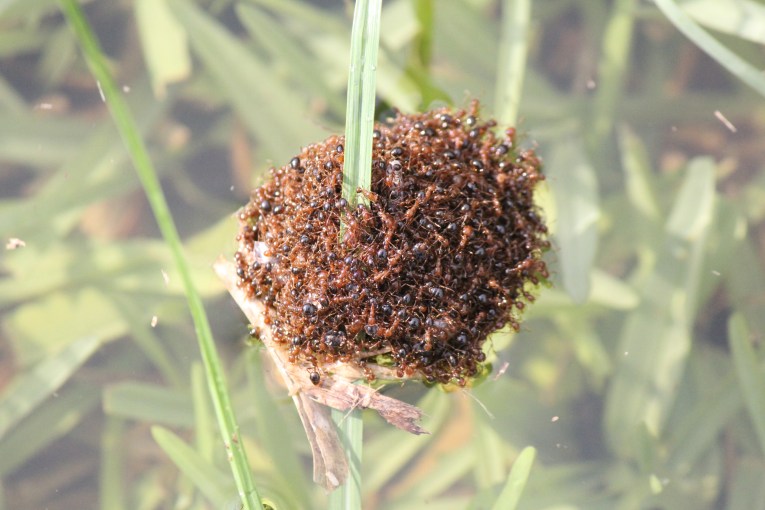
“[They] can lock their legs together and form a big raft — a ball of fire ants — and basically carry the queen and the brood downstream with the floodwaters,” Reece Pianta, from the Invasive Species Council, told the ABC at the time.
“Inadvertently, we’ve found a species that is almost perfectly evolved to infest and spread on the continent of Australia.”
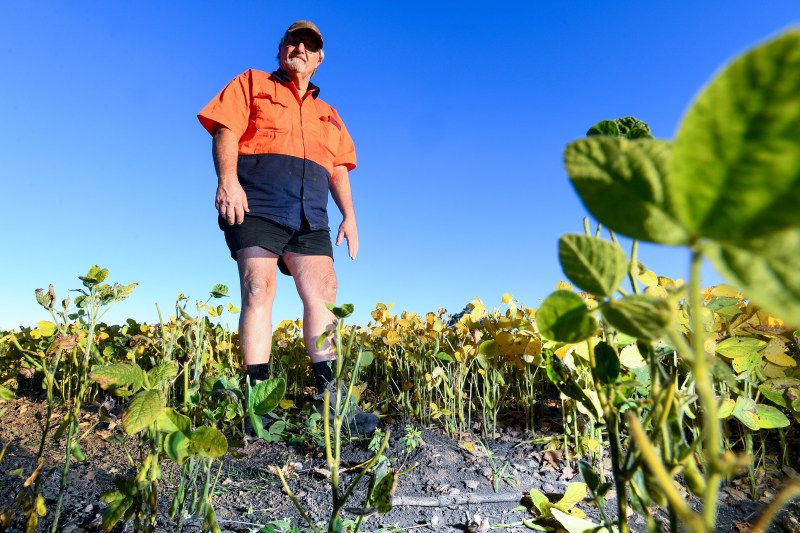
Cane farmer Larry Spann next to a fire ant nest on his Gold Coast land. Photo: AAP
With almost all of Australia considered suitable habitat for the species, the incursions further south have fuelled concerns the pest could spread more widely.
The biggest threat is accidental transport by people, including through soil, mulch, machinery and other materials.
However, the ants’ ability to survive floods and bushfires and spread with ease has also contributed to their reputation as “notorious hitchhikers”.
Red imported fire ants (RIFA) were first detected in Australia in 2001, near the Port of Brisbane. They are believed to have arrived in cargo shipments.
The discovery led to the establishment of the National Fire Ant Eradication Program, a joint initiative between Commonwealth, state and territory governments, aimed at eradicating the species from Australia by 2032.
Collectively, it committed $592.8 million to a Fire Ant Response Plan to fund management and eradication activities from 2023 to 2027.
However, despite ongoing containment efforts, the aggressive pests have been intercepted on transported plant material in Victoria, Western Australia and Tasmania.
The Australia Institute’s report warns that if the destructive species is allowed to continue to spread, it could inflict more than $22 billion in environmental, social and economic damage by the 2040s.
“Australia’s government isn’t doing enough to protect people or the economy from fire ants, but perhaps it will act to protect our pets,” Campbell said.
“Prime Minister [Anthony] Albanese, a renowned animal lover, could save Australian households $1 billion a year and a lot of heartache by properly funding and prioritising fire ant eradication.”
Campbell said current funding fell well short of what experts say is required.
A 2021 report, prepared for the steering committee of the National RIFA Eradication Program, estimated eradication in south-east Queensland would require $200 million-$300 million a year for a decade.
“There is an urgent need for aggressive area-wide suppression,” it report noted.
“Political will, combined with a stronger coalition for action and governance changes, are needed to pivot the program to a multifaceted approach making RIFA control truly a shared responsibility.”
Queensland’s recent state budget included $10.5 million to continue aerial baiting and backyard treatment programs through to mid-2027.
However, critics argued it wouldn’t be enough to help local councils meet the costs of delivering ground suppression treatments.
“The funding keeps the lights on for another 12 months, but it does not provide the long-term certainty needed to protect Queensland communities or deliver eradication,” Invasive Species Council advocacy director Reece Pianta said.
Campbell said if governments delayed eradication, the costs of mitigation would only rise.
“Our research shows that investing in fire ant eradication is one of the best economic policies a government could adopt, as well as being good environmental and security policy,” he said.
“Australia has a crucial window in which to halt the spread of fire ants and protect Australia’s environment, economy, and communities.
“To achieve eradication of fire ants, sufficient investment is needed now.”
This article was originally published on The Point. Read the original article.
Republished under Creative Commons — Attribution-NoDerivatives 4.0 International — CC BY-ND 4.0.
‘Super pest’ detected in Sydney warehouse
Magnitude 4.8 quake shakes Victoria