Profits of doom: Gas boss stretches the truth at press club

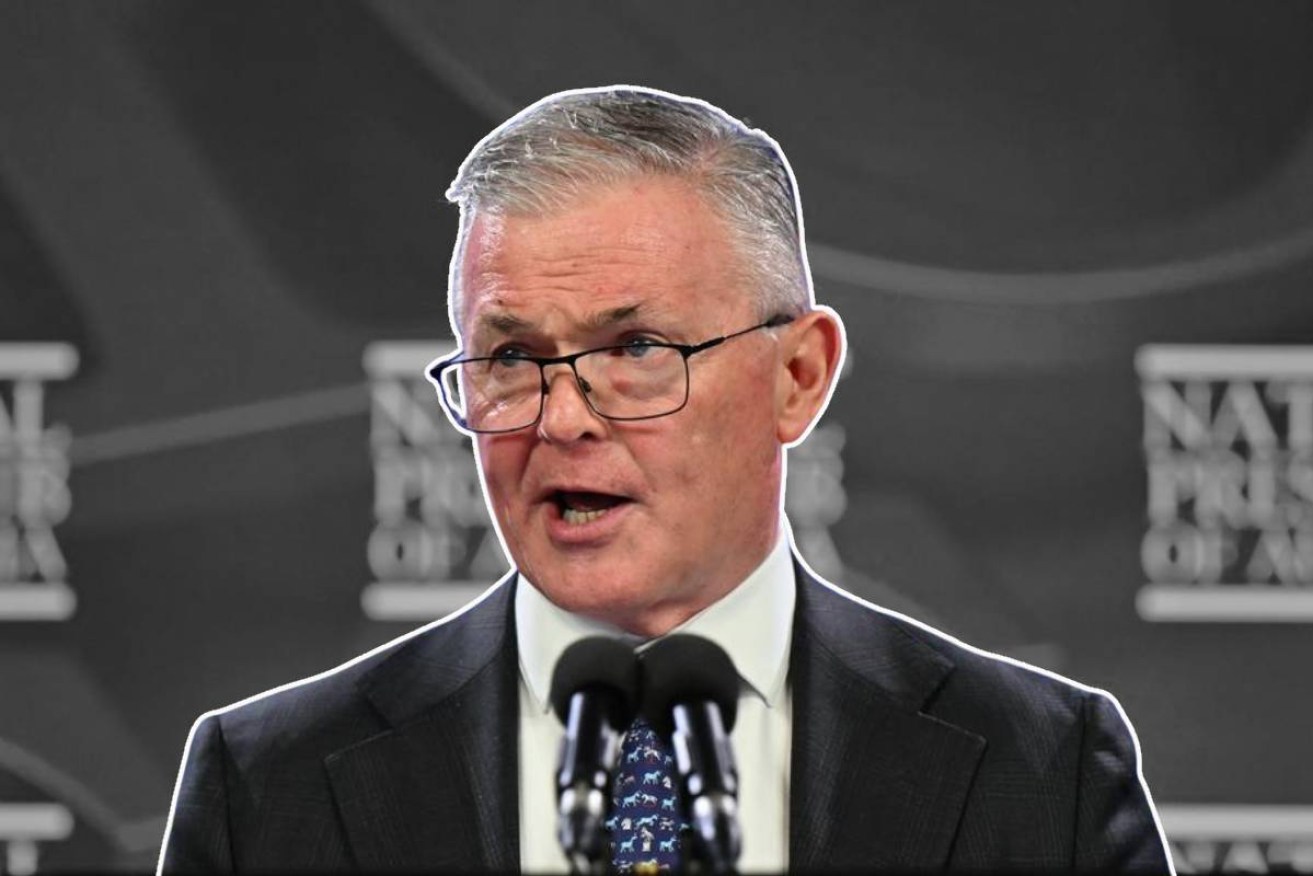
Kevin Gallagher’s Press Club speech was billed as ‘Australia's energy opportunity in an uncertain world’ Photo: AAP/TND
The “Gish gallop” debating technique involves making so many false or misleading claims in quick succession to sneak away without proper challenge.
We sat through a classic of the genre when the head of one of Australia’s biggest oil and gas companies, Santos, turned up at the National Press Club in Canberra on Wednesday to claim his business was here to solve the country’s energy security needs.
Kevin Gallagher’s speech was billed as “Australia’s energy opportunity in an uncertain world”, but a more accurate title would be: “Help my polluting gas company cash in on this crisis”.
In Gallagher’s telling, the Iran war and the disruptions caused by the closure of the Strait of Hormuz are just another reason to let his company do more drilling. How convenient.
Gallagher quoted from the International Energy Agency, but forgot the little bit where it said continued expansion of renewables “has played a key role in diversifying electricity supplies, thereby supporting energy security and helping limit the impacts of the shock”.
According to the IEA’s Electricity Mid-Year Update 2026, wholesale electricity prices in Australia were about 45 per cent lower in the second quarter of 2026 “as strong generation from renewables and rapidly expanding battery storage capacity helped reduce reliance on gas-fired plants during peak electricity demand periods”.
Gas is expensive. Use it more, and the price goes up.
Gallagher conceded “we can electrify many things” but played down the pace of the renewables rollout by repeatedly referring to such sources as a share of “primary energy demand”.
The founder of the BloombergNEF think tank, Michael Liebreich, visited Australia a few months ago and pointed out fossil fuels are incredibly inefficient and so “around two-thirds of primary energy is wasted, mainly from oil, gas and coal – it never does anything useful for anyone”.
Liebreich is no woke leftist. He served alongside Tony Abbott on the UK board of trade under the previous Conservative government and is a member of that party.
Giving his own speech at the National Press Club, Liebreich said: “Whenever you hear anyone using the words ‘primary energy’, one of two things is happening. Either they don’t understand what they are talking about, or they do, but they are hoping that you don’t.”
Which brings us back to Gallagher. He went on to claim the oil and gas industry “needs no subsidies nor asks for them”, but that is completely false.
He also said his company’s Moomba carbon capture and storage (CCS) project in South Australia “contributed about one-third of the reduction” in emissions covered by the federal government’s safeguard mechanism in the last reporting year.
In fact, the Moomba CCS project has received a $15 million grant from the federal government. When you also factor in tradeable offset units alongside government grants, Santos has received benefits worth $100 million just from the federal government to support a project that it should have paid for out of its own pocket.
Some of this largesse will need to be paid back eventually – and rightly so – but the stench is rich.
We have no third-party verification of Santos’s effort yet. At this point in the hype cycle, Chevron’s disastrous Gorgon CCS was similarly spruiked as a raging success. A few years on, nobody does that anymore.
The gas industry does rely on government support. For example, the Northern Territory government has struck a secret take-or-pay agreement for gas from the contentious Beetaloo Basin.
And in June, Santos signed another generous gas supply deal with the South Australian government that Gallagher described at the time as an example of a “high-return opportunity”.
That’s some largesse for a man claiming to receive no subsidies.
Gallagher pushed back at the design of the federal government’s new policy to reserve 20 per cent of gas for Australian domestic use, claiming: “Australians rightly expect their own needs to be met before we export gas overseas, but it is not true that east coast gas supply issues were caused by Queensland’s LNG export industry, nor that there is an imminent supply or price crisis.”
He is right in one regard. It wasn’t caused by the east coast gas industry. It was caused by Santos. First among equals, Santos is specifically responsible for the mess we are in.
To meet its export commitments, Santos’s Gladstone LNG (GLNG) project contracted gas from South Australia’s Moomba basin that previously went to the domestic market, explained the Institute for Energy Economics and Financial Analysis in a report published this week.
The report estimates GLNG has siphoned more than 1000 petajoules of gas from the domestic market since 2017, equivalent to more than two years of domestic demand, which has contributed to increases in gas prices.
It is telling that Gallagher failed to mention the word “climate” a single time in the half-hour speech.
When pressed on this by journalists, he deployed the classic “drug dealer’s defence”. Asked about the Beetaloo basin, which has been widely described as a “carbon bomb”, Gallagher said: “If we shut down gas here in Australia, they will just get it from somewhere else.”
Australia is the world’s second-largest LNG producer and provides one-fifth of global supply. Anyone trying to suggest that you can remove one-fifth of global supply from a market with zero impact does not deserve to pass a high school economics class, let alone run a global petroleum company.
We need to plan for a fossil fuel phaseout, not for governments to keep approving new polluting projects.
The science is clear – climate pollution from coal, oil and gas all fuel global heating. The more we burn, the more we are cooked.
That includes more intense extreme weather events here in Australia and catastrophes abroad, just like the Nepal disaster.
Unreliable offsets and false solutions like carbon capture and storage can’t paper over this physical reality.
We now have proven solutions that can help us improve our energy security, reduce climate pollution and cut costs at the same time. That’s why Australians are switching to EVs in record numbers and racing to install home batteries to go with their solar panels.
Australia’s trading partners are also rethinking their exposure to volatile, expensive fossil fuels, with South Korea President Lee Jae-myung declaring the Middle East crisis shows why his country “must swiftly transition to renewable energy”.
Thailand’s energy minister, Akanat Promphan, believes “we must urgently reduce imports of LNG and other fuels”.
That’s good news for the climate and energy security, but bad news for oil and gas executives like Gallagher.
Tim Baxter is a climate and energy policy analyst and the founder of Naru Research