Poultry farm lockdowns after second bird flu case
Source: Mike Bowers
Australia’s largest poultry producer has put farms into lockdown after confirmation of a second case of a deadly avian flu strain in Australia.
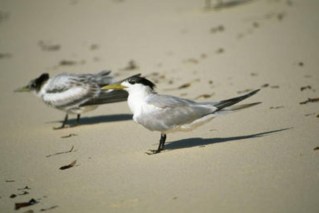
Monday’s announcement from Inghams Group came slightly ahead of tests confirming a northern giant petrel found in Western Australia also had the H5N1 strain.
It was found at the weekend, near where the first case, involving a brown skua, was detected.
Agriculture Minister Julie Collins said there had been no evidence of mass mortalities among birds to date.
“We are working to determine whether or not the H5 bird flu has established in the wildlife or established in Australia, other than these two isolated birds,” she said on Monday.
The sick brown skua was found on a remote beach near Esperance in Western Australia, about 700 kilometres south-east of Perth, last week.
Along with the second case confirmed on Monday, there have been more than a dozen more cases of sick or dead birds reported.
Inghams Group said on Monday that despite no detections in commercial poultry, it had decided to mitigate against potential risks across its WA sites.
“This includes the implementation of a complete lockdown, preventing all non-essential access, across all the company’s WA farms and processing operations,” it said.
The company is also seeking a regional housing order from the state government. That would allow it to keep its free range poultry indoors in WA.

Inghams has farms and hatcheries across Australia and New Zealand. Image: Inghams Group
Chief veterinary officer Beth Cookson said Australia had been preparing for the deadly avian flu for years as the only continent previously unaffected by the strain.
“Our actions at the moment are really to understand whether these two single individual birds have been able to spread it into other populations in Australia,” Cookson told ABC Radio National on Monday.
“Our approach is to really learn from the overseas experience and look at the practical actions that can be put in place to mitigate the impacts as far as possible.”
There were so far no other detections in wildlife, poultry or agricultural systems, Cookson said.
She said the two sick birds had a breeding habitat on the sub-Antarctic territories Heard Island and McDonald Islands, where the strain has killed 13,359 southern elephant seal pups.
People are urged to report any sick or injured birds they find. They should also keep their distance as the virus can sometimes spread to humans who are nearby.
Environment Minister Murray Watt said people should avoid contact with sick or dead birds.
“It is important to remember that at this point in time we only have two confirmed cases,” he said.
“But we don’t underplay the threat that this poses to wildlife and our agriculture sector in Australia.”
The federal government has developed more than 100 response plans for key sites and vulnerable species and invested about $100 million in preparedness.
The discovery has fuelled fears among scientists, conservationists and agricultural groups, who point to mass mortality events and species-level population reductions in overseas outbreaks.
University of Melbourne researcher Michelle Wille said Australian authorities had been preparing for a worst-case scenario, but international examples painted a gloomy picture.
“Everywhere this virus has emerged has been really catastrophic, with mass mortality events in wildlife, and in some places, we’ve seen species-level reductions in population,” she said.
Industry impacts could also be significant, she said, noting more than 200 million chickens had been culled in the US since the virus arrived there.
-AAP
Want to see more stories from The New Daily in your Google search results?
- Click here to set The New Daily as a preferred source.
- Tick the box next to "The New Daily". That's it.