Little kids trust know-all robots more than incompetent humans

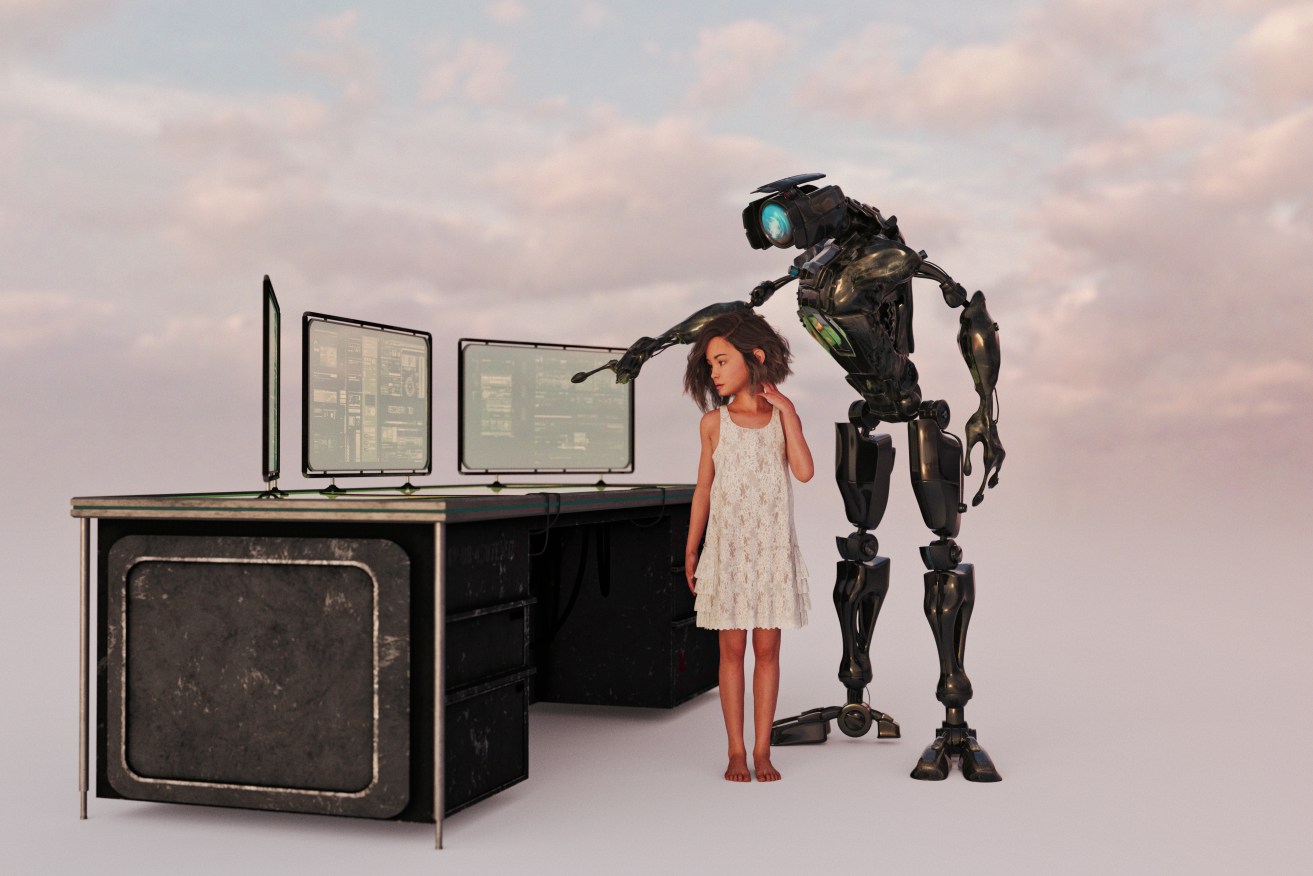
Kindergarten-aged children dropped their human teacher like a hot rock in a new experiment about trust. Photo: Getty
Don’t obviously lie to your little kids for the fun of it. What seems cute to you amounts to an immediate loss of trust for the young ones.
That’s my main take-away from a new study that found that “preschoolers prefer learning from what they perceive as a competent robot over an incompetent human”.
This study is purportedly the first to use both a human and a robot to see if children give more weight to “social affiliation and similarity” than competency when choosing who to trust and learn from.
In other words, will they be loyal to their fellow humans, even when those humans are apparent idiots? Or will they put their faith in an uppity piece of technology?
The study
The study, from psychologists at Concordia University, Montreal, was in two parts.
It involved two groups of children, one aged five years, give or take three months, the other aged three years, give or take three months.
The set-up was a Zoom meeting that featured a video of a young woman and a small humanoid-looking robot. This means the robot had a head, face, torso, arms and legs.
The robot was named Nao. It sat side by side with the young woman.
Robot and humans took turns labelling familiar objects.
The robot labelled correctly, the woman did not. Instead, she referred to “a car as a book, a ball as a shoe and a cup as a dog”.
What the heck is a ‘fep’?
Next, the two groups of children were presented with unfamiliar items: the top of a turkey baster, a roll of twine and a silicone muffin container.
The robot and the human each gave these items different nonsense names such as “mido,” “toma,” “fep” and “dax”.
The children were then asked what each object was called. They had to choose between the silly names given by the robot, and the silly names given by the woman.
The results
The three-year-olds showed no preference for one silly word over another (possibly choosing the name that was most fun).
The five-year-olds, however, were much more likely to adopt the silly names given by the robot than the human.
“We can see that by age five, children are choosing to learn from a competent teacher over someone who is more familiar to them – even if the competent teacher is a robot,” said the paper’s lead author, PhD candidate Anna-Elisabeth Baumann.
Were the kids just backing themselves?
Strictly speaking, the five-year-olds discarded the nonsense idea that a car is a book etc and went with what they knew to be true. It could be argued they were backing themselves as much as backing the robot.
However, certainly the woman had shown herself to be unreliable. The kids probably thought she was an idiot, certainly a trickster.
And when it came to naming unfamiliar objects, they followed the advice of the robot that had proved to be competent, as the scientists put it.
At this point, too, it pays to keep in mind that both robot and humans are treating the children dishonestly. And perhaps the equally important lesson here is that once you gain a five-year-old’s trust, they’re more easily misled.
Part two of the study
The next part of the study investigated whether or not the young participants would put their faith in a robot that didn’t have human-like features.
The original experiment was repeated with new group of three and five-year-olds. the woman
The researchers repeated the experiments with new groups of three- and five-year-olds, This time the humanoid Nao was replaced with a small truck-shaped robot called Cozmo.
The woman once more played the fool with the familiar objects, while the robot did not. Then the woman and the little truck gave their silly names to the unfamiliar objects.
Once again, the older children tended to follow the robot’s advice – “suggesting that the robot’s morphology does not affect the children’s selective trust strategies”.
Meaning: it didn’t matter what shape the robot took, as long as it didn’t call a car a book.
Finally
The researchers gave the children what’s known as a “naive biology task”.
They were asked “if biological organs or mechanical gears formed the internal parts of unfamiliar animals and robots”.
The three-year-olds appeared confused, “assigning both biological and mechanical internal parts to the robots”.
However, the five-year-olds were much more likely to believe that only mechanical parts belonged inside the robots.
“This data tells us that the children will choose to learn from a robot even though they know it is not like them. They know that the robot is mechanical,” says Ms Baumann.