 Subscribe

More than one million Aussies are now juggling multiple jobs
A record number of Australians are working more than one job, with women and younger workers most likely to be juggling multiple sources of income.

- A record 1.05 million Australians held multiple jobs in June, representing 6.9 per cent of employed people.
- Women are more likely than men to work multiple jobs, with healthcare and social assistance accounting for a significant share.
- The trend raises questions about wages, working hours and whether Australians can earn enough from a single job.
More than one million Australians are now working multiple jobs, with the proportion of workers juggling additional employment reaching a record high.
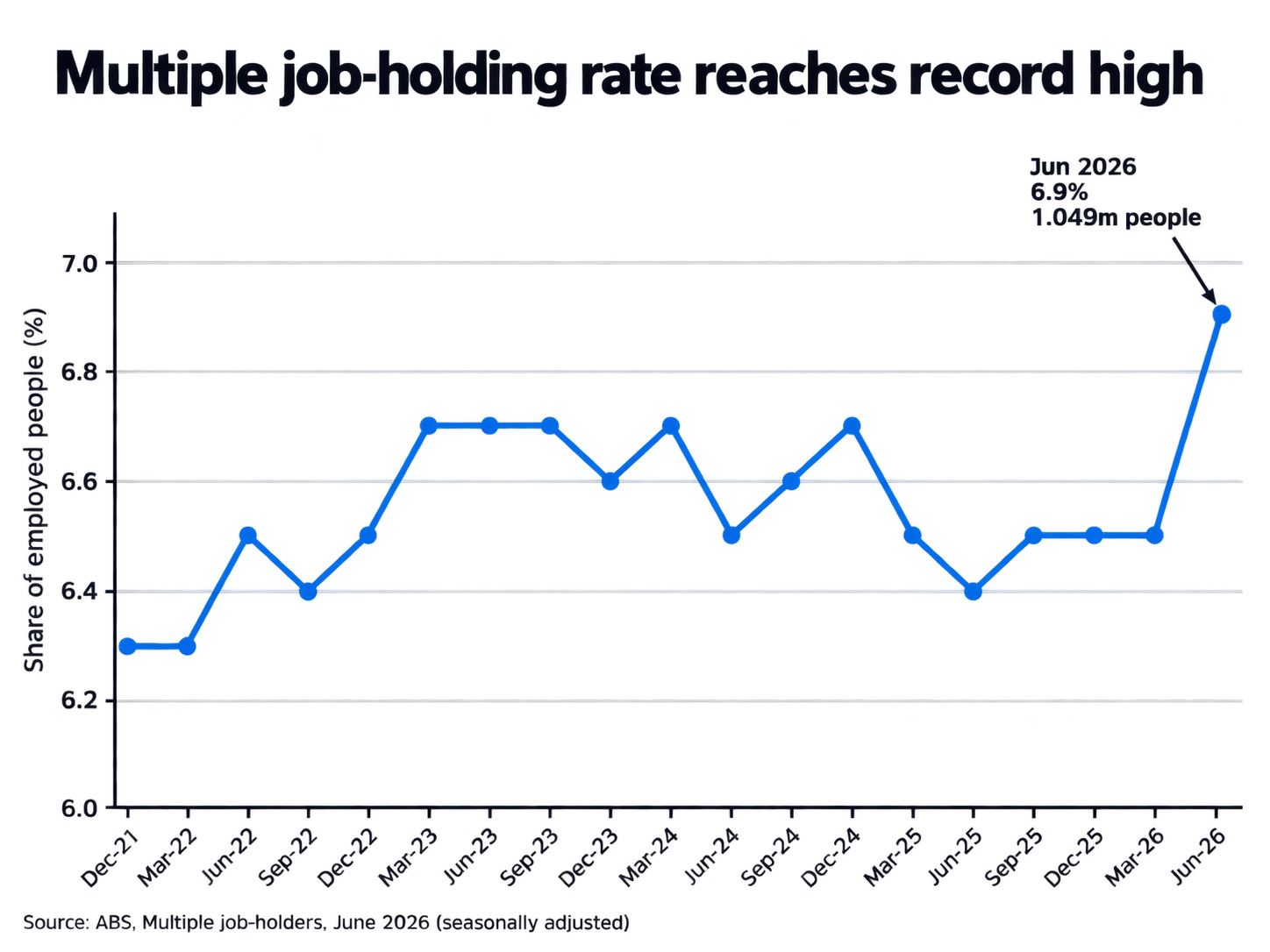
The latest figures from the Australian Bureau of Statistics (ABS) show 1.049 million Australians held more than one job in June, equivalent to 6.9 per cent of employed people.
That was up from 984,200 in March and marked the highest multiple job-holding rate on record.
It follows the latest report from Jobs and Skills Australia (JSA), released earlier this month, that tells the story of the longer-term shift towards multiple job-holding, particularly among women working in healthcare and social assistance.
Over the decade to March, the proportion of employed Australians holding multiple jobs climbed from 5.7 per cent to 6.5 per cent, the report found.
The trend has become even more pronounced since the pandemic.
Before 2020, the multiple-job-holding rate generally hovered between 5 and 6 per cent. The trouble is that rate has remained above 6.4 per cent since June 2022.
“Workers are under pressure from high interest rates and higher prices for essentials, and they are having to take on multiple jobs just to get the hours they need to make ends meet,” Melissa Donnelly, Secretary of the Australian Council of Trade Unions, told The Money Edition.
“We are already seeing a rising unemployment rate because of the Reserve Bank raising interest rates, which is now putting at risk the gains we made in secure work over the last few years.
“Workers should be able to get the hours they need from a good, secure and well-paid job, and this data is a worrying sign that a higher unemployment rate and continued cost of living pressures are making that harder,” she added.
Women more likely to hold multiple jobs
In another concerning trend, women are disproportionately represented among Australians working more than one job.
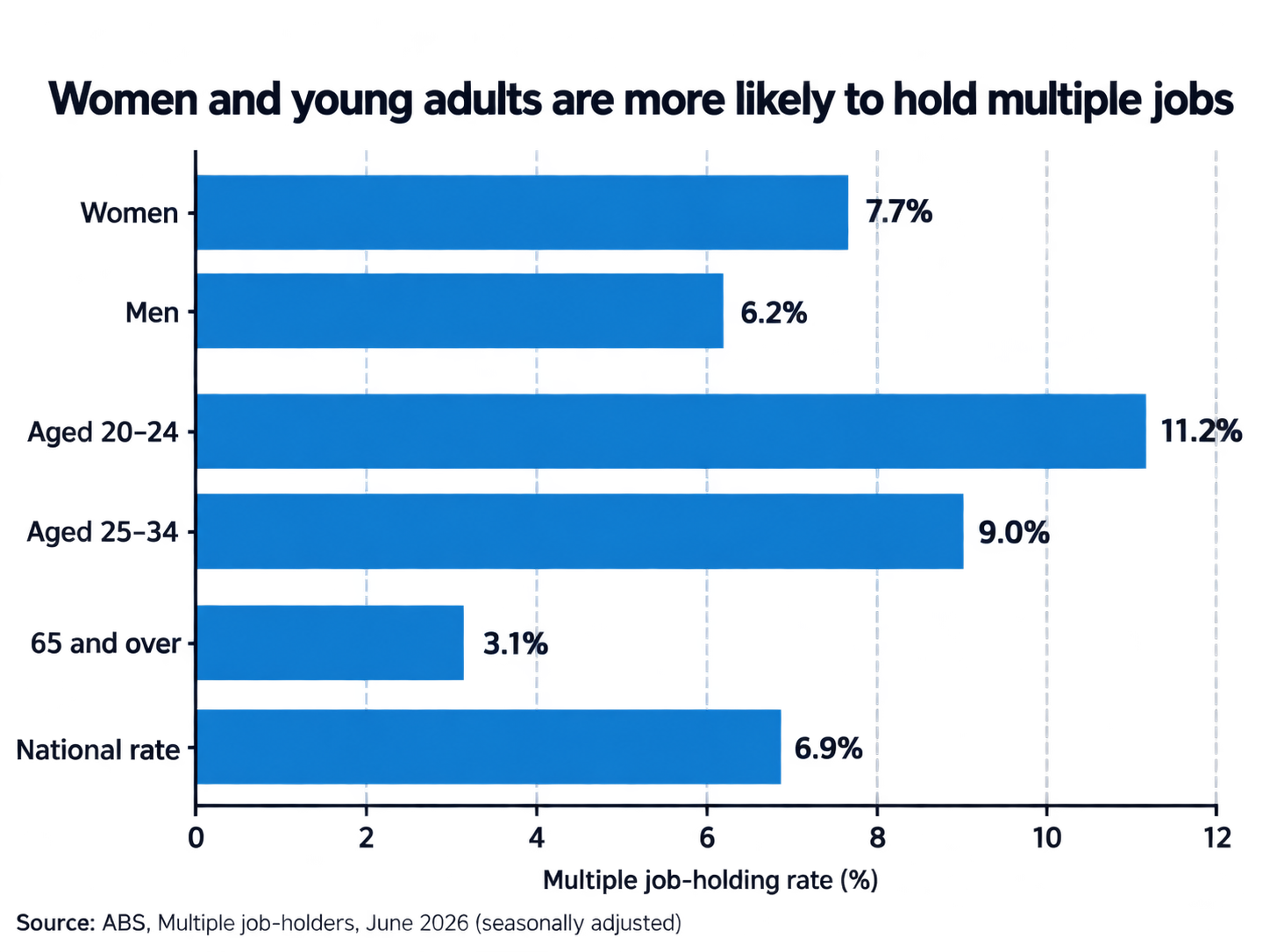
ABS data shows 7.7 per cent of employed women held multiple jobs in June, compared with 6.2 per cent of men.
The divide is particularly noticeable in healthcare and social assistance, where women accounted for around 140,000 multiple jobholders in the data examined by JSA. That represents approximately one in seven Australians holding multiple jobs.
The report also found women holding multiple jobs typically worked fewer hours in their main employment than men. In March, women averaged 26.4 hours a week in their primary job, compared with 34.7 hours for men.
Their additional jobs contributed another nine hours a week on average, compared with 9.6 hours for men. While that divide is closer on paper, JSA said the findings suggest women are more likely to combine part-time work across multiple jobs to build up hours and income.
Young Australians leading the trend
Younger Australians are also more likely to work multiple jobs than older employees, which makes sense at first glance.
In June, 11.2 per cent of employed Australians aged 20 to 24 held more than one job, representing the highest proportion of any age group. By comparison, the national multiple job-holding rate was 6.9 per cent.
The figures point to a labour market in which holding more than one job has become increasingly common for the younger generation, particularly those in industries with substantial part-time employment.
Neither the ABS figures nor the JSA report shows how many Australians take second jobs specifically because of financial pressure. But as the ACTU, the peak body for Australian unions, points out, the times they are a-changin.
The challenge of earning enough from one job
The JSA report makes the case that improving working conditions and providing sufficient hours could help address workforce challenges in high-demand industries.
In healthcare and social assistance, where skills shortages have persisted, the report identifies job design and employment stability as important factors in retaining workers.
Rather than simply recruiting more people, employers may need to give existing workers opportunities to increase their hours, advance their careers and secure more stable employment.
The report also highlights the growing role of digital platform work, including jobs undertaken alongside regular employment.
Earlier ABS research found that 53 per cent of digital platform workers undertook that work alongside their main job, yet only 11 per cent reported being multiple jobholders in the Labour Force Survey, pointing to potential gaps in how secondary employment is captured.
“Taking on a second job is becoming a practical financial decision rather than simply a career choice,” Emma Sestic, Director at recruitment agency Robert Half, told The Money Edition.
“For some Australians, it’s about supplementing their salary as household costs put pressure on disposable income, while for others it can be a way to make up for limited hours in their primary role.
“Either way, the broader trend suggests more workers are looking beyond a single job to give themselves greater financial flexibility.”
Research Robert Half conducted in 2024 found that nearly half of Australian workers said they were considering a second job.
“That suggests additional employment is not simply about pursuing a passion or trying a different career,” Sestic said. “For many workers, it is being considered as a practical way of creating greater financial breathing room.”
With more than one million Australians now combining jobs, the reality is that a growing portion of the working population are beginning to chafe under strained economic conditions.
Eventually something has to give, or else something has to break. Most of us would prefer to see the former.