 Subscribe
Aussies pour record $7 billion into ETFs as property prices fall
Australians are investing record amounts in exchange-traded funds as rising mortgage costs and falling house prices put the spotlight on alternative ways to build wealth.

-
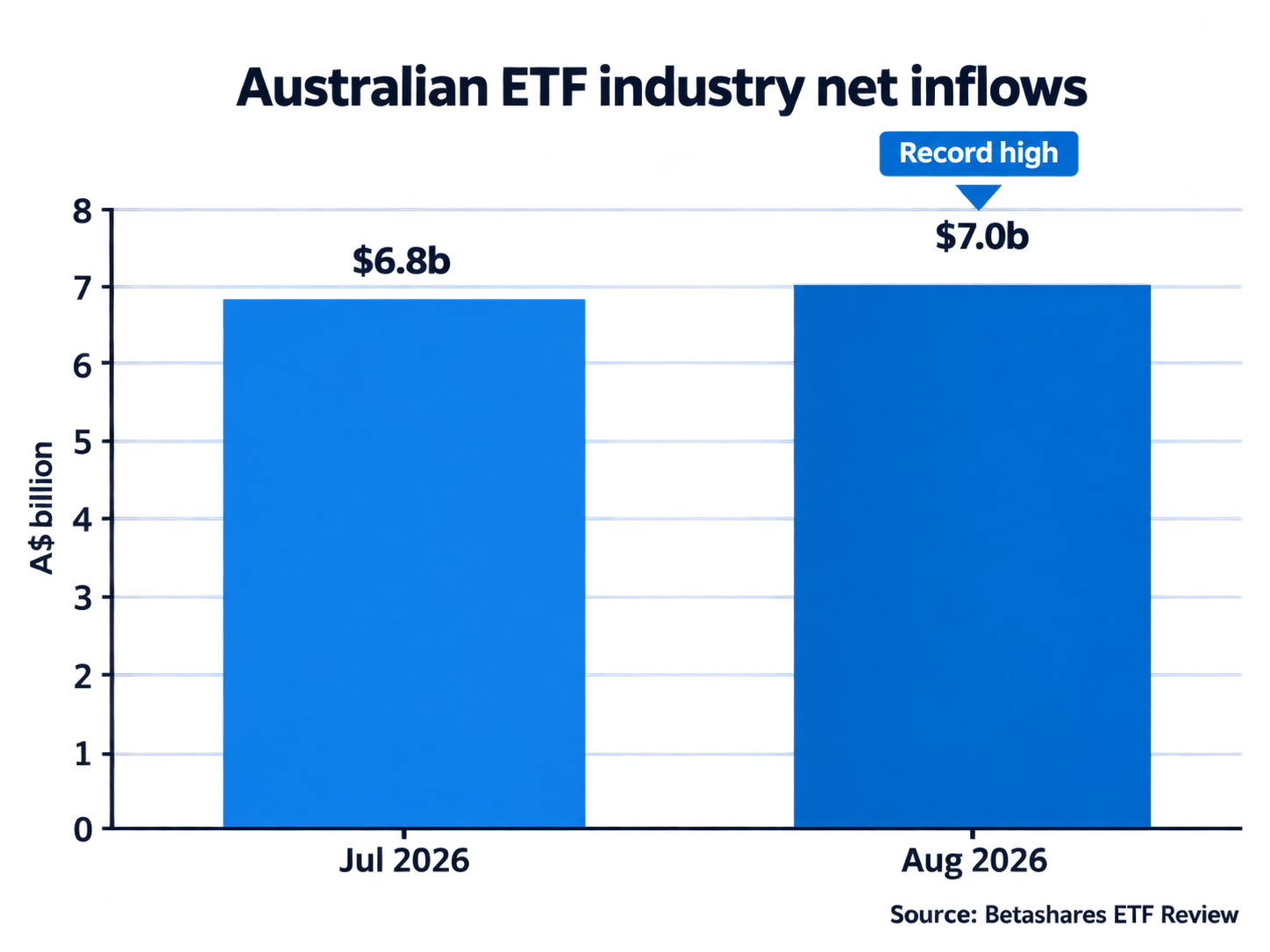
Australia’s ETF industry attracted a record $7 billion in August, taking total assets to $382 billion.
-
Falling property prices and rising mortgage costs are highlighting the much higher cost of entering the housing market.
-
ETFs offer a lower-cost entry point to investing, but investors remain exposed to market volatility, fees and potential losses.
Property has long been the go-to for Australians looking to build wealth.
Yet this year’s declines in house prices, rising mortgage costs and policy changes have sharpened the focus on investing elsewhere, including in exchange-traded funds (ETFs).
New data from investment firm Betashares shows the Australian ETF industry attracted a record $7 billion in net inflows in August, taking total assets to $382 billion.
While falling property prices and record ETF inflows have occurred alongside each other, there is no clear evidence that one is driving the other.
However, recent figures highlight different ways Australians can build wealth, especially as high borrowing costs make entering the property market harder.
With low barriers to entry, ETFs let Australians start investing right away, giving them easy access to specific domestic and overseas markets to build wealth alongside their super balance.
It also comes at a time when Australians are dealing with ongoing cost-of-living pressures.
Last month, the Reserve Bank of Australia lifted the cash rate to 4.60 per cent, its highest level in 15 years, prompting banks to raise mortgage rates and further increase borrowing costs for households.
Those pressures are putting downward pressure on the housing market, with data from Cotality showing national dwelling values fell for a sixth straight month in September.
In other words, many Australians simply cannot afford, or choose not, to take on a mortgage as interest rates hit their highest levels in years.
Meanwhile, a recent report from Betashares found the Australian ETF industry attracted $7 billion in net inflows in August.
This was above July’s then-record $6.83 billion, marking the first time the industry recorded back-to-back months above $ 6.5 billion.
The figures also show Aussie investors are increasingly looking overseas for investment opportunities.
International equity ETFs attracted a record $3.8 billion in August, accounting for more than half of the month’s total net inflows and surpassing July’s previous high.
As a result of recent weakness in Australian equities, international equity ETFs have emerged as a clear beneficiary of investors looking to diversify their portfolios.
Property versus ETFs: The cost of entry
You could choose to invest relatively small amounts in an ETF, while property obviously comes with a hefty price tag, significant debt and ongoing interest repayments.
A traditional mortgage in Australia often requires a 20 per cent deposit to avoid lenders mortgage insurance, although buyers can purchase with smaller deposits.
The average (mean) residential dwelling price in Australia sits at $1,100,400, according to the Australian Bureau of Statistics’ June quarter 2026 data.
This means a hypothetical purchase of the average property in Australia with a 20 per cent deposit would require savings of $220,080.
It’s money many Australians simply don’t have.
Investing in an ETF generally requires far less money upfront. A first purchase of an ASX-listed ETF typically requires at least $500, although some investment platforms allow smaller amounts.
This means Australians can start investing much sooner without needing to save a property deposit or take on a mortgage.
What is an ETF?
You may or may not be familiar with the Australian Securities Exchange (ASX).
For generations, investors have bought and sold “shares” (tiny pieces) of companies through the Australian stock market.
The simple goal is to buy shares and sell them for a profit down the line as the company becomes more valuable.
But for the average Australian with a job, responsibilities and a life of their own, making these kinds of financial decisions can be overwhelming and risky.
Diversification can reduce these risks and many ETFs provide it.
Instead of investing in one company, plenty of ETFs combine hundreds or even thousands of investments into one “basket.”
These can include Australian and international shares, bonds, commodities and other assets.
More than 500 ETFs are available to Australian investors, ranging from funds that hold Australian and international companies to those that focus on a niche like technology or artificial intelligence.
It lets you invest in a range of assets at once, rather than choosing just one or two.
This means you rely less on one company’s performance, although diversification does not eliminate the risk of losses.
What are the risks?
While ETFs can offer simple diversification, they still carry risk. Like any investment decision, there is plenty to weigh up.
For example, the ASX 200 index, which represents 200 of the largest companies listed in Australia, lost roughly 35 per cent between February 20 and March 23, 2020, as the COVID-19 pandemic roiled global financial markets.
Meanwhile, residential property prices rose 1.6 per cent over the March quarter of 2020, according to the Australian Bureau of Statistics, although the two figures cover different periods.
Additionally, ETFs charge fees to run and manage the fund, which can offset or eat into potential gains.