 Subscribe
Petrol prices top $2.40 nationally: Why Aussie motorists are being hit by overseas wars
The average petrol retail price nationally in Australia has topped $2.40 a litre as global conflict continues to drag oil prices higher.

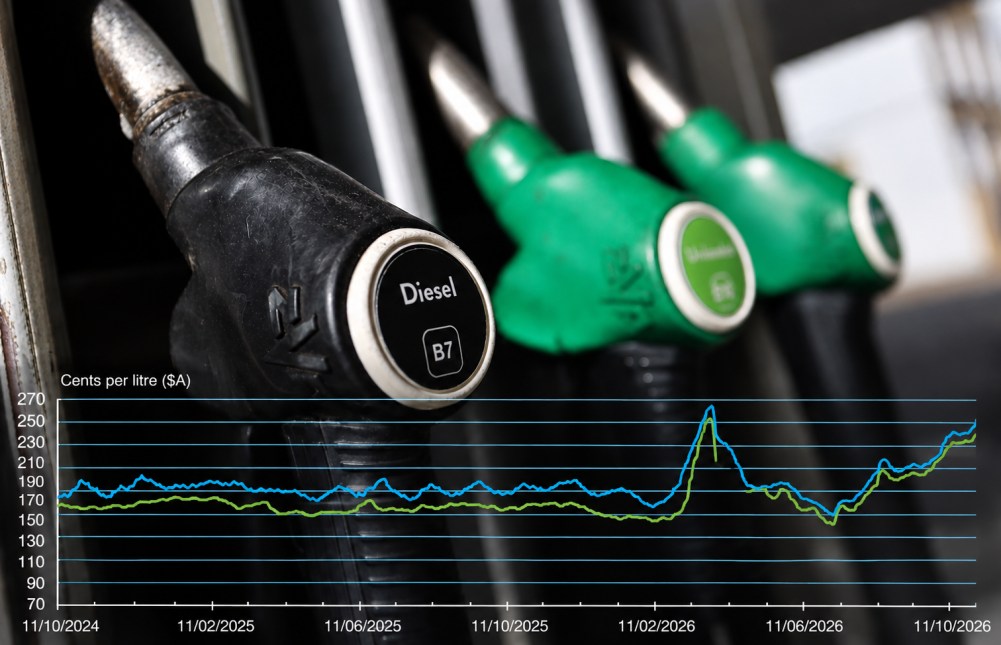
- The average national retail price of petrol in Australia has topped $2.40 a litre as global conflict continues to push oil prices higher.
- Petrol prices were last this high nationally in early April 2026, a month after the outbreak of the Iran war.
- As a net fuel importer, Australia’s motorists are vulnerable to geopolitical shocks.
Australia’s national retail petrol price has topped $2.40 per litre for the first time in more than six months.
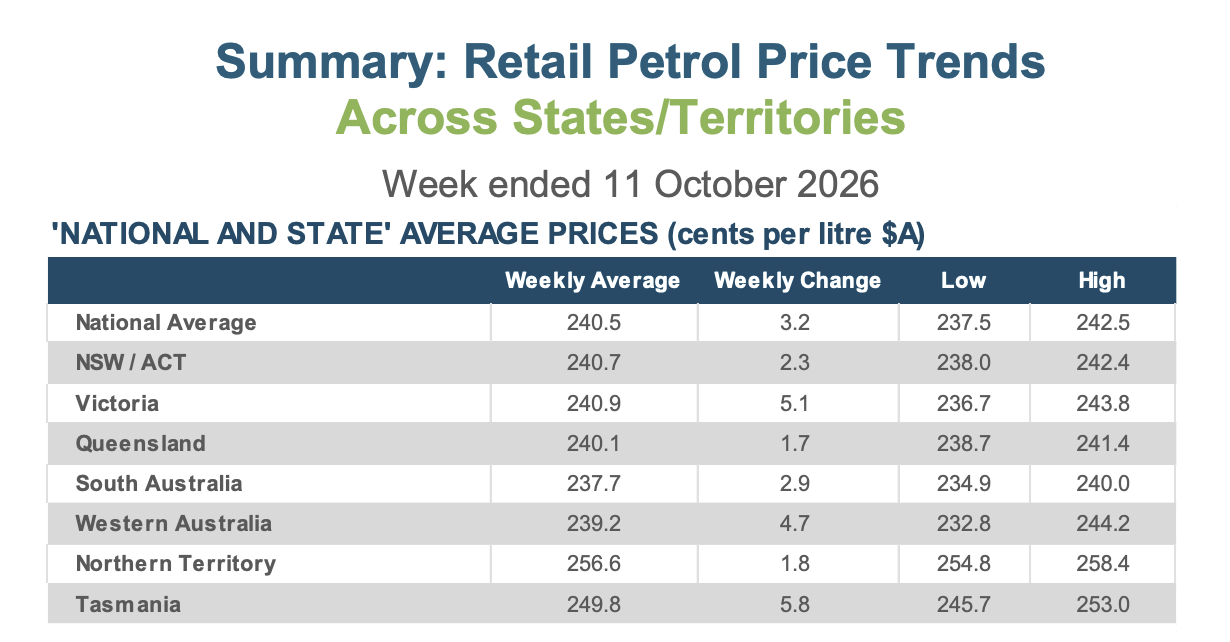
New data from the Australian Institute of Petroleum (AIP) shows that in the week to October 11, the average retail petrol price rose to $240.5 cents per litre.
Average petrol prices across Australia last exceeded $2.40 a litre on April 5, about a month after the conflict involving the US, Israel and Iran began.
For diesel, which relies more on oil prices, the average retail price rose to $2.83 cents per litre nationally.
It comes as oil prices continue to tick higher.
US President Donald Trump has pledged not to attack Iran before the US midterm elections in November, which may give markets some breathing room. But that could also prolong the pain currently hitting the global oil supply.
It’s not just about the Middle East, either.
Overnight Russia struck six Ukrainian energy facilities, despite Trump declaring publicly that an energy ceasefire had taken effect immediately.
“Oil’s early ceasefire discount did not last. Brent briefly fell by roughly 2 per cent towards $US102 per barrel after the ceasefire announcement, before reversing sharply to $US106.86, up 2.04 per cent over the session; WTI rose 2.14 per cent to $US93.82,” writes NAB Senior FX Strategist Rodrigo Catril.
“The failed de-escalation narrative was compounded by Middle East shipping risks and temporary US supply disruption.
“Hurricane Isaias had shut in around 30 per cent of Gulf of Mexico crude production, or about 604,000 barrels a day, as of Monday.”
I’m in Australia – why do these wars thousands of kilometres away impact me?
It feels cruel that events happening on the other side of the world are hitting Australian motorists, but there’s a very simple reason: Around 80 to 90 per cent of Australia’s refined fuel is imported from overseas.
That means retailers here, like your local station, are subject to the price they can buy the fuel at, known as the wholesale price.
As businesses, once they buy the fuel, they need to add their operating costs, wages for employees, pump maintenance, energy costs and their own profit margin.
Most of Australia’s refined fuel is imported from Asia, with Singapore, South Korea and Malaysia the primary suppliers.
Importing from Asia has lower transport and logistical costs than shipping litres of diesel from the US or the Middle East.
If Australia gets its fuel from Asia, then why are local prices hit by events in the Middle East?
Good question. Unavoidably, the global economy runs on oil supply and demand.
Once refined into fuel, oil is the benchmark against which many countries produce the goods and services they need to keep their economies running.
From mining to farming to keeping the lights on at AI data centres, fuel costs directly affect every corner of the global economy.
If one geographic area is squeezed, such as Iran, it upsets the delicate balance of supply and demand.

I don’t even drive a car. How does this affect me?
It’s not just motorists who suffer when fuel prices are displayed at the bowser; their hip-pocket pain is more tangible and immediate.
Think about all the sectors that rely on fuel.
Australia’s major supermarkets need to drive fresh produce all over the country using diesel-powered trucks. Airlines need to ferry commuters and workers across the country.
Clothing manufacturers need to ship their products to stores, and those stores need to pay the energy bill to keep their lights on.
Higher fuel costs can ripple through the economy, and while the effects may be delayed compared with filling up a diesel tank, they can contribute to price inflation across a wide range of products over the long term.
Topics: Consumer, money, Petrol Prices