Yes, it’s the economy, stupid. But One Nation is outflanking the government on messaging, too


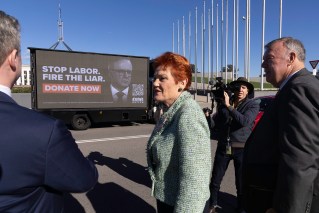
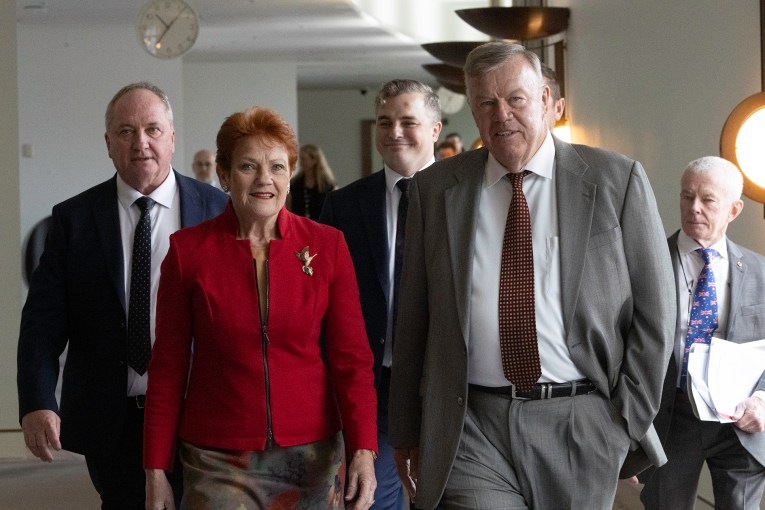
One Nation has plenty to smile about as both major parties struggle to combat its appeal to voters. Photo: Mike Bowers
Labor is no doubt dreading the likelihood of further interest rate rises, despite Treasurer Jim Chalmers talking up the economy.
When One Nation outpolled Labor’s primary vote for the first time back in June, Prime Minister Anthony Albanese responded: “It’s the economy, stupid”.
He argued voters were struggling economically despite working hard. Consequently, “many people feel that the system isn’t working for them”.
Albanese’s overreliance on an economic explanation risks underestimating other factors such as race, ethnicity and gender.
Nonetheless, election studies and opinion polls have indeed shown economic concerns are a major factor driving the increased vote for One Nation.
Two in three One Nation voters say their household finances have worsened over the past few years, while 77 per cent believe a Hanson government would successfully manage the cost-of-living crisis.
With voters in a world of economic pain, what might it mean politically?
The economic pain is real
The economic pain voters are feeling is real. Successive interest rate increases have seen many voters paying tens of thousands of dollars extra in mortgage repayments since Labor was elected in 2022.
The economy might be growing slowly, but living standards are not. Profits are rising but real wages are dropping due to inflation.
The government is being punished as a result. The Coalition is blaming Labor for Australia’s economic woes. One Nation is blaming both major parties.
However, the economy is also being impacted by forces outside any Australian government’s control. For example, Albanese argues “every country is facing” economic problems and inflation as a result of the wars in Ukraine and the Middle East. It should be noted, though, that Australia’s inflation and interest rates are particularly high.
The relatively small growth in the Australian economy that may result in the Reserve Bank increasing interest rates yet again has been driven significantly by private consumers purchasing electric cars in response to the petrol crisis caused by the Middle East war. It has also been driven by private business purchasing equipment for data centres as AI reshapes the international economy.
Any Reserve Bank decision to raise interest rates further to contain inflation based on current economic growth figures is therefore contentious. Ordinary Australians are already constraining their normal spending due to the cost-of-living crisis and lower real wages. Higher interest rates will simply hurt them even more.
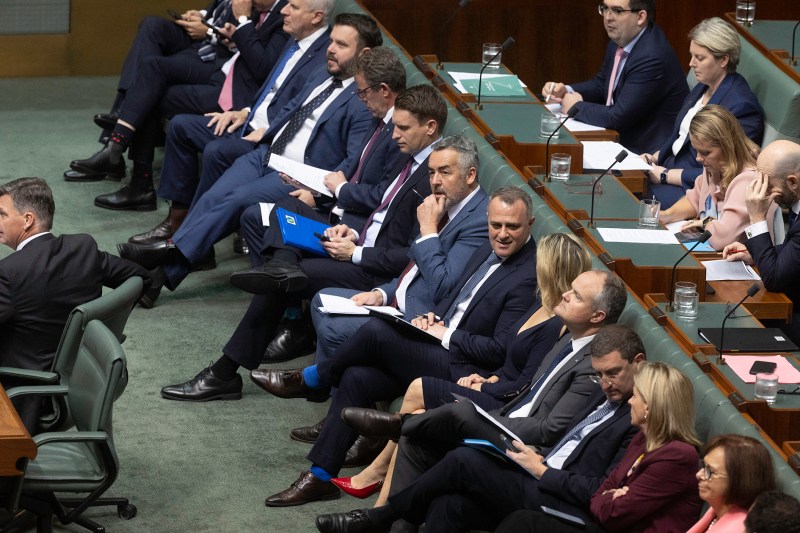
Voters have skirted around the Coalition in a rush to back One Nation. Photo: Mike Bowers
Perceptions matter too
Voters therefore have very real economic concerns. Nonetheless, perceptions also play a role. It’s not just that voters who are hurting can blame governments for some economic factors beyond their control. Voter perceptions of whether the government is listening and trying to address their economic difficulties are important too.
Albanese argues the government is hearing voters’ pain. He cites multiple efforts the government has made to address the cost-of-living crisis. These include wage rises, tax cuts and greater subsidies for health and childcare costs. There are also the controversial tax measures designed to address the housing affordability crisis.
However, such efforts are continually being undercut by inflation and interest rate rises. Furthermore, the government is constrained by the fear the Reserve Bank will raise interest rates even more if funding additional cost-of-living measures increases government debt.
Chalmers has ruled out abandoning the decades-long convention of Reserve Bank independence and using a residual government power to override its interest rate decisions.
Meanwhile, both the Liberals and One Nation have criticised current government debt levels, arguing they have fuelled inflation and therefore high interest rates.
One Nation has also constructed the domestic issue of immigration as an economic one that is contributing to the housing affordability crisis and depressing wages. Similarly, the government’s energy policies, designed to address climate change, are being criticised for increasing power bills.
However, the housing crisis long predates Labor, and climate change critics overlook that increasing power bills are partly driven by fossil fuel industries as well as by the war in Ukraine.
Yet there is also little comfort in all this for the Coalition. Its declining primary vote and electoral losses to One Nation indicate many voters don’t see it as offering a solution either. The anger in sections of the electorate who feel abandoned by the major parties is palpable, along with a transgressive joy in punishing the establishment.
To some extent, the Coalition may be suffering from a problem of its own making. After decades of flirting with a neoliberal populism that criticised Labor by arguing big government was the problem, not the solution, and that politically correct elites were abandoning mainstream Australians, it has now come to be seen as just another self-serving “uniparty” elite itself.
However, Labor faces a particular perception problem that can undermine its efforts to tackle cost-of-living issues.
One Nation is depicting itself as the champion of the workers and Labor’s attempts at discounting that claim are not cutting through. A key reason is that populist arguments by both the Coalition and One Nation have long mimicked class politics.
They have suggested “woke” elites are exploiting workers by ripping off taxpayer funds to support minority groups and issues such as climate change, rather than workers’ exploitation occurring in the labour market.
It is cleverly designed to appeal to workers, reframing debates away from workers versus bosses to workers versus so-called elites. This is also why older-style class-based Labor arguments emphasising wage issues or associating Hanson with wealthy supporters such as Gina Rinehart may not be sufficient.
If Labor is to win back less socially conservative working-class voters it has lost to One Nation, it needs to be more successful at arguing that its equality agendas for groups from women to Indigenous people are not supporting woke elites but disadvantaged Australians who are often members of the diverse working class themselves.
Labor needs to emphasise that its policies are based on equal opportunity and a fair go, given One Nation suggests they discriminate against mainstream groups such as white men.
Similarly, Labor needs to become better at convincing voters that climate change is not a woke elite issue either. After all, workers’ homes in at-risk areas won’t be miraculously immune from increased bushfires. Blue-collar workers and tradies are at risk from work-related heat stroke due to rising temperatures.
The framing of voter perceptions on economic-related issues is therefore crucial. The economy may not be the only explanation for the growth of right-wing populism, but it is an essential part of the perceptual glue that holds various populist narratives together.
For all the above reasons, economic perceptions matter alongside real economic issues. However, so far neither Labor nor the Coalition is cutting through sufficiently to win back the swathes of voters who have abandoned them on economic grounds.
Carol Johnson, Emerita Professor, Department of Politics and International Relations
This article is republished from The Conversation under a Creative Commons licence. Read the original article.
Want to see more stories from The New Daily in your Google search results?
- Click here to set The New Daily as a preferred source.
- Tick the box next to "The New Daily". That's it.
Economy not the only reason for One Nation's rise