A bullet dodged, but Trumpageddon 2.0 could cause mayhem

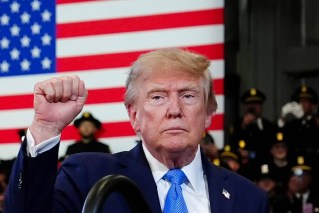
Eleven months ago when Donald Trump won the US presidency, market watchers expected a ‘Trumpageddon’ slump in stock markets.
As it turned out, the President-elect’s acceptance speech made it clear that he had little intention of acting on his most dangerous economic policies.
So instead of dumping stocks, traders started buying, and 11 months on the US stock market has risen by more than 17 per cent. A bullet dodged, you might think.
Well not quite. A growing chorus of investors and central bankers are now saying that the expected asset price slump was not so much dodged, as postponed.
Legendary bond investor Bill Gross warned earlier this week that we’re in an era of “fake markets” in which the price of assets – shares, bonds, property and so on – do not reflect the ‘yield’ those assets produce.
And on Monday, Dutch central bank governor Klass Knot said the state of overvalued asset markets “resembles that of the period before the financial crisis“.
Why all the gloom?
The main driver of all this sudden doomsaying is the US Federal Reserve. As reported recently, after eight years of pumping up markets with its bond-buying programme, it now wants to sell $US4.5 trillion ($A5.7 trillion) in bonds back into global markets.
As it does so, some of the artificial inflation of asset markets should reverse, and global borrowing rates should rise.
Economists are divided on whether such an unprecedented monetary trick can be pulled off without crashing markets or choking the real economy.
In theory it looks possible, but in practice it’s being attempted against two unfavourable backdrops.
One is the floundering Trump administration, which is increasingly being seen as “failing to govern”, even by prominent Republicans.
Another is is the threat to global trade and markets of the debt-soaked Chinese economy (and let’s not even think about North Korea).
That’s what is making pundits of the calibre of Mr Gross or Mr Knot nervous – the feel-good factor that averted Trumpageddon 1.0 would be unlikely to save global markets from version 2.0.
Doubts remain
Making hard-and-fast forecasts of a stock market crash is a mug’s game, but even a mug can see that the super-low returns in many asset markets don’t make sense.
Whether the prices of those assets fall into line with the yields they pay quickly or gradually is the key question.
History teaches us that rapid price corrections have a momentum all of their own – large intra-day falls in share markets, for instance, create a sense of panic that ends up pushing share prices well below their intrinsic values.
That usually creates a buying opportunity for contrarian investors who are sitting on piles of cash waiting for shares, property or whatever to tumble in price.
But what does it mean for everyday Australians who don’t consider themselves active investors at all?
Thinking back to the market carnage of 2009, it means hard-working Aussies ripping open their superannuation statements and staring at big holes in their retirement savings.
It would not end there, however.
The Federal Reserve’s actions have helped finance businesses around the world very cheaply.
As cheap finance becomes harder to come by, global interest rates are expected to rise.
And as US dollars head for home in a ‘flight to safety’, currencies such as the Aussie dollar would fall against the greenback.
The short version, then, is that asset-rich Australians would lose a chunk of wealth via asset deflation; higher borrowing costs would hit businesses and mortgage holders; and ‘imported inflation’ would start to erode real wages.
But that list of troubles is getting a bit ahead of things.
Markets were confounded when Trumpageddon 1.0 didn’t happen, and so the current fears of economists and investment gurus may also prove to be overdone.
But even if they are, everyday Aussies will be forgiven for feeling that central banks and the big end of town are playing a dangerous game that could smash their personal wealth and throw their work lives into chaos.
The great irony is that it was exactly that kind of feeling that burned in the bellies of voters who elected Mr Trump in the first place.
Maybe he wasn’t the answer they were looking for after all.
Not just the economy, stupid – everything else too
Listen, deliver, rebuild trust to quiet the populist right