Those free-market doomsayers were wrong, so wrong, about Arrium

The securing of a buyer for Whyalla-headquartered steel manufacturer Arrium is a victory for pragmatic thinkers who are trying to reshape the Australian economy for the 21st century.
Or, if you prefer, it’s a slap in the face for ideologues who’ve wasted the past few years chanting childish free-market rubbish, while standing back and watching Australian jobs and industries implode.
Just a year ago, deposed PM Tony Abbott had this to say to broadcaster Steve Price about the South Australian steel-maker: “In the end what you can’t do is prop up a loss-making business – you just can’t … Pretty soon you don’t have a market economy. You’ve got essentially a statist economy, where the taxpayer ends up covering for commercial mistakes.”
That’s the same kind of thinking that let Australian auto-manufacturing shift abroad just as the long-spell of a sky-high Aussie dollar was coming to an end.
Thank goodness the Turnbull government, and the South Australian Weatherill government have had the vision to see through the ‘free’ market nonsense.
In reality, the market for Australian steel was decimated by a high dollar, which was caused by the ‘statist’ decisions of the Chinese Communist Party.
Their massive stimulus spending from 2009 onwards made our miners rich, and inflicted what’s known as ‘Dutch disease’ on the rest of the economy.
That was made worse by China’s habit of dumping its own surplus steel in Australia and on our near neighbours – technically against World Trade Organisation rules, but a practice that takes a long time to stamp out.
Long-term thinking
The Turnbull government, the Weatherill government, and even the GFG consortium itself have seen the Whyalla steel mills’ potential more clearly.
Until the GFG deal was announced on Wednesday, the most likely buyer of Arrium was thought to be a Korean consortium headed up by Newlake Alliance.
As part of its bid, the state and federal governments were working on a subsidy of around $400 million to keep the existing steel works running while more high-tech facilities were built.
The subsidy amount is now lower. GFG is expected to get about $50 million from each of the state and federal governments, though its business model will benefit far more from other government initiatives.
For one, the government’s ramp up in infrastructure, including the Melbourne-to-Brisbane inland rail line, will boost demand for Arrium’s products.
If a Labor government is elected in Canberra, the ALP is promising to boost local-content rules for all public works, another potential boost for local steel.
But there is one other way the state and federal governments are likely to boost Arrium’s profits under its new ownership – through their policies on renewable power.
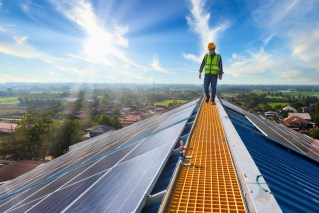
At the federal level, if the Turnbull government can stop its infighting and forge ahead with the Finkel report’s recommendations on clean energy, it will lower power costs and hand more competitive advantage to Arrium.
At a state level, South Australia is generating huge quantities of very cheap renewable power, something the GFG Alliance is already making a good deal of noise about. It’s ‘Greensteel’ initiatives around the world are positioning the group to produce steel with a smaller carbon footprint.
GFG’s spokesperson in Singapore tells me the company plans to buy the often extremely cheap renewable power from the national energy market, and store it in its own pumped hydro-electric scheme – something it has already done in the UK.
So what we are seeing unfold in South Australia is truly joined-up economic thinking.
It will not only secure the 5500 jobs related to Arrium’s operations, but it will demonstrate to the naysayers that businesses, with small encouragement from the public purse, are hunting for opportunities that dovetail with Australia’s future as a ‘clean energy super-power‘.
The Arrium buy-out isn’t about saving an old industry. It’s about creating a new one.
Not just the economy, stupid – everything else too

Listen, deliver, rebuild trust to quiet the populist right