Inside the secret societies of killer whales
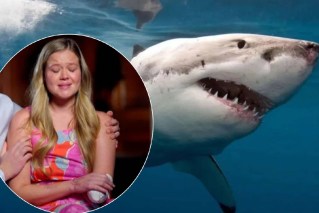
Source: ABC TV
Orcas have dialects, family traditions and strong opinions about dinner. South Australian scientist Dr Isabella Reeves is uncovering how their societies work – and why some are in trouble.
“When people think of predators, they think of sharks,” Reeves says.
“It’s like, well, no – there’s this giant dolphin that’s beautiful and sleek and super smart.”
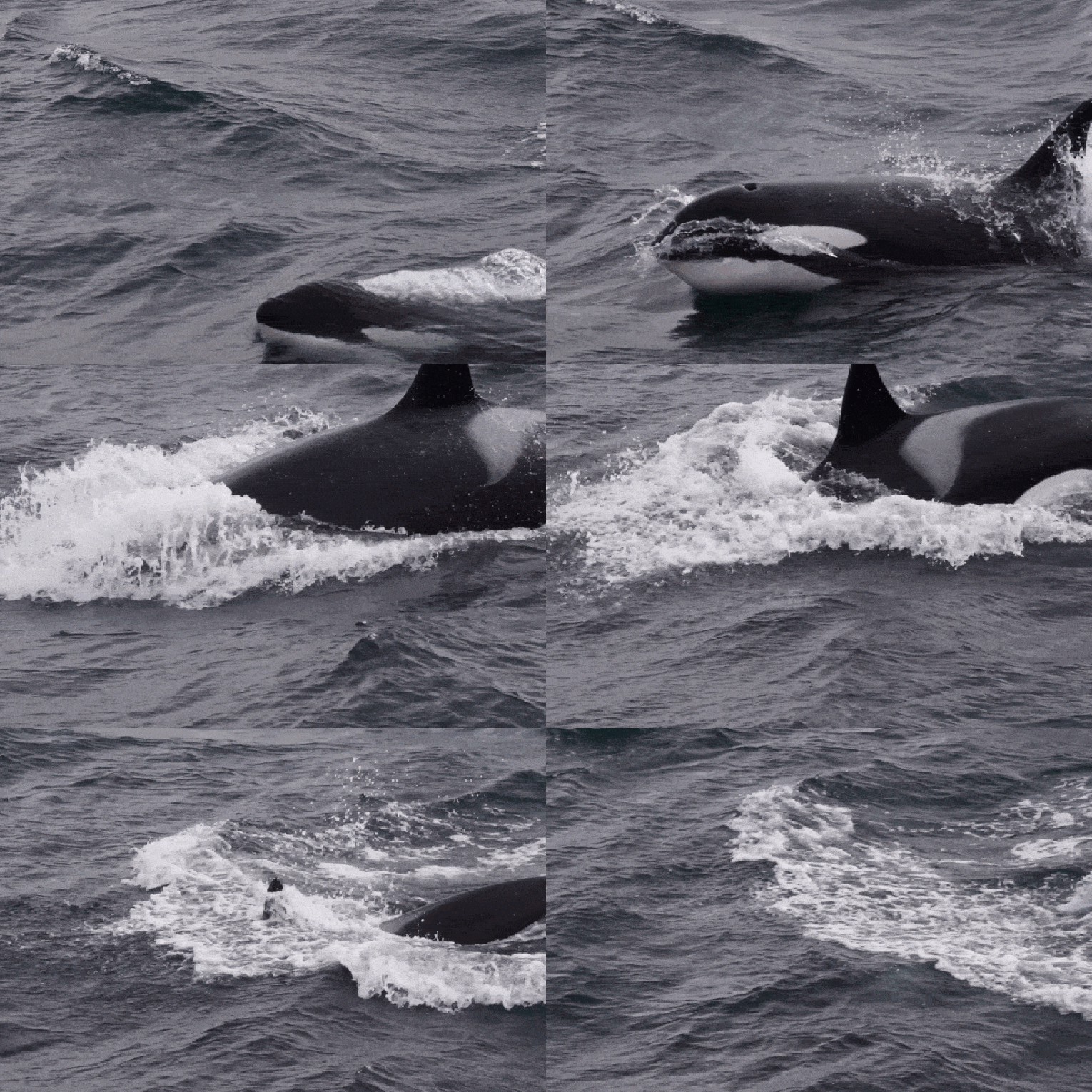
That giant dolphin is the orca. Despite the name “killer whale”, orcas are actually the world’s largest dolphin – and they sit above sharks at the top of the ocean food chain as apex predators.
Orcas have been filmed bringing down a full-grown 20-metre blue whale, working together as a family. They also hunt great white sharks.
“People don’t think they’re that big,” Reeves, who completed her PhD at Flinders University, says. “But when you’re looking down at a seven-metre animal beside the boat, it gives you goosebumps.”
“We’ve dominated the land. They’ve dominated the sea.”
Orcas live in distinct societies around the world, each with its own culture – dialects, family traditions and firm rules about what is acceptable to eat, handed down through generations.
Reeves’ research used genetics, diet, whaling records and First Nations knowledge to work out how Australasian orca societies developed, and why culture could decide which survive. It has made her one of three finalists for PhD Research Excellence in this year’s SA Science Excellence and Innovation Awards.
Meet the family
“Grandmothers run orca societies,” Reeves says. “They teach their offspring, grandchildren and great-grandchildren how to hunt.”
Some females live about as long as humans and spend decades after menopause passing on what they know. The males contribute a little less.
“The boys go out to mate and then come back,” Reeves says. “They’re mama’s boys, so they really never leave their family group, they always return.”
While scientists have to be careful not to anthropomorphise animals, orca families do have some things in common with humans.
“They do value the same sort of principles that we do as a society,” Reeves says.
When a calf dies, mothers have been seen carrying the body on their nose for weeks.
“We can see that they’re empathetic. We can see that they care about their offspring and that they mourn. They’ve got communication and strategy. They’ve got super strong family bonds. They stay together their whole lives … they’re curious,” she says.
Hunts are practised rather than improvised, with a specific role for each family member specific role – and the whole group celebrates afterwards.
“After a successful hunt, they basically have a party … they’re so vocal, as if they are celebrating a touch down,” she says.
Families scale up into societies that keep to themselves. Reeves identified at least three genetically distinct populations in our part of the world: Ningaloo Reef in north-western Australia, Bremer Bay in the south-west and New Zealand.
“Considering how far whales and dolphins can travel, there’s not much geographic distance between them, but they’re genetically isolated, so there’s no ongoing mating,” she says.
Her “high-tech Ancestry.com test” did find that some Bremer animals had Antarctic ancestors within the past few generations. That occasional mixing increased the population’s genetic diversity and may have improved its ability to adapt.
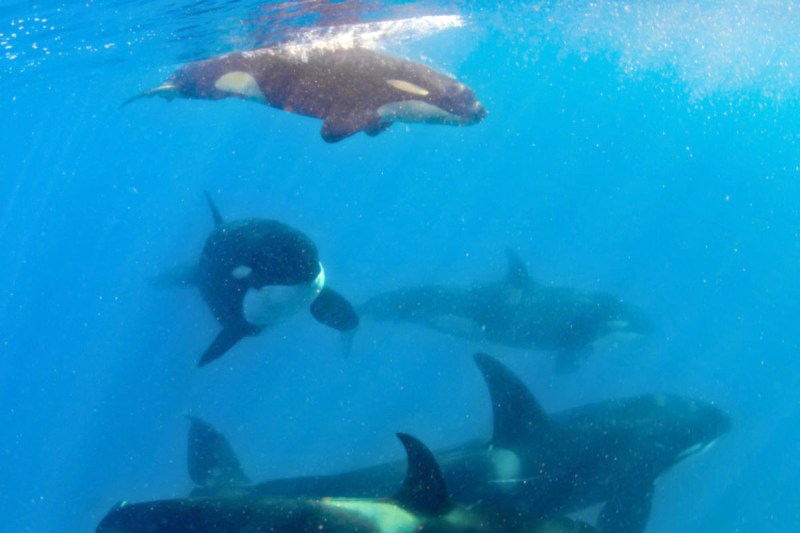
A family of orcas in the Ningaloo Reef. Photo: CETREC
Fine dining, orca style
“What’s acceptable to eat is passed down within cultures,” Reeves says. “They can be picky.”
“They target whale tongues and shark livers, but also brains from swordfish. They even fillet 30-centimetre herring.”
Comparing more than 800 tissue samples from 40 prey species (“gross but worth it”), Reeves found separate populations around the world had independently discovered their own sources of high-fat, low-protein food.
Wild carnivores had generally been assumed to chase calories and nothing else.
“This was the first time we saw a wild carnivore select for something beyond calories,” Reeves says. “They’re definitely the bougiest around.”
She says too much protein would stress an orca’s body, so choosing fat helps them survive – and the knowledge is taught.
Where that fat comes from varies. Some populations specialise in fish or marine mammals. Bremer orcas eat a much wider range of prey, while Ningaloo specialise on a single prey.
“Their culture has been defined by what’s available in those habitats,” Reeves says. “With Bremer, because there’s been so much available, they’ve basically got a smorgasbord all the time.”
“When I show my colleagues pictures, they say, ‘Wow, you’ve got fat whales’.”
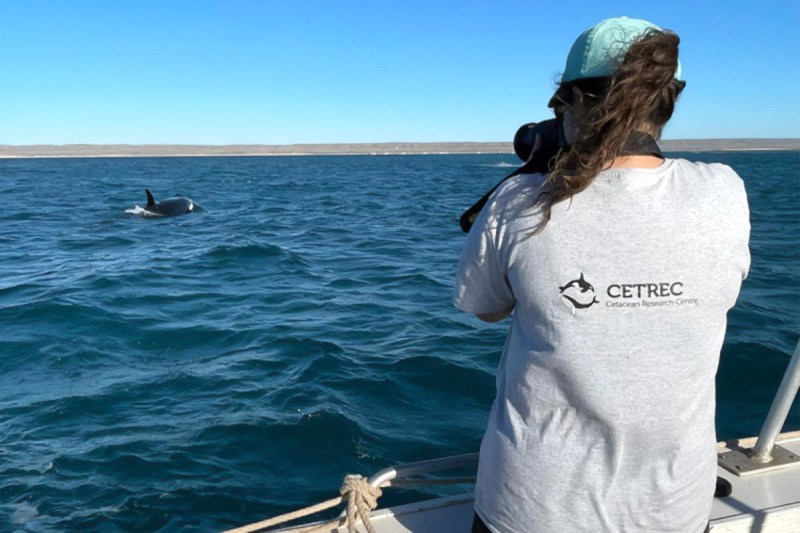
Dr Isabella Reeves at the office. Photo: CETREC
When culture becomes a trap
Globally, orcas are listed as “data deficient”, meaning scientists don’t know enough even to say if the species as a whole is threatened. What they do know is that different orca societies are faring very differently.
Bremer orcas’ varied diet makes them more adaptable to changing oceans. The smaller, more specialised Ningaloo population doesn’t have that range to fall back on.
“They’re declining and could be facing extinction,” Reeves says. “The biggest threat we’re seeing is the loss of prey and how climate change is affecting that prey.”
“They become so picky that they don’t like other food and, in some cases, their bodies can’t even process it.”
That’s why, Reeves says, says each population has to be treated as its own entity, rather than as a sample of one worldwide species.
“They have unique cultural traditions locally. Populations need to be identified and managed separately when it comes to conservation,” she says.
The culture we lost
Orcas don’t attack people in the wild. Young ones have even been seen swimming up to a person with food in their mouth, trying to share.
Once, that instinct went a lot further. In Australian waters near Eden on the NSW south coast, a group of orcas and people hunted whales together until about 1930 – the only recorded example of its kind globally.
“Normally, killer whales don’t need to share and whalers don’t need to share,” Reeves says. “What made this relationship so special is that they couldn’t do it well without each other.”
It began thousands of years ago with the Thaua people of Twofold Bay near Eden. Orcas drove baleen whales into the bay and wore them down. Thaua hunters completed the kill, the orcas got the tongues and the people took the rest. It became known as the Law of the Tongue.
“This was capitalised on by white whalers, but it actually started with First Nations people in that area thousands of years ago,” Reeves says.
During the commercial whaling era, some orcas wore down the whale while others slapped their tails on the water to alert whalers. Only together, could they take on adult whales to kill.
With Thaua Traditional Custodian Uncle Steven Holmes, Reeves helped put that older history back on the record.
She also used ancient DNA techniques on the most famous of the Eden orcas, Old Tom, who even pulled whaling boats towards the hunt by gripping a rope in his teeth.
“His DNA was most similar to New Zealand killer whales, but it still wasn’t a close match,” she says. “Unfortunately, the family line of Old Tom and the Killers of Eden seems to be extinct.
“We lost not only that globally unique connection, but that unique culture as well.”
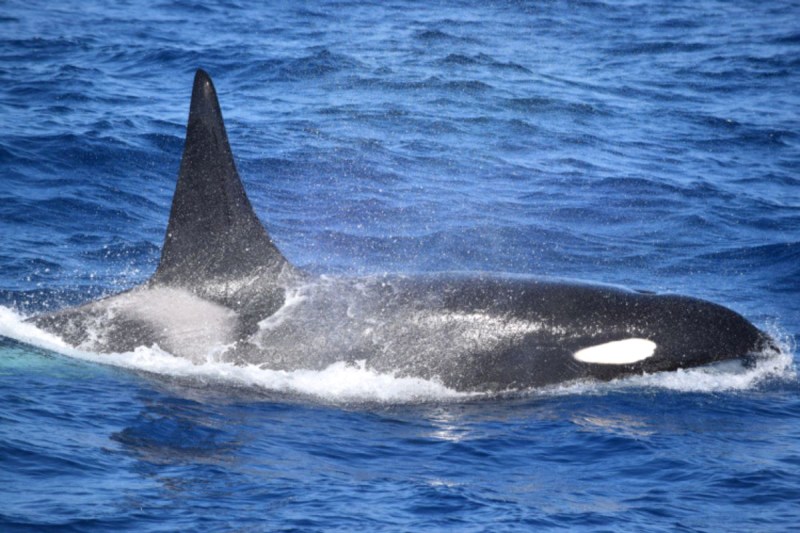
A Bremer orca in the wild. Photo: CETREC
What’s left
One society might be gone, but those that are still here are starting to be understood, thanks to Reeves’ research.
It was done with support from CETREC (the Cetacean Research Centre) in Western Australia and the Southern Shark Ecology Group at Flinders University.
“The Australasian killer whales are changing how we’re seeing killer whales as a whole,” she says.
Reeves, who has studied orcas for more than a decade, says her work can be slow – but she wouldn’t change a thing.
“We can be out there for weeks on the boat and not see them, and then we can lose a sample to a seagull,” she says.
“My life follows whale migrations, because that’s what the killer whales eat. My entire life is planned around it.
“When I finished school, I didn’t think it was possible to work on killer whales in Australia. Who would have done that? Turns out it’s me.
“This isn’t just something I just do anymore; it’s a core part of who I’ve become ”
Learn more about Isabella’s research and Australia’s orcas in Killer Whale: Australia’s Megapod on ABC iview.
Republished from The Post SA
Want to see more stories from The New Daily in your Google search results?
- Click here to set The New Daily as a preferred source.
- Tick the box next to "The New Daily". That's it.