Octopuses’ incredible escape artist tricks caught on camera

Source: The Company of Biologists
Octopuses have been having a moment since Netflix’s Oscar-winning documentary My Octopus Teacher became a viral hit.
Based around the unusual friendship between a filmmaker and an octopus living in a South African kelp forest, the film fuelled viewers’ fascination with these eight-armed “monsters of the deep” renowned for their high IQ.
Since then, our collective obsession has spawned both further research and more film projects, including the 2025 doco Octopus!, narrated by Fleabag’s Phoebe Waller-Bridge, and this year’s Netflix film Remarkably Bright Creatures, starring Sally Field and based on a 2022 novel of the same name.
“They are so sexy for people at the moment,” one expert notes in Octopus!, while another comments that the alien-like creatures are “very charismatic, even though they’re very ugly”.
Beauty, of course, is in the eye of the beholder. But along with its smarts and remarkable camouflage abilities, one of the octopus’s other intriguing features is its ability as an escapologist.
“Octopuses can change their body shape to squeeze through tiny holes, almost like water flowing through a gap, so their size doesn’t always limit where they can go,” says Wenci Xin, a researcher at the National University of Singapore’s Soft Robotics Lab.
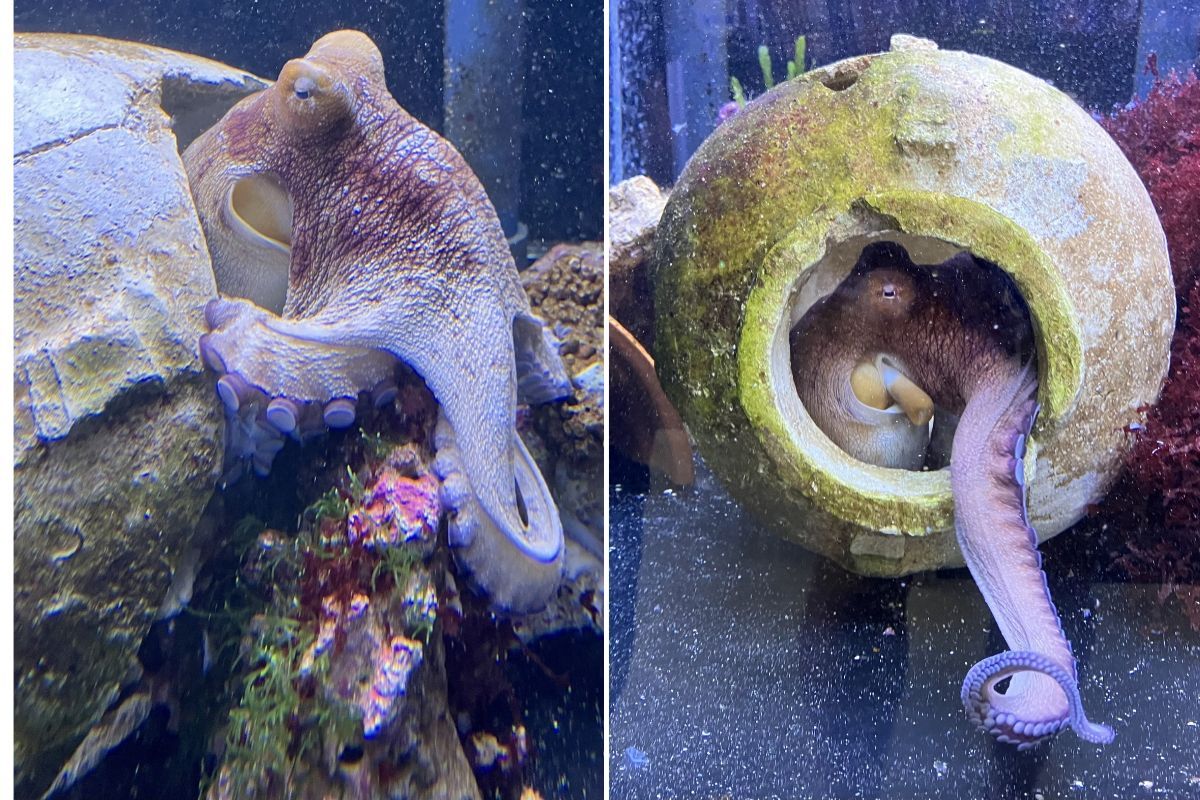
A octopus can squeeze into tiny spaces. Photos: Michael Kuba
Xin is one of an international team of scientists who have this week released the results of a study exploring just how octopuses manage to manoeuvre through gaps much smaller than their mantles (the large bulbous structure behind the head containing all its vital organs).
They say the findings can not only help us to understand the animal’s evolving intelligence, but might also inspire a new era in the design of search and rescue robots.
For their research, published in the Journal of Experimental Biology, the team used two different types of octopus: Young common octopuses (Octopus vulgaris) and Mayan octopuses (Octopus maya).
They designed individual plastic boxes with different-sized holes for the animals to escape through, and discovered that they used different techniques depending on the size of the space.
“When the hole was relatively spacious, each octopus first explored the hole with its arms before popping one through – usually one of the two front left arms – and then threaded up to five of the remaining arms through after,” the researchers said.
“Then, the octopuses reached back with two of the arms that had already passed through, adhering to the partition with their suckers before stiffening and extending the arms to push on the partition and pull the remaining arms, head and mantle through.”
When confronted with a smaller hole, the common octopuses broke the final manoeuvre into two stages, pulling the remaining arms through the space before then squeezing their heads and mantles and dragging them through.
Given that octopuses have a soft, flexible body and a total of nine brains, we should perhaps not be surprised by the impressive feats of contortion displayed in videos capturing the experiments. However, it is their use of alternative strategies that has especially buoyed the scientists.
“At the beginning, we expected the animals to use the same strategy … We were surprised when we found that the strategy changed,” Xin said.
He wants to take the lessons the researchers have learned and use them in soft-bodied robots – machines made from flexible materials such as silicone and rubber, which are used for things like searching ruins in disaster zones and exploring the ocean.
The world’s first soft-bodied robot, built by a team of scientists at Harvard University in 2016, was inspired by an octopus and dubbed the “octobot”.
However, one issue with the so-called “squishy” search and rescue robots, according to Xin, is that they have “slender, snake-like bodies” to help them move through narrow gaps or bottlenecks. That limits the number of sensors and manipulators that can be packed into the robots, thereby reducing their adaptability during challenging missions.
This is where the research may offer fresh insights for future design developments.
“As octopuses continue to inspire advances in soft robotics, a deeper understanding of their squeezing strategies offers valuable principles for designing soft-bodied robots capable of exploiting embodied intelligence to navigate and overcome physical limitations in complex environments,” the researchers conclude.