Cancer breakthrough offers hope but time is running out

Dee Ozolins with husband Greg. She says new treatments have given her her life back. Photo: AAP
Danielle Ozolins and her husband sometimes wish everyone could appreciate life’s simplest pleasures the way they do, without enduring the heartbreak that taught them.
The Sydney mother of two has survived major surgery, gruelling chemotherapy and a terminal pancreatic cancer diagnosis that left her with nine to 12 months to live.
Yet rather than dwell on what she has lost, the 50-year-old is grateful for what she still has.
An experimental treatment has given her another year, allowing her to celebrate family milestones she feared she would miss.
Every morning, Ozolins says, is a gift.
But while she has accepted the uncertainty of her future, there is something Ozolins finds much harder to swallow.
A potentially groundbreaking new pancreatic cancer treatment is emerging overseas but Australia’s lengthy drug subsidy process – which takes a median 22 months to get new medicines listed on the Pharmaceutical Benefits Scheme – could leave it beyond her reach.
“We don’t have two years,” Ozolins says.
“You know that drugs are available that could potentially give you a lot more time, but you cannot access them.
“That’s … it’s inhumane.”
For decades, pancreatic cancer – known as “the silent killer” – has been among the deadliest common cancers, with few treatment advances and a five-year survival rate of just 14 per cent.
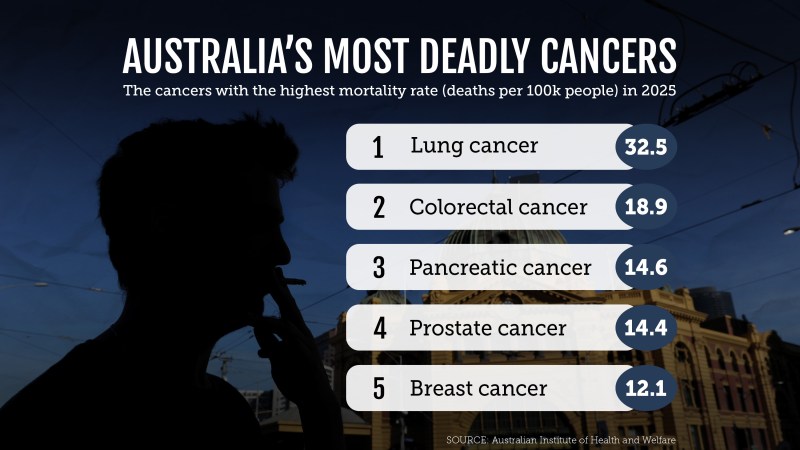
The top five cancers in Australia with the highest mortality rate. Image: AAP
Almost two-thirds of Australians diagnosed with the disease die within 12 months. Only 22 per cent survive two years.
But a promising new class of drugs has raised hopes of significantly extending patients’ lives.
The breakthrough has generated extraordinary excitement among researchers, with more than 80 companies developing treatments targeting the RAS pathway, a system of signals that tells cells when to grow and divide but, when faulty, can drive cancer growth.
Pankind Pancreatic Cancer Australia chief executive Michelle Stewart says the situation is particularly cruel for people with pancreatic cancer, where treatment options have barely changed in three decades.
“If the first stages of treatment don’t work, there’s not a lot left to try,” Stewart says.
“The cupboard is kind of bare there in pancreatic cancer.”
She describes the emerging treatment as the beginning of a new era, although it is not yet a cure.
For patients facing a terminal diagnosis, even a few extra months could mean surviving long enough to benefit from another treatment.
But the new drug has not yet been submitted for Australian approval, and Stewart fears the existing system will not move quickly enough when it arrives.
“It’s the best of times and the worst of times,” she says.
Medical oncologist Michael Lee says early trial results suggest the emerging treatment could substantially extend survival compared with conventional chemotherapy, while offering patients a better quality of life.
Unlike chemotherapy, which can leave patients debilitated by severe side effects, the approach could allow them to spend their remaining time feeling considerably better.
But its anticipated price tag, potentially exceeding $400,000 per patient, presents another challenge.
Lee points to melanoma, the outlook for which has been transformed by immunotherapy, costing the government about half a billion dollars annually.
A decade ago, patients with metastatic melanoma often died within a year.
Today, Lee says, more than half can survive 10 years with modern treatments.
The economic case for such investment is easier to make when treatments can produce long-term survival or even cures. Pancreatic cancer treatments, by comparison, might extend survival by months rather than years.
“The healthcare dollars do only stretch so far … [the government] has to cut the line somewhere,” Lee says.
“Unfortunately for pancreatic cancer, it lands on the wrong side of the fence.”
Yet those additional months can mean everything to patients and their families.
For Ozolins, a clinical trial offered the only alternative when chemotherapy failed.
She had undergone a Whipple procedure, a complex operation to remove part of her pancreas and surrounding organs, followed by seven months of chemotherapy. Her first scan after treatment revealed the cancer had spread to her lungs.
Fortunately, early genomic testing had identified her tumour’s genetic characteristics, allowing doctors to find an experimental treatment for which she was eligible.
At the time, Ozolins would have considered another month or two an extraordinary gift. Instead, her cancer has remained stable and she has gained another year.
She remembers weighing just 35 kilograms and being unable to get off the lounge or participate in family life.
“It’s given me my life back, these new types of treatments,” she says.
Ozolins’ experience is not evidence that the emerging drug being championed by Pankind works, but it shows what access to experimental treatments can mean.
Pankind wants the federal government to implement a recommendation from its 2024 Health Technology Assessment Review that could accelerate PBS access to promising treatments that address urgent unmet clinical needs.
The charity says reforms could bring medicines to patients more than a year sooner. It is urging Australians to contact their federal MPs to demand action.
But pancreatic cancer faces another cruel disadvantage in the competition for research funding and political attention.
Survivors of breast, prostate and other cancers can spend decades campaigning for better treatments, raising money and building powerful advocacy networks.
Pancreatic cancer patients often do not live long enough to do the same.
“For our pancreatic folks, they may not be here in a year’s time, and you’re asking your loved one to keep opening their wound and just to advocate for other people,” Lee says.
“There’s only so much goodwill one is able to sustain.”
It is a vicious cycle: Poor survival means fewer advocates, less attention and fewer resources to drive the breakthroughs that could improve survival.
Details of government responses to the Pankind campaign have been sought.
Ozolins is, meanwhile, determined to be one of those voices while she can. For her, the urgency is brutally simple:
“We die waiting,” she says.
-AAP