Ask the Expert: How early we retire can often depend on the lifestyle we’re planning for


The longer you work and the more you contribute to super, the higher your retirement income is likely to be. Photo: Pexels
A note to readers: I will shortly leave Industry Fund Services and, sadly, this is my final column.
It’s been a pleasure writing for The New Daily over the past five years, and I am grateful to the team for the opportunity to connect with readers on issues that matter to everyday Australians.
Your questions have provided valuable insight into the financial issues that matter most to Australians, and it has been a privilege to help address them.
Thank you to everyone who has taken the time to share both positive and constructive feedback along the way. I wish you all the very best with your financial journey.
While I am leaving, Ask the Expert will continue and remain in safe hands, with my IFS colleagues continuing to answer your questions each week.
all the best,
Craig
Question 1
I’m nearly 60 years old, earn $85,000 a year and have $500,000 in superannuation. I owe $190,000 on my house and want to know if I have enough cash to go part time when I turn 60 in 18 months.
Thanks, Clare
Hi Clare,
This really depends on the lifestyle you want in retirement.
Generally, the longer you work and the more you contribute to super, the higher your retirement income is likely to be.
That said, if you are comfortable living on a more modest income, you may still be able to move to part-time work at 60 as planned.
You could supplement your part-time income with super payments through a transition-to-retirement income stream. Once you turn 65 or retire, if that happens earlier, you can access all of your super and may choose to use some of it to pay down your mortgage.
From age 67, you may also be eligible for some Age Pension support.
Before deciding, try Moneysmart’s retirement calculators and also check whether your super fund offers similar tools. Test different salary levels and retirement dates to estimate your likely income and see whether you are on track for the lifestyle you want.
Many super funds also offer retirement health checks that can run the numbers for you, so it is worth contacting your fund to see what support is available.
Question 2
If you are over 65 and still working, and want to place all your wage into super, do you pay tax on the wage and then pay a net amount to super before?
Regardless of your age, income tax and super contributions tax generally work in the same way.
If your salary is paid to you as wages into your bank account, you pay income tax on that amount.
If you salary sacrifice part of your pre-tax salary into super, your super fund pays contributions tax on that amount.
There are also limits on how much you can contribute to super each financial year. Pre-tax contributions are called concessional contributions. The current cap is $32,500, although it may be higher if you are eligible to use carry-forward provisions.
Current income tax rates are shown below:
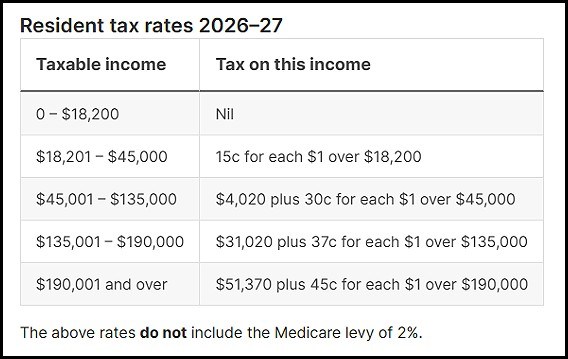
Source: ATO
Contributions tax is generally applied at 15 per cent, with some exceptions.
High-income earners with income above $250,000 may pay additional contributions tax, known as Division 293 tax, of up to a further 15 per cent.
Lower-income earners may receive a refund of some or all contributions tax paid through the Low Income Super Tax Offset (LISTO). To qualify, your income must be below $37,000. This threshold increases to $45,000 from 2027-28.
For example, if you earn $70,000 and make no salary sacrifice contributions, you would pay income tax and Medicare levy of $12,920.
If you instead salary sacrificed $20,000 into super, your income tax and Medicare levy would fall to $6270. Your super fund would pay $3000 in contributions tax, bringing total tax paid to $9270.
This represents an annual net tax saving of $3650 ($12,920-$9270). As you are 65, your super is accessible, so there is no significant downside.
Question 3
My wife and I are planning to retire this year. We are both 62 and each have $500,000 in super. We also have two investment units with a total value of $1 million, which we plan to sell separately over the next five years and use the bring-forward provisions to put the money into super.
What do we need to know to do this in a way to minimise tax? I’m concerned if there is any impact after turning 67. For example, does it cancel the bring-forward provisions?
I look forward to your information every week.
You can generally use the bring-forward rule as long as you are under age 75 at some point during the financial year.
If you use the full bring-forward amount, you generally cannot make further after-tax, or non-concessional, contributions for three years.
For example, if you contributed $390,000 in 2026-27, your next contribution would not be available until 2029-30. This means the timing of your contributions is important.
Based on your balance, it appears you are well below the threshold for making non-concessional contributions, as shown in the table below.
As you are approaching retirement, selling investments and looking to maximise super contributions, it would be worth considering professional personal advice.
Craig Sankey is a licensed financial adviser and head of Technical Services and Advice Enablement at Industry Fund Services.
Disclaimer: The responses provided are general in nature, and while they are prompted by the questions asked, they have been prepared without taking into consideration all your objectives, financial situation or needs.
Before relying on any of the information, please ensure that you consider the appropriateness of the information for your objectives, financial situation or needs. To the extent that it is permitted by law, no responsibility for errors or omissions is accepted by IFS and its representatives.
Want to see more stories from The New Daily in your Google search results?
- Click here to set The New Daily as a preferred source.
- Tick the box next to "The New Daily". That's it.