 Subscribe

Who gets hit first as the Australian economy slows?
Higher interest rates are putting pressure on Australia's jobs market, but some workers and industries could feel the effects well before others.

- Australia’s unemployment rate has climbed to 4.7%, with CommBank forecasting a further rise to 5.1% by the end of 2027.
- Casual and part-time workers, younger Australians and employees in retail, hospitality and construction could be among the first to feel the squeeze.
- Businesses may cut working hours and freeze recruitment before making staff redundant, while AI could further reduce vacancies in some industries.
It may sound counterintuitive.
But to get Australia’s resurgent inflation under control and return the economy to a sustainable growth path, unemployment levels will likely need to rise further.
And while a slowing economy will affect workers across the country, some industries and employees could feel the impact well before others.
“The labour market will need to ease further to bring overall demand and supply back into balance and inflation sustainably back to target,” Reserve Bank of Australia (RBA) governor Michele Bullock said at a press conference on 3 November.
The RBA board noted that the unemployment rate has already increased and is forecast to rise from current levels. Total employment is still expected to increase, spurred by population growth.
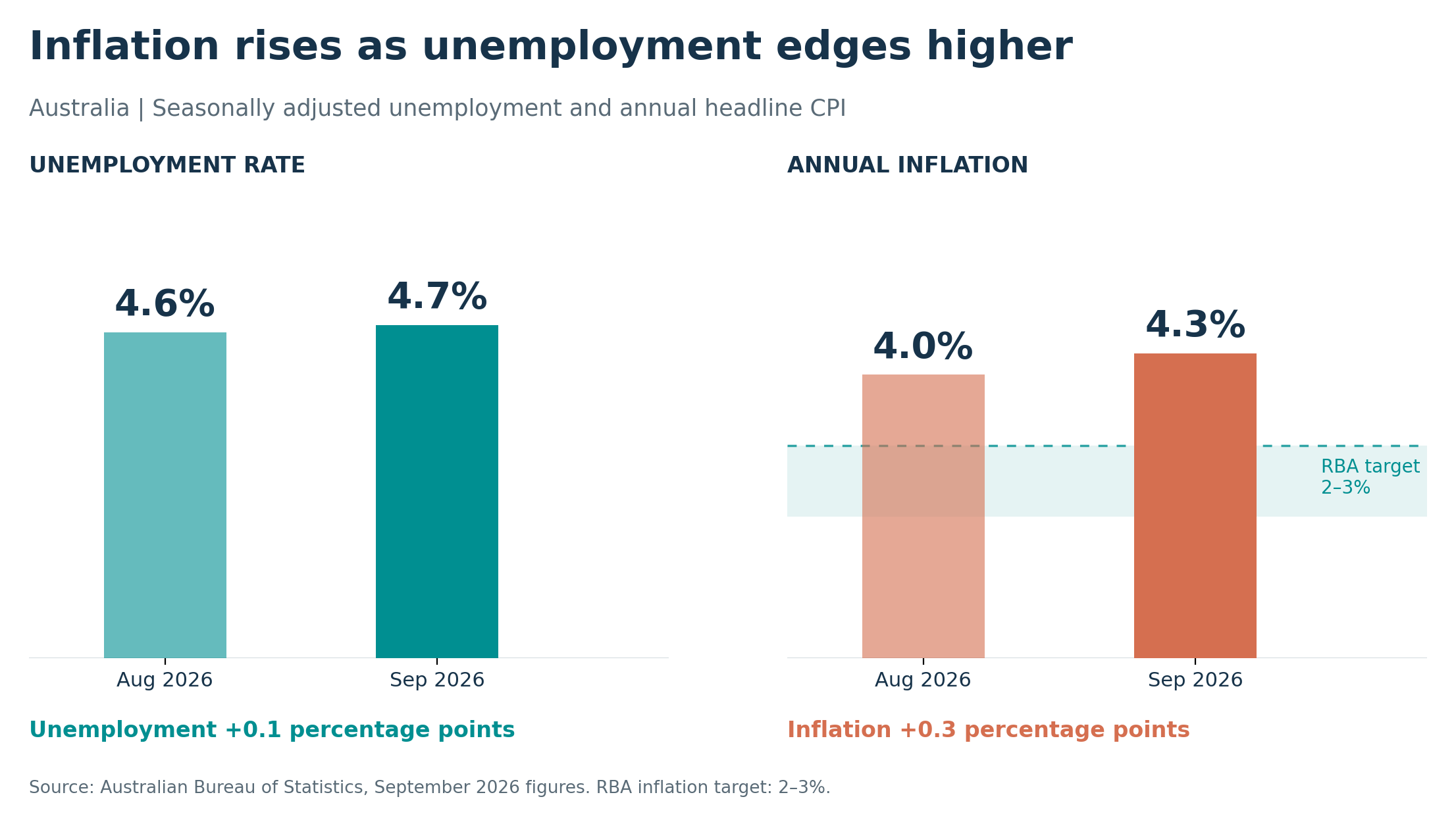
That won’t be good news for job seekers, with the Australian Bureau of Statistics (ABS) revealing that national unemployment ticked up 0.1 percentage points in September to 4.7%.
The number of unemployed Australians jumped 8.2% year on year to 732,000, up 55,200.
In seasonally adjusted terms, this marks the highest unemployment rate in the post-pandemic years. But that uptick has yet to reverse stubbornly rising inflation.
On 28 October, the ABS reported that the Consumer Price Index (CPI) increased by 4.3% in the 12 months to September 2026. That’s up from the 4.0% rise in headline inflation reported for the 12 months to August. And it’s well above the RBA’s 2% to 3% target range.
The RBA noted this is partly being driven by higher fuel prices.
However, the central bank added that domestic price and cost pressures are adding fuel to the fire, with inflation not expected to return to the midpoint of its target range until mid-2028.
So, what does this mean for Aussie workers?
First, it’s important to understand the delayed impact rising interest rates have on the economy and the jobs market.
“It can take 12 months or so, or maybe a bit longer for the full effects of it to flow through,” Bullock said.
Including its 3 November hike, the RBA has now lifted interest rates five times in 2026. At 4.85%, that’s the highest official cash rate in 18 years.
Yet the impacts of those rate increases on the economy and labour demand won’t be fully realised for months yet.
Reading the tea leaves, CommBank economists now expect Australia’s unemployment rate to peak at 5.1% by the end of 2027. CBA then forecasts unemployment to ease to 4.9% by the end of 2028.
But rising unemployment doesn’t necessarily begin with widespread job losses.
Businesses facing higher costs and weaker demand can first respond by reducing employee hours, freezing recruitment or deciding not to replace workers who leave.
That means some Australians could find themselves working fewer shifts or struggling to secure a job well before the full effects of the slowdown appear in the national unemployment figures.
Where the jobs slowdown could hit hardest
Which brings us back to our headline question.
With higher interest rates and falling housing prices pressuring consumer spending and dwelling investment, construction and property-related businesses, as well as the retail and hospitality industries, could all face mounting headwinds heading into 2027.
Tradies could see lower demand if rising financing costs and falling property prices weigh on residential building projects and commercial developments.
Developers may delay projects that no longer stack up financially, potentially reducing demand for contractors and workers across the construction industry.
Retail employees and their employers are vulnerable to cuts in household discretionary spending as the nation collectively tightens its belt.
Hospitality businesses could face similar pressures as consumers cut back on dining out and other non-essential expenses.
For workers in these industries, the first signs of a slowdown may not be redundancies, but fewer shifts, shorter working weeks and reduced opportunities for new employment.
Customer service and administrative workers could also face higher unemployment as businesses cut costs to address higher interest rates and potentially lower sales and revenue amid the slowing economy.
Younger and part-time workers face greater risks
Part-time workers appear particularly vulnerable to a slowing economy.
While the latest ABS data showed full-time hours worked increased by 0.4%, part-time hours worked declined by 1.5%.
This suggests that some of the initial pressure on the jobs market may be showing up in part-time employment.
And it could mean casual workers, particularly in retail and hospitality, could face further headwinds in the year ahead.
Unlike full-time employees with regular working arrangements, casual workers can see their income fall as employers reduce shifts to manage weaker demand.
Entry-level jobs and graduate recruitment levels may also be among the first to be hit.

Indeed, youth unemployment (15 to 24-year-olds) increased 0.3 percentage points to 11.1% in September.
Younger Australians looking to enter the workforce could find themselves competing for fewer vacancies as employers put recruitment plans on hold.
And for graduates and other first-time job seekers, a hiring freeze can have much the same immediate effect as a redundancy: fewer opportunities to earn an income.
On the other hand, demand for workers in the healthcare and social assistance sectors is likely to remain resilient despite a slowing economy.
Could AI make the jobs slowdown worse?
Finally, it’s hard to discuss the Aussie jobs market without mentioning artificial intelligence.
The jury is still out on AI’s likely long-term impact on employment levels.
But in the short term, businesses under pressure to cut costs amid high interest and inflation rates may have an added incentive to automate tasks previously done by human workers.
ABS figures released last week revealed that 16% of businesses in information media and telecommunications reported fewer vacancies due to AI, with wholesale trade businesses reporting an 8% reduction and manufacturing businesses reporting a 6% decline in vacancies.
Over the next 12 months, 8% of all businesses expect AI to reduce their job vacancies.
While fewer vacancies don’t necessarily mean existing employees will lose their jobs, they could make it harder for job seekers to find a position.
And with the full impact of the RBA’s interest rate hikes still to flow through the economy, that pressure could intensify in the year ahead.
For workers, the effects of a slowing economy are unlikely to arrive all at once.
Some could lose shifts or working hours, while others may struggle to find employment as businesses hold back on hiring.
Widespread redundancies may come later, if weaker demand persists.
That means the first Aussies to feel the economic slowdown may not be those losing their jobs, but those finding less work available in the first place.