 Subscribe

Banks are quick to lift mortgage rates. But what about your savings?
The latest RBA hike should be welcome news for Australians with money in the bank, but lenders aren't necessarily sharing the windfall equally.

- Major banks are lifting variable mortgage rates by 0.25 percentage points following the RBA’s fifth interest rate hike this year.
- At the previous hike, banks increased bonus savings rates by an average of just 0.20 percentage points, while base rates barely moved.
- Some savings accounts are offering rates above 6 per cent, but deposit requirements, balance caps and other conditions could leave customers earning far less.
Australia’s banks have been quick to pass on the Reserve Bank’s latest interest rate hike to mortgage holders, but savers aren’t necessarily getting the same treatment.
Following the RBA’s September rate hike, banks increased bonus savings rates by an average of just 0.20 percentage points, while base rates barely budged, rising a “measly 0.01 percentage point”, according to Canstar’s data insights director Sally Tindall.
Even savers attracted by advertised rates above 6 per cent could earn considerably less if they fail to meet monthly conditions or exceed balance limits.
The Reserve Bank lifted the cash rate to 4.85 per cent on November 3, its fifth increase this year, taking borrowing costs to an 18-year high.
Shortly after, Westpac announced it would pass on the full rate hike to variable mortgage customers from November 13, with National Australia Bank doing the same. Commonwealth Bank, ANZ and Macquarie have also announced 0.25 percentage point increases.
With the average home loan size of $730,719, the cumulative rate increases since January have left the average borrower paying an additional $538 per month, or $6,460 a year, according to Finder.
How savers fare
If you’ve got money in the bank, higher interest rates should be good news, but don’t assume you’re automatically getting the benefit, Tindall said.
While some banks pass on the full 0.25 percentage-point increase, others are more selective about which accounts get the bump and by how much.
“Banks are also increasingly using other conditions such as balance caps and age restrictions and new customer introductory deals to limit to whom and when they pay out the maximum interest rate,” Tindall said.
“It’s a reminder that even when banks advertise a rate rise, the devil is often in the detail.”
This means how much someone earns in interest each month depends on whether they qualify for their bank’s maximum rate that month and, because interest is calculated daily, how many days are in the month.

Savers with larger balances, for example, can often find they’re getting a much lower interest rate on money sitting above a particular threshold because, after a point, the bank’s appetite to pay a competitive interest rate diminishes.
Sometimes this threshold can be as high as $2 million; other times it can be as low as $10,000, Tindall explained.
“If someone with a $20,000 investment is earning a rate of 6.00 per cent in December, they’ll receive $102 in interest for that month,” Tindall said.
“Someone with $50,000 earning the same rate will pocket $255 a month. This is based on the lump sum and does not factor in any additional deposits.
“The key is making sure you’re actually earning that 6 per cent ongoing rate, rather than just getting a short-lived honeymoon rate or one that comes with a long list of conditions.”
Where the best savings rates are
ING is among the banks offering some of the highest savings rates, while Westpac is offering 6.20 per cent for eligible customers aged 18 to 40 who meet its monthly conditions.
For those who don’t want to jump through monthly hoops, AMP is offering a 5.75 per cent ongoing rate with no monthly conditions to meet from Monday.
However, if you think this account has no strings, think again. Once your balance hits $50,000, anything over that amount earns a lower interest rate.
For savers chasing the highest advertised returns, these conditions can significantly affect how much interest they actually earn.
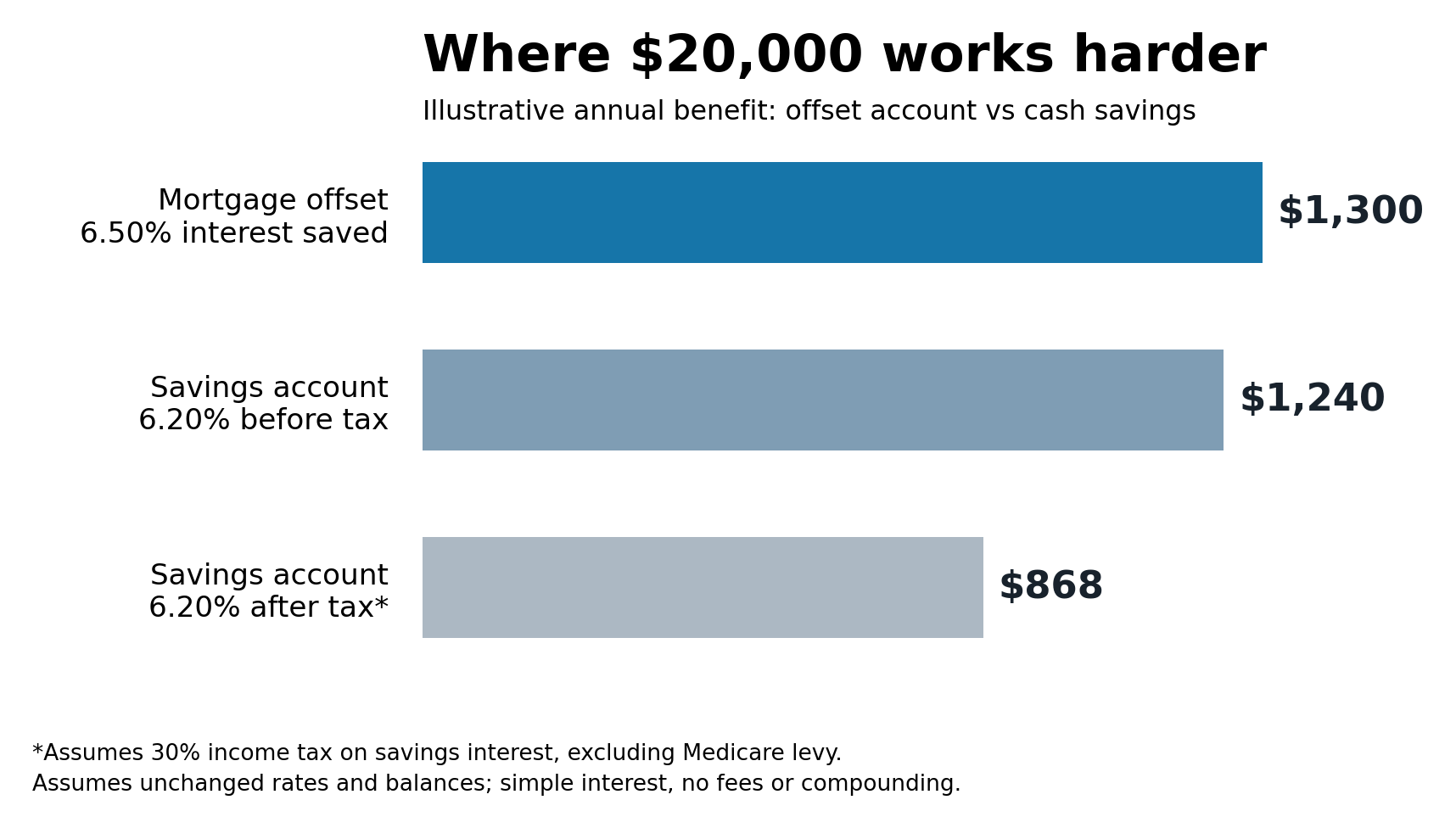
A $20,000 balance earning 6.20 per cent would generate $1,240 in interest over a year, assuming the rate and balance remain unchanged and excluding compounding.
What savers should watch for
For homeowners with a mortgage, putting spare cash into an offset account could deliver a better return than a high-interest savings account.
Money held in an offset account reduces the balance on which mortgage interest is calculated, with the savings effectively matching the home loan’s interest rate.
Unlike interest earned on savings, which is generally taxable income, the interest saved through an offset account on an owner-occupied home is not.
Someone with $20,000 in an offset account linked to a mortgage charging 6.50 per cent could save about $1,300 in interest over a year.
The same $20,000 in a savings account paying 6.20 per cent would earn $1,240 before tax, leaving the mortgage holder potentially hundreds of dollars better off.
Whatever your specific case, some money experts surveyed by Finder believe banks should scrap bonus conditions on savings accounts in favour of a single advertised rate.
Taylor Blackburn, personal finance specialist at Finder, said difficult-to-meet bonus conditions can quietly undo the benefit of higher savings rates.
“Rate hikes are only good news for savers if they actually earn the higher rate, Blackburn said.
Before switching accounts, savers should check whether the advertised rate is ongoing or introductory, whether it applies to their entire balance and what they must do each month to qualify.
It’s also worth checking the base rate, particularly if meeting the bonus conditions every month could prove difficult.
For mortgage holders, comparing the after-tax return on a savings account with the interest saved through an offset account may matter as much as chasing the highest advertised rate.
The information provided on this website is general in nature only and does not constitute personal financial advice. The information has been prepared without taking into account your personal objectives, financial situation or needs. Before acting on any information on this website, you should consider the appropriateness of the information having regard to your objectives, financial situation and needs.
Topics: Banks, Mortgage, Mortgage rates