The Stats Guy: Australians losing the will to fight – this is what it says about our country

Nearly half the country is unsure whether they’d defend the place they call home. Photo: TND/Canva
On my Facebook and X accounts, I share maps and charts that explain how the world works every day.
Today I stumbled across a bit of research that just screamed to be turned into a column. The research measured the willingness of Australians to fight for their country if we were under attack.
Just 52 per cent of Australians said “yes”. The rest either say “no or don’t know”.
That means nearly half the country is unsure whether they’d defend the place they call home.
The figure comes from the latest Lowy Institute Poll (the link includes an interactive tool that allows you to play with the data), which tracks Australians’ attitudes towards defence, democracy, and foreign affairs.
It’s not that most Australians have suddenly turned pacifist or cowardly. Instead, the slow decline in our willingness to “fight for Australia” reveals something deeper about who we’ve become and what we now expect from the nation itself.
The luxury of peace and distance
For most of its history, Australia has lived at a comfortable distance from existential threats.
No tanks have rolled across our borders, no boots have stormed out beaches.
When war feels remote, the idea of taking up arms becomes an abstract thought experiment.
In Europe or East Asia, where the memory of invasion or conflict remains alive, people’s answers to this same question are far more visceral.
In the 2024 Gallup International survey, 96 per cent of Armenians and 85 per cent of Ukrainians said they would fight for their country. For Australians, the number barely scrapes half.
We’ve lived in peace long enough that we’ve forgotten what it means to fear for it.
Generational and cultural change
Younger Australians are the least likely to say they’d fight. Only 31 per cent of people aged 18-29 would fight to defend Australia.
For them, the word “patriotism” doesn’t conjure Anzac marches or national flags. At best, “patriotism” is linked with the idea of civic decency, inclusion, and global co-operation. At worst, “patriotism” is seen by young people as a veiled term for “racism”.
They’ve grown up with multicultural classrooms, global pop culture and a strong sense that humanity’s biggest challenges (climate change, inequality, pandemics) don’t stop at national borders.
Young people wouldn’t describe their worldview as anti-Australian but as post-national. It’s also shaped by the information diet of a digital generation: Endless global crises in the feed, and little faith that governments or institutions can solve them.
When asked to fight for a political system they see as flawed or self-interested, many understandably hesitate.
Migration and belonging
One easy explanation blames multiculturalism: “Australia is too diverse now. People don’t feel the same loyalty.”
Sure, migrants from non-English speaking countries are less likely to show a willingness to defend Australia. Interestingly the share of people saying they wouldn’t defend Australia is lower than it is among Australian-born residents.
Migrants from non-English speaking countries are simply more likely to be in the undecided camp. I’d expect recent migrants to be less committed to Australia than folks who’ve called Australia home for a few more years already.
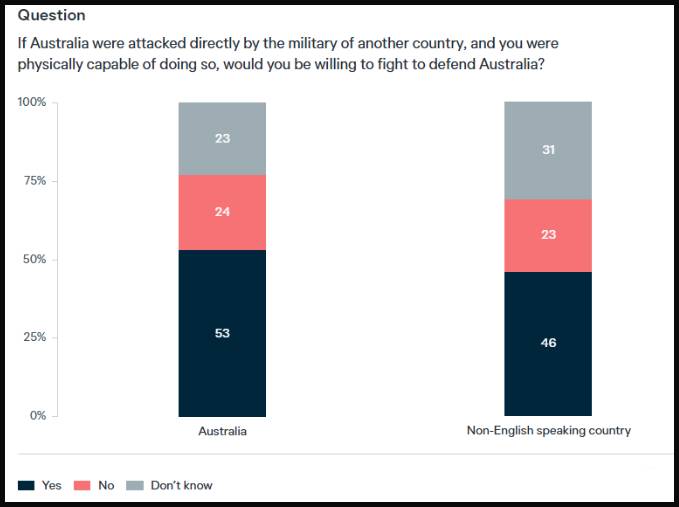
Source: The Lowy Institute
Around the world, research using World Values Survey data finds only a weak correlation between migrant share and willingness to fight once you account for education, age and national context.
In other words, diversity doesn’t automatically dilute loyalty, but alienation might.
Australia’s experience supports that. Two-thirds of Australians, including many migrants, agree that our openness to people from around the world “is essential to who we are as a nation”.
That’s not the rhetoric of a fractured society. It’s the language of a country still figuring out its “we”.
Migration-nations like Australia constantly need to reassess their collective sense of identity.
When the nation stops delivering
There is, however, another type of alienation worth watching: Not cultural but economic.
Patriotism (in its most positive and inclusive definition) thrives when people feel the social contract works. That’s when we collectively believe that hard work pays off, that institutions are fair, that the next generation will do better.
Many Australians would argue that these promises are faltering.
Young people see a housing market that is deliberately working against them, insecure jobs that stall their independence and student debts that stretch well into midlife.
When asked to fight for a system that seems rigged in favour of old people, their instinctive answer may be: “Fight for what, exactly?”
Young people are also acutely aware that they are of fighting age. For them, the question of fighting is much more real than for the older people.
Among the 60-plus cohort, 73 per cent say they would fight for Australia but under what scenario would that cohort be called to the frontline?
When the nation stops feeling like a shared project and starts feeling like a rigged game, loyalty curdles into apathy among the disadvantaged cohorts.
Crisis of belonging, not bravery
The question “Would you fight for your country?” is really about belonging. It’s asking: Do you still feel part of something bigger than yourself?
If nearly half of Australians hesitate, that’s not a failure of courage. It’s a signal that the emotional and social glue holding the country together has thinned.
When trust in government slides, when social mobility stalls and when younger generations believe they’re inheriting a broken deal, calls to self-sacrifice ring hollow.
You can’t rebuild patriotism with slogans or parades. You rebuild it by keeping the promise of a fair go alive.
A country worth defending
Australia is still a remarkable project. A liberal democracy at peace with a prosperous (albeit simplistic) economy, and mostly well-integrated migrants.
The country remains a success story. But Australia remains worth defending only if it keeps working for its people.
That means fixing housing. Investing in opportunity. Restoring faith in institutions.
When citizens feel they have a genuine stake in their society, you don’t need to ask whether they’d fight for it. They already are defending it every day.
Until then, the declining willingness to fight isn’t an indictment of Australians’ character. It’s a warning flare about our social contract and a call to action for our political class to make the nation work for all.
In case you are nervous about fighting for Australia, please remember that any military invasion of Australia remains largely hypothetical – all the things worth taking from us (mineral and agricultural products) we willingly sell to our would-be-invaders anyway.
Simon Kuestenmacher is a co-founder of The Demographics Group. His columns, media commentary and public speaking focus on current socio-demographic trends and how these impact Australia. His podcast, Demographics Decoded, explores the world through the demographic lens. Follow Simon on Twitter (X), Facebook, or LinkedIn.




China and housing: Two things we may have missed