‘Inexplicable’ decision put two trains on collision course

Source: Guardia Civil
Spain’s Transport minister Óscar Puente says an “inexplicable” decision from a command centre allowed a fast-moving train to slam into a stationary train, killing at least 68 people.
The train was travelling at a reported 200 kilometres an hour when it hit the rear of a train that had stopped, with both heading from Madrid to Seville in the southwest of the country.
Puente said the accident was caused when the security system on a 63-kilometre stretch of the railway line stopped working at 8.30am on Wednesday (local time) due to a computer malfunction.
The computer communications failure automatically stopped traffic.
But Puente said an erroneous decision was then taken in the control centre to restart the Renfe train at 8.36am while the “stop signal” was still active.
“The decision to resume traffic while that system had not been restored belongs to the control centre, and the control centre … took the decision to resume traffic in circumstances that, from our point of view, are inexplicable,” Puente said.
Spanish Prime Minister Pedro Sanchez declared three days of mourning.
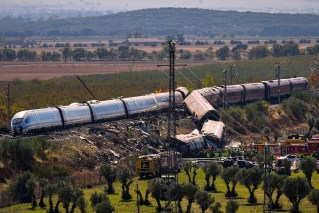
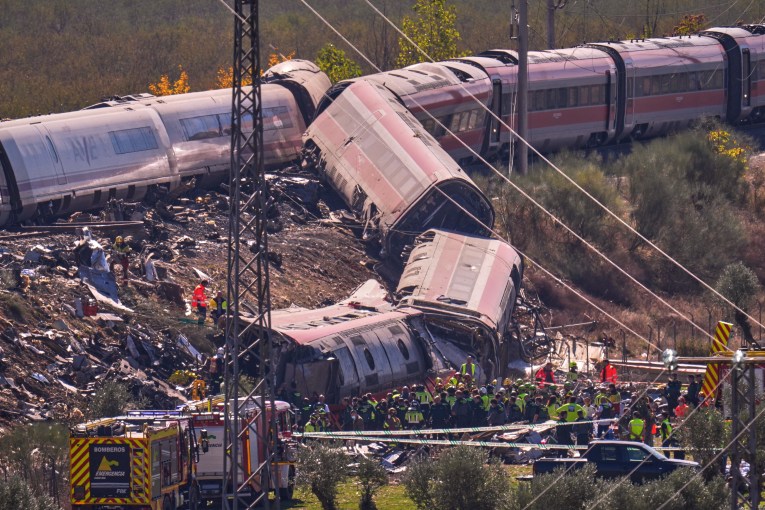
At the scene in rural Castilla-La Mancha, ambulances, funeral home vans and helicopters assembled beside one of the trains on an elevated stretch of track while twisted metal and wreckage lay scattered down an embankment where at least three carriages had plunged.
Passengers removed from the train streamed along a road near the scene, some splattered with blood or with their wounds bandaged, others wheeling suitcases and being given water by volunteers who said it had been donated from neighbouring towns.
The disaster, the deadliest train accident in Europe since a 2013 derailment in Spain’s Santiago de Compostela in which 80 people died, follows another fatal accident in January involving high-speed trains operated by the same companies on the same line, in which 46 people died.
Renfe said on Wednesday that after being authorised to continue its journey, its train had crashed into the Iryo train that had remained stationary “for reasons we don’t know”.
“The Renfe train continued on its way as instructed, and a collision occurred. The exact sequence of events, the traffic conditions and the circumstances of the impact will have to be established by the investigation,” Renfe said in a statement.
Iryo, which said it had activated emergency protocols, and state-owned infrastructure operator Adif did not respond to requests for comment.
A Castilla-La Mancha government spokesperson said 147 people, including a baby, were on board the Iryo train and 397 on the Renfe service when the crash occurred about 9am, derailing two Iryo carriages.
Passenger Rafael Barcelo said he felt lucky as he had stepped away from his seat for a coffee, adding there had been at least eight victims from his carriage.
“We were having breakfast, drinking a coffee when we felt a very strong impact and we were sent flying,” he said.
Renfe said it had opened a special line for families of victims.
The railway operator said it had suspended ticket sales on the Madrid-Andalusia high-speed corridor until December 13.
Spanish Health Minister Monica García said emergency workers were focusing on rescuing survivors and bodies from the two most damaged train cars.
The crash, which occurred in a flat stretch surrounded by olive fields in between the towns of Urda and Los Yebenes, left one car shredded into bits of metal and other material, scattering debris down a gravel slope.
The accident was between two high-speed trains heading in the same direction from the capital Madrid to Seville in southwestern Spain, according to Esther Padilla, spokeswoman for the Castilla La Mancha region.
-with AAP/AP

Bolsonaro arrives in US, challenges election result