Labor celebrates a couple of big wins – and doesn’t stop to ask who for


Labor and the Coalition are united on gambling "reform", which won't actually put more controls on gambling. Photo: AAP
It’s not radical to say that Labor and the Coalition agree on more than they disagree on these days.
That’s neoliberalism in a nutshell – both parties are tied to protecting the market and capital. Although the Coalition, as the party more historically tied to capitalism, is flirting with what comes next more and more – leaving Labor one of the last defenders of a system that has comprehensively failed us.
The parties agreed on passing cuts to the NDIS, which they both dressed up as economic sensibility. But in reality was just a choice – a choice to make disabled, the future disabled, and their families and loved ones pay for the inconvenience of being disabled, while defence and fossil fuel spending continues unabated.
Make no mistake – it was a choice. And one that was rushed ahead of any attempt to set up supports for people who are about to find themselves with very limited choices, if any at all.
The Coalition celebrated this by pretending it secured a win in bringing forward a fix that was already in the works and had no immediate time pressure. Labor has celebrated by putting Mark Butler forward as a potential leader.
We saw that in the gambling advertising “reforms” as well – both Angus Taylor and Anthony Albanese pretending this was about “balance” and that the people’s right to have a punt was protected.
Except it was never in doubt. None of the measures put forward were about stopping gambling – just the ads that surround the billion-dollar industry, which harm people trying to take control over their lives. But having made the choice to support big business over people, the leaders had to pretend they did it to protect your free will, even though it was never in doubt. At least the Coalition had public dissenters. Labor MPs couldn’t even manage that.
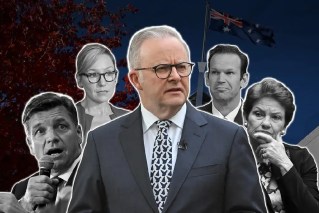
In the background, we have the usual leadership hustling. As discussed, Butler is being touted by insiders as a potential replacement for Albanese when he decides to leave, while Daniel Mulino and Andrew Charlton are both being manoeuvered into more public-facing positions, which of course, also helps to knock Jim Chalmers down a peg or two.
Charlton and Mulino stick to the Albanese line, and carry more of that “sensible centrism” the Prime Minister is obsessed with.
Chalmers, who read the electoral tea leaves a little better, is seen as frustrating for attempting to push more progressive agendas. It is not a coincidence that Chalmers has barely touched the NDIS cuts. He knows what the reaction will be, and he’s deliberately staying clear.
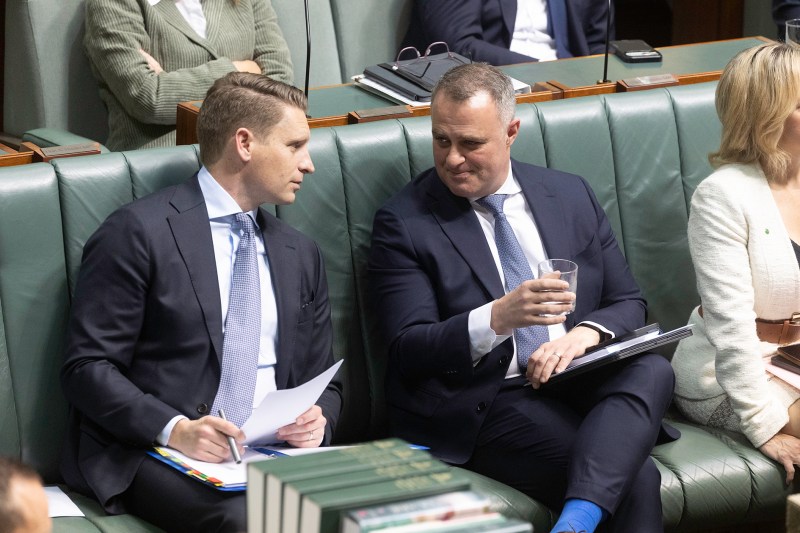
Hastie (left) is waiting in the wings for the Liberal leadership. Photo: Mike Bowers
Then we have the Coalition, where Andrew Hastie has been waiting in the wings, stepping forward only to deliver interventions that remind his colleagues he is waiting. He gave one of those interviews on Wednesday morning, where he took a middle road on policy, refused to censure Andrew Bragg for freelancing on policy in a speech last week (although let everyone know they had “talked”) and reiterated how much he loved pressure and was ready for the fight against One Nation.
This is also happening at the same time as One Nation directs both government and opposition policy, floating brain farts through friendly media and the socials and then stepping back and letting the major parties stumble over themselves to respond.
What we are left with is two parties, both on the same page, becoming increasingly desperate to try to find some difference from each other – but not so much difference they would upset “the middle” (even as that “middle” increasingly collapses to One Nation).
Labor won’t wake up until the threat is real. Some of that will come in November, when the party in Victoria is wiped out by the throup-ilition. But it won’t seem real until it creeps closer to impacting the NSW election in March.
That will be too late for any meaningful policy change.
So we’ll see more of the parties fall to old ideological battles, and among those, superannuation will shape up as one of the easiest.
A couple of years ago, under the Morrison government, the Coalition worked out just how much power industry super funds had in terms of the direction of the country. Not because of how they lobby, but because of their investment power.
Australia’s super industry is worth about $4.4 trillion. Of that, industry super controls about $1.6 trillion. The public service super has about $604 billion to invest. To the Coalition, that investment means control and, despite industry super not stepping out of the boundaries of neoliberalism with its investments, the threat of that control is enough to spark a fight.
Barnaby Joyce has enough memories of this to imply on radio that the government wanted people’s super to pay down national debt. It’s a fantasy, of course, but a very easy ideological fight to spark, and one that all the neoliberal parties are prepared to throw down for, because it helps hide how much they are in agreement on the policies that impact your daily life.
We have superannuation because of the extreme gaps in worker retirement funds, between white and blue collar, men and women. In 1974, a male government worker was 11 times more likely to be covered by superannuation than a female manual worker. By the time of Hawke and Keating, the thinking around super was that it should provide generous retirement benefits to all workers, not just those in management.
It seems like a good fight to have. Except, in 2026, it’s gone from a fight over workers’ rights to dignity to one over who controls the capital.
Which is also the reason they’ll have this fight. It’s another example of appearing to be on opposing sides, but actually agreeing on the substance. And it doesn’t appear as though Australia’s leaders give Australian voters enough credit for recognising that.
The issue for Labor is not just what happens if One Nation keeps dominating the polls, but what happens if Hastie wins control of the Coalition and starts taking up all the policies Labor has rejected as “populist” while also keeping One Nation’s soft voters in the tent. As he told the ABC on Wednesday:
“I think we’ve got to focus on who we are as Liberals, and this is what we’re doing. We’ve got a plan. We’re talking about it. It’s lower taxes, cheaper power. It’s cutting migration, building more homes, and then putting Australians first. We’ve got a sovereign wealth fund that we’re going to set up using windfall profits from the resources sector, and put that towards nation-building infrastructure. So we have a plan, and we’re going to keep talking about that plan. We’re not going to be distracted by One Nation or Labor. We’re going to talk about who we are, what we believe, and what our plan is to make Australia more secure and prosperous.”
Albanese’s Labor is building the conditions not just for One Nation, but also Hastie, both of whom at least appear to be listening to parts of the electorate, while Labor offers nothing more than agreement with the Liberals.
Labor is taking this parliamentary fortnight as a win. But for who? That’s the question that keeps tripping it up.
Amy Remeikis is a contributing editor for The New Daily and chief political analyst for The Australia Institute
China and housing: Two things we may have missed


Households in pain, but budget crisis can be solved
David Shoebridge elected as new Greens leader
'About the team': Greens to choose new leader