Partner’s plea as first Australian declared dead in Nepal

Source: Instagram (Emily Boyd)
The first Australian death in Nepal has been confirmed by loved ones as NSW man Michael Keats, who was reportedly on a spiritual pilgrimage.
Keats’ partner, Emily Boyd, said it was the “most heartbreaking and overwhelming” time of her life and she was scrambling to get to India to honour him.
Media reports said Keats, from Mollymook on the NSW South Coast, was at the border crossing between Tibet and Nepal when the floods struck.
The hiker was returning from a group journey to Mount Kailash in Tibet.
Earlier, The Guardian reported that Keats had reached the Tibet-Nepal border moments before the deadly disaster unfolded.
“Confusion around the timing of the floods initially led us to believe our beautiful Michael would be safe in Kathmandu, preparing to fly home,” the family said on the weekend.
“Unfortunately, it was confirmed relatively quickly by the Isha Foundation that Michael and his Kailash travel group had arrived at Gyirong Port on the Nepal-Tibet border just 10 minutes before the tragic floods hit.”
Boyd launched an crowd-funding campaign after she was invited to India for a yoga and spiritual ritual “as a way of honouring Michael, processing this loss and supporting his transition after death”.
“For us, this journey carries deep spiritual meaning, and being able to participate would mean so much during this incredibly difficult time,” she wrote.
“Michael was my partner and an incredibly important part of our family. He was also my young son’s stepfather, although he was the only father he has ever known. His loss has changed everything for both of us.
“We are trying to navigate the shock and grief of losing someone we love deeply, while also suddenly having to face life without the person who was such an important part of our family and our household.
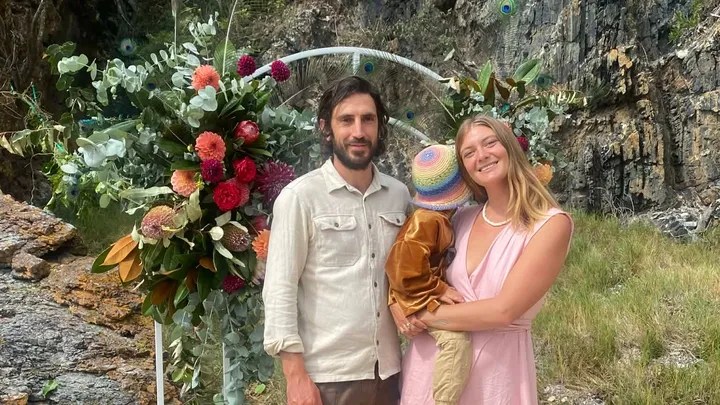
Emily Boyd wants to honour her partner Michael Keats, who died in Nepal. Photo: GoFundMe
“This fundraiser is about more than one trip. It is about giving my son and me some breathing room while we navigate an unimaginable loss and begin to work out what our life looks like now.”
More than 4700 people are still missing on either side of the border, including 43 Australians, after the disaster was triggered by a glacier collapse in the Himalayas near the Nepal-Tibet border last Wednesday.
Hundreds of bodies, many unidentified, have been buried in shallow graves as they began decomposing in the humid weather in the plains of the Himalayan country after being swept down the mountains by the torrent.
Hundreds trapped in tunnels
Rescuers are racing to free hundreds of workers believed to be trapped in tunnels at hydropower sites, with at least 900 people unaccounted for at 12 hydropower projects.
About 500 of those workers were believed to be trapped in tunnels.
At least one expert said that some workers could have access to oxygen but others warned that the chances of finding survivors were diminishing.
As the rescue efforts intensified, four bodies were recovered from three mud-filled tunnels, Nepal’s army said.
Some workers managed to call for help when the disaster struck last Wednesday. It is unclear if rescuers have had any contact with other trapped workers since initial calls for help.
Six days after the disaster, fears were growing that some might have suffocated, said Mohan Kumar Dangi, president of the Independent Power Producers’ Association.
Rescue efforts were focused on people trapped in the gigantic tunnels built for controlling the flow of water.
“These tunnels are big enough to drive trucks through,” said Jakob Steiner, a geoscientist at the University of Graz in Austria based in Dhaka, Bangladesh.
“From what we understand, they have managed to get oxygen to some of those stuck inside and are trying to rescue them now. It’s a race for time, though, as people need food and water.”
In the Upper Trishuli-1 Hydropower Project, in the hard-hit Rasuwa district, at least 576 people were missing, Dangi said, adding that about 300 of them were believed to be trapped inside the project’s tunnel.
At the Trishuli-3 Hydropower Project, crews were working to descend about 15 metres into a tunnel to try to reach those believed trapped, Nepali army spokesman Brigadir General Raja Ram Basnet said.
Workers shovelling mud from a flood-ravaged power station in Dhading, Nepal, said the station was a key connection for providing power to more than 20,000 people in the region.
On the Chinese side, rescue and recovery efforts included rebuilding the road leading to the Gyirong Port border crossing that regulated travel between China and Nepal.
Trucks carried giant rocks as workers tried to repave part of the road, state broadcaster CCTV showed on Monday, next to rapidly rushing waters, which have been made more powerful by days of rain.
The road is now under up to three metres of water.
The repaving effort was just a little over a kilometre from the border, CCTV said.
Although some rescue teams have managed to reach the border, that represented only a portion of the force.
Chinese state media coverage has focused largely on the official response, highlighting the deployment of firefighters, the army and instructions from top leaders.
Little is known about victims on the Chinese side.
In Nepal, the first victims of the floods are being buried in mass graves as authorities struggle to identify and store the growing number of bodies recovered from the disaster.
The decision has sparked controversy in the predominantly Hindu country, where the dead are traditionally cremated.
Some relatives of the missing and other critics have questioned whether authorities began the burials too quickly and without sufficient regard for Hindu funeral rites.
Many of the bodies were swept dozens or even hundreds of kilometres downstream and were recovered badly decomposed or mutilated, making visual identification difficult.
Mortuaries in some affected areas have reached capacity while hot and humid conditions have accelerated decomposition.
Authorities said photographs, DNA samples and other identifying information were being collected before burial so that relatives could later establish the identity of victims.
-with AAP