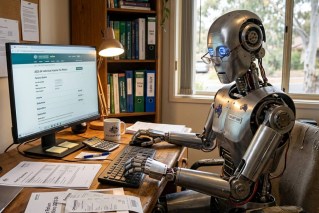
AI isn’t replacing workers yet. The belief that it will already is

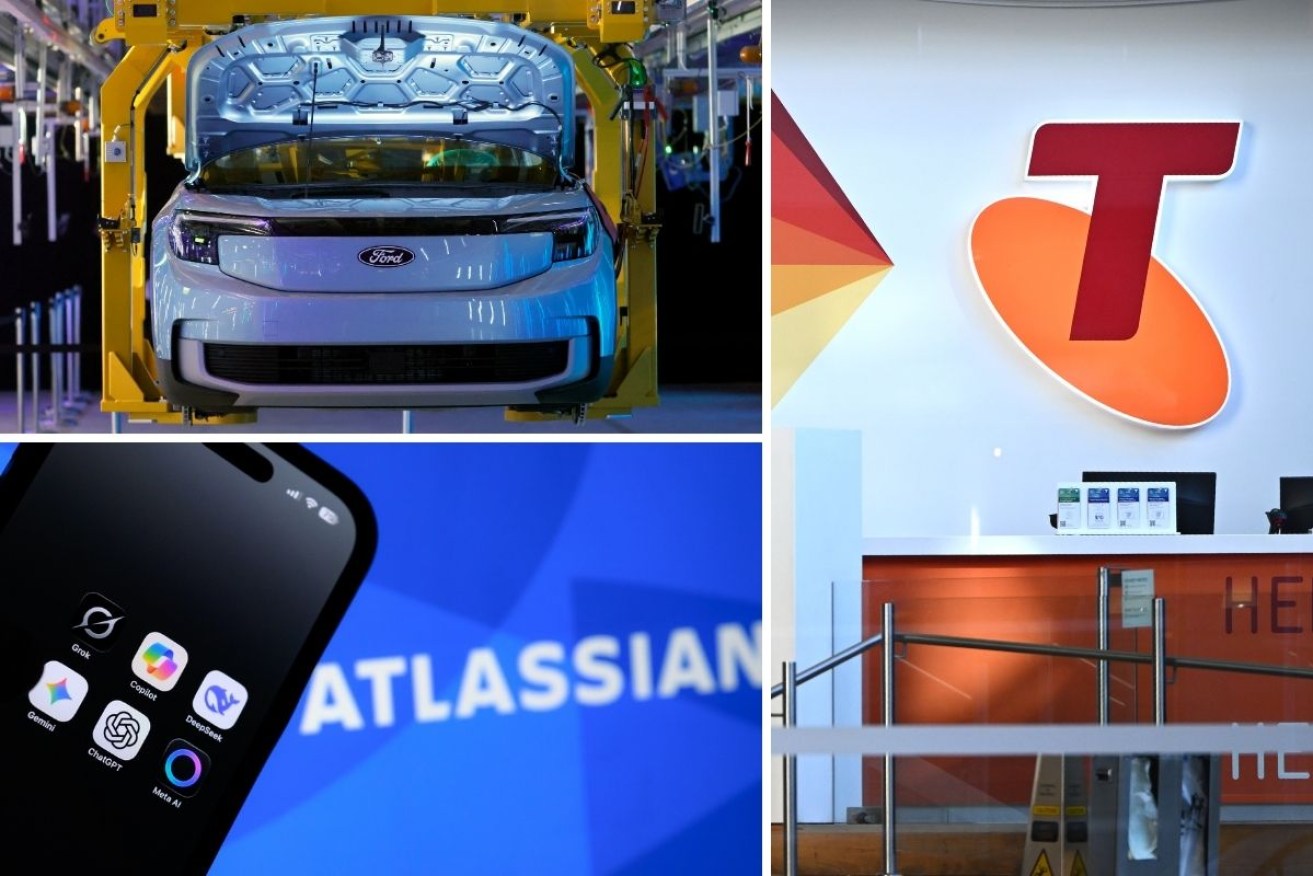
Some of our biggest brands are turning to "AI washing". Photos: AAP/TND
Redundancies, hiring freezes and corporate restructures are increasingly being justified in the language of artificial intelligence.
What might once have been described as cost-cutting, margin pressure or strategic realignment is now presented as becoming “AI-first”.
A speculative future is being used to rationalise present-day decisions. The effect is not simply rhetorical. It is organisational. It changes what companies believe they need, and therefore what they choose to build.
This phenomenon has a name: AI washing.
By AI washing, I mean the use of artificial intelligence narratives to legitimise more conventional forms of corporate retrenchment, particularly in organisations facing slowing growth, shareholder pressure or internal efficiency drives. AI becomes less a technology than an explanatory framework — a way of making familiar decisions appear inevitable.
The pattern is already visible across major Australian firms.
Atlassian recently announced significant global job cuts, including hundreds of roles in Australia, while explicitly linking its restructuring to the need to accelerate investment in AI and adapt to a changing “skills mix”. WiseTech went further, describing a reduction of around 2000 roles as part of a “deep AI transformation” aimed at building a leaner, more AI-led organisation. In both cases, AI does not merely describe technological adoption, it functions as justification for workforce contraction at scale.

Telstra has cut thousands of jobs, citing a looming “AI efficiency”. Photo: AAP
Beyond the tech sector, the same logic is filtering into mainstream corporate Australia. Commonwealth Bank has combined workforce reductions with an aggressive expansion of generative AI across operations and customer service. Telstra has cut thousands of roles while publicly emphasising automation and AI-driven efficiency as central to its transformation strategy. Yet the company has also explicitly denied that its July 2025 cuts were caused by AI, even as its CEO has told investors that AI will materially reduce headcount by 2030.
The contradiction is not incidental – it is precisely what makes the framing powerful. AI is disavowed as a direct cause in operational messaging while simultaneously elevated as a strategic driver in investor communications. These are not purely AI-driven layoffs in any narrow sense, but AI is increasingly the language through which restructuring is explained and made legible to investors, staff and the public.
What is striking is not whether these decisions are justified, but how they are being justified.
The question inside organisations is no longer simply whether a role is necessary, but why it cannot be performed by AI. The burden of proof has shifted onto human labour itself.
This shift is occurring despite relatively modest evidence of realised gains. PwC’s 2026 Global CEO Survey, which surveyed more than 4000 chief executives across 95 countries, found that only one in eight reported that AI had delivered both cost reductions and revenue growth. More than half reported no meaningful financial benefit at all. Despite this, investment and restructuring continue at pace, driven less by proven productivity gains than by anticipated ones.
Ford’s recent experience offers a useful counterpoint to the inevitability narrative. The carmaker rehired more than 300 veteran quality inspectors after AI-powered quality checks failed to match the judgment and experience of human engineers. Ford veteran executives admitted that automated systems had not performed as expected, in part because the company had underestimated the value of knowledge built over many product cycles.
The lesson is not that AI has no role in industrial systems. It is that human expertise is not simply a cost to be replaced. In many cases, it is the condition that makes the technology useful at all.
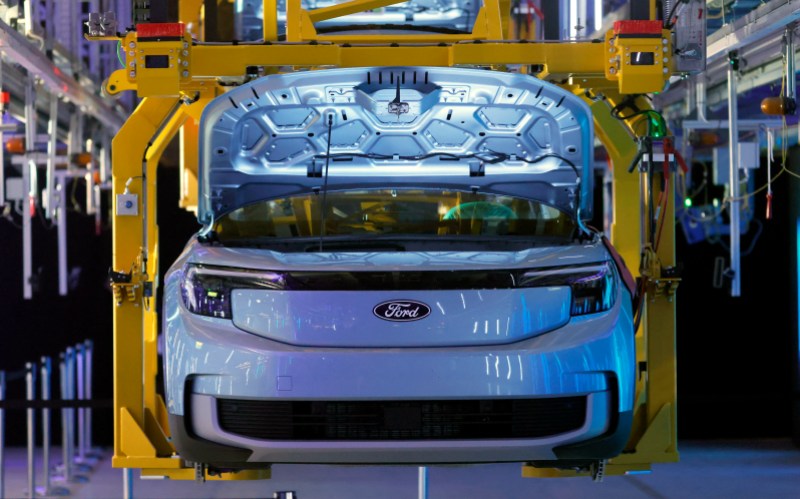
Motoring giant Ford had to re-hire hundreds of engineers after finding AI wasn’t enough to replace them. Photo: AAP
At the same time, labour market reporting in the US has linked tens of thousands of job reductions to AI-related restructuring narratives, even where broader economic conditions, post-pandemic correction, cost pressures and investor expectations, are also clearly at play. AI becomes the most modern, and therefore most acceptable, explanation for decisions that often have multiple, older causes.
This is where AI washing becomes analytically useful. It does not necessarily describe deception. It describes substitution: The replacement of complex, often unglamorous economic explanations with a single, powerful technological story.
Italian Marxist Antonio Gramsci used the term “common sense” to describe ideas that become so culturally dominant they cease to appear ideological. They stop being argued for and simply become reality. AI is beginning to occupy this space.
The belief that artificial intelligence will inevitably replace large numbers of workers is increasingly treated not as a prediction but as a premise. Once that premise takes hold, it begins to reorganise behaviour in advance of technological reality. Companies slow hiring because automation is expected to improve. Teams are not expanded because software may soon perform the work. Employees are asked to absorb additional responsibilities because reduced headcount is already assumed to be the trajectory.
Prediction becomes infrastructure. The expectation of change begins producing the institutional conditions that make that expectation appear correct.
The risk is not that AI suddenly displaces labour on a dramatic scale overnight. It is that organisations gradually restructure themselves around assumptions about AI long before those assumptions have been validated.
Australian corporate behaviour offers an early illustration of this dynamic. Firms such as Atlassian and WiseTech are not simply responding to AI as a deployed capability, but reorganising around AI as a projected inevitability.
In the broader market, Commonwealth Bank and Telstra embed similar narratives of automation and efficiency into workforce decisions that are also shaped by profit cycles, regulation and shareholder expectations.
Technological revolutions have never been purely technological. The steam engine did not determine the factory system; it was embedded in existing struggles over labour and capital. The internet did not inevitably produce the platform economy; it was shaped by regulatory choices, investment flows and corporate strategy.
Artificial intelligence will be no different.
The central question is therefore not simply which jobs AI will replace, but who benefits when the belief in inevitable replacement becomes the organising principle of economic decision-making.
Because once that belief becomes common sense, it no longer needs to be true to be effective. It only needs to be believed. And by the time its consequences become measurable, the organisations shaped by it may already have been quietly redesigned.
Salem Lassoued is founder and director of AI market research platform Muja and marketing and behavioural consultancy Data Organica