‘Hermione’s handbag’: Nobel winning Aussie’s big idea

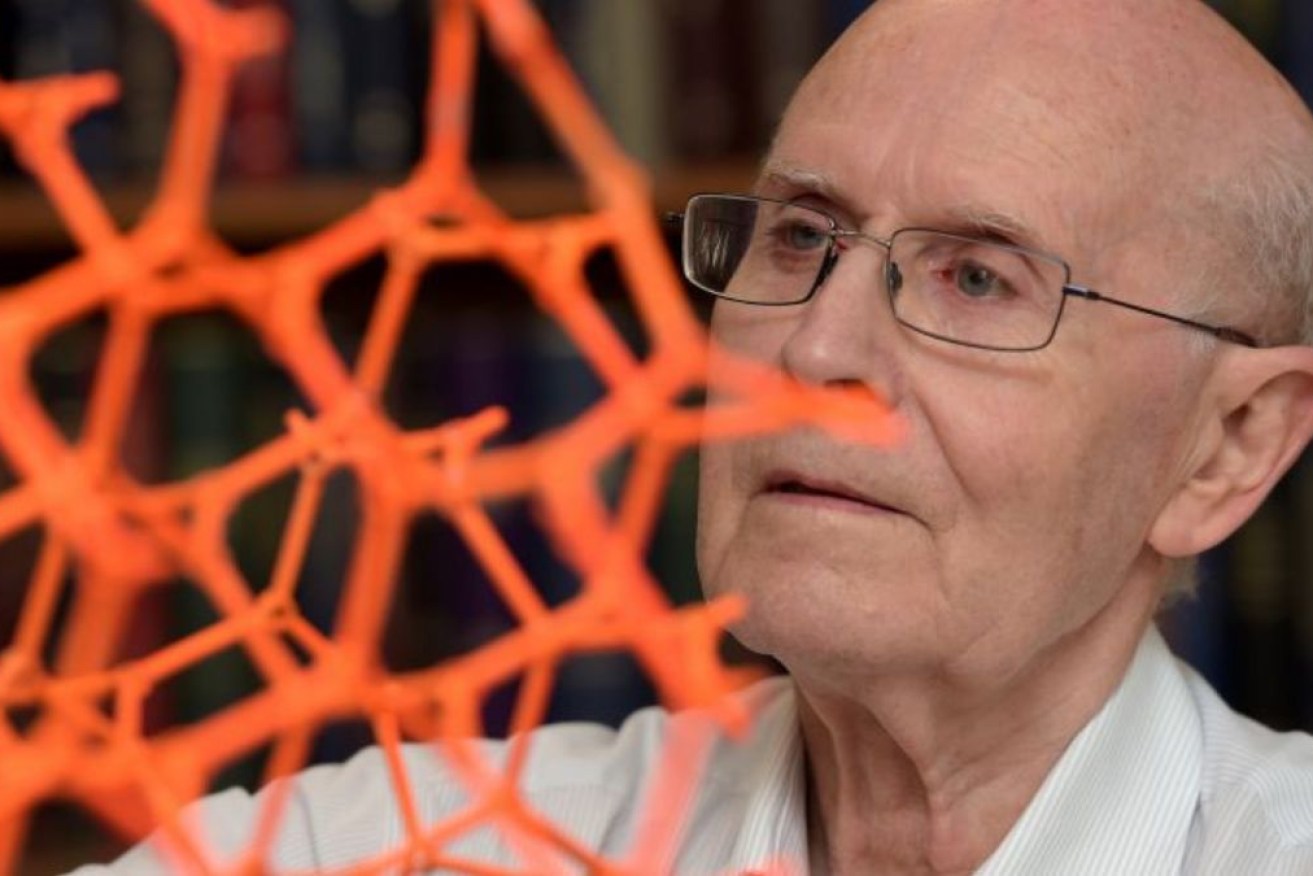
The University of Melbourne's Richard Robson is "very pleased and a bit stunned" by his Nobel win. Photo: AAP
A humble Australian professor whose work was once dismissed as a “whole lot of rubbish” has won a prestigious Nobel Prize for Chemistry.
The University of Melbourne’s Richard Robson has been honoured at the age of 88 for pioneering a world-leading new form of molecular architecture.
He was awarded alongside Japan’s Susumu Kitagawa and American-Jordanian Omar Yaghi.
The three laureates created molecular constructions through which gases and other chemicals can flow.
Australian Prime Minister Anthony Albanese told federal parliament the scientists’ work was molecular, but the implications were far-reaching.
Their discoveries could help capture water in arid environments, deliver precise drug doses to cancer patients, capture carbon, store and transport hydrogen and so much more, said Albanese.
“These are global challenges but also Australian challenges. Our nation will be better able to meet those challenges and seize the opportunities they present thanks to this landmark Australian scientific research.”
Albanese said Robson’s work “really matters, pun intended”.
“But there has been a clear theme in the coverage of this from of this morning that is his humility.”
Robson has been researching, teaching and inspiring people at the University of Melbourne for nearly 60 years.
“It will inspire countless others with this outstanding achievement of which all Australians should be proud.”
Robson said his work might easily have been dismissed, recalling how some thought it was “rubbish” when he began developing the idea in the 1970s.
The concept occurred to him while building models for teaching, which was the starting point for the growing field of metal-organic frameworks.
Over a 10-year period, he would often revisit his framework and concepts while preparing lectures in his field of chemistry.
“I kept being reminded of it each year when these lectures came up. I thought I really ought to follow that up,” he said in a Nobel Prize Conversations interview posted on YouTube after his prize was announced in Stockholm on Wednesday.
“Eventually I did.”
Robson describes himself as a lone scientist with an “obsessive” habit of neglecting other responsibilities to aid his research.
He gives credit to the many, invaluable researchers and scientists who supported him throughout his decades-long career.
The Nobel Committee noted the trio’s metal-organic framework had a remarkably large surface area.
For example, a porous material roughly the size of a sugar cube could contain as much surface area as a large football pitch.
“A small amount of such material can be almost like Hermione’s handbag in Harry Potter,” said Olof Ramstrom, member of the Nobel Committee for Chemistry.
“It can store huge amounts of gas in a tiny volume.”
The three chemists worked separately but added to each other’s breakthroughs, which began with Robson.
The framework was a breakthrough four decades in the making, said Net Zero Institute director Deanna D’Alessandro of Sydney University.
“The discovery begins in the 1970s and ’80s and it’s a beautiful story about the close link between education and research,” she said.
The prize marked a “wonderful day for Australian science,” D’Alessandro added.
“There’s a lot in question at the moment about the value of research and science and here’s the example of why it matters.”
University of Melbourne deputy vice-chancellor Mark Cassidy hopes the prize will inspire a wave of research to advance metal-organic frameworks into products vital to Australia’s push toward renewable energy solutions.
“Professor Robson is a humble man who has achieved this honour by simply doing what he loves, going into the lab every day, talking with students, thinking big chemistry thoughts for decades and running experiments,” he said.
As for Robson, who’s the ninth oldest Nobel Prize winner, he plans to celebrate the award modestly.
“I’m now 88. The people I knew 25 or 30 years ago are all dead or close to it, like myself,” he said.
“There are upsides and downsides (to winning the prize). I’m quite old now. Handling all the nonsense that’s going to happen is going to be hard work.”
The oldest Nobel winner, at 97, was John B Goodenough, who also won the chemistry prize in 2019 for his development of lithium-ion batteries.
-with AAP
Want to see more stories from The New Daily in your Google search results?
- Click here to set The New Daily as a preferred source.
- Tick the box next to "The New Daily". That's it.