Rupert Murdoch is almost certainly the most globally influential Australian.
That Australia has one of the most concentrated media markets in the world is, sadly, a reflection of his influence, even though he has relinquished citizenship to become a dominant media figure in the United States.
There are already a number of books about him, including biographies by journalists Michael Wolff and William Shawcross.
The bitter family dispute, played out in the courts three years ago, about who would control Murdoch’s media companies after his death, could have been scripted by the writers of the successful television series Succession.
Andrew Dodd and Matthew Ricketson have not written another biography of Murdoch, but rather a forensic account of how the Murdoch empire bullies, intimidates and destroys individual citizens and governments. Both writers, now professors of journalism, have worked across the media, including for Murdoch’s local flagship, The Australian.

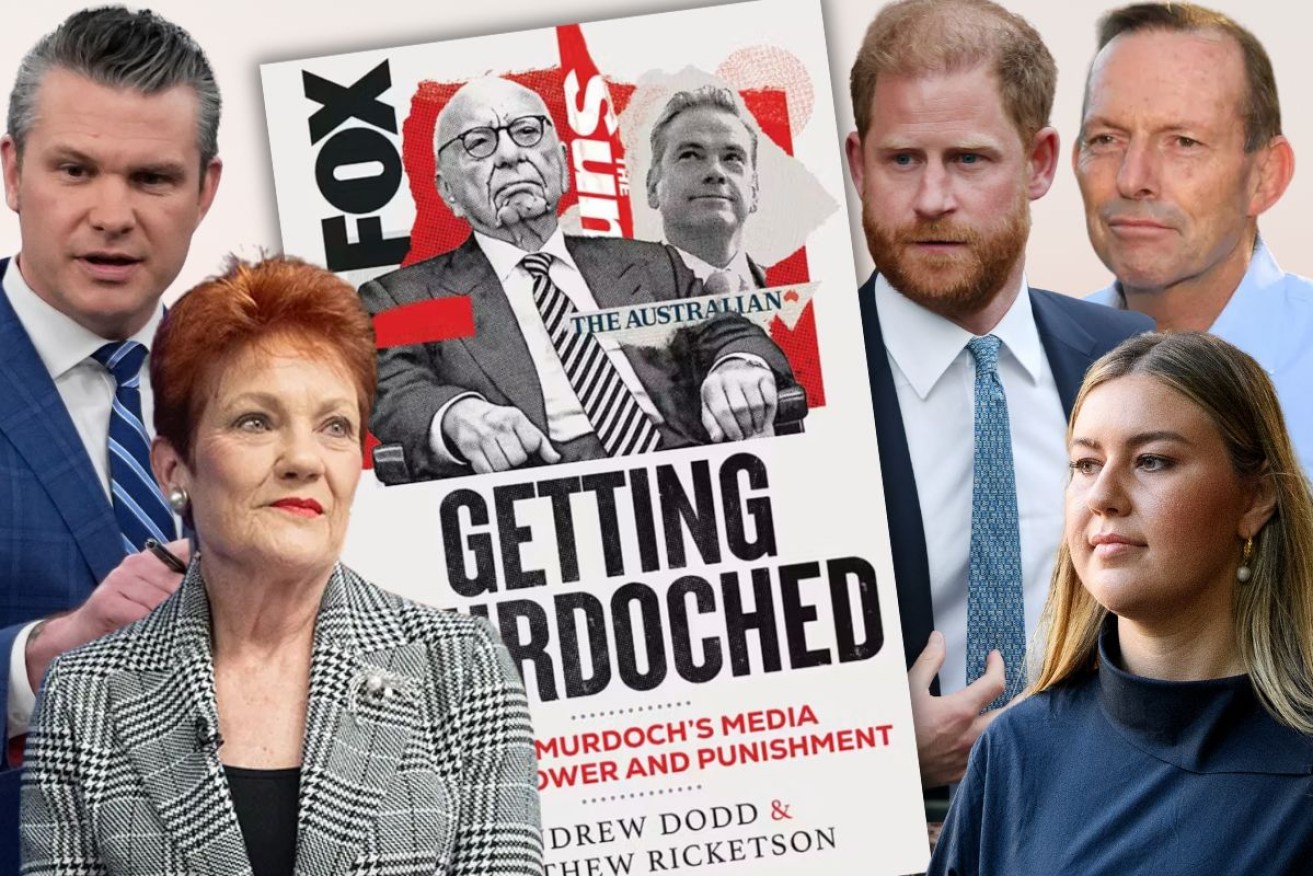
Their book, Getting Murdoched, straddles the three countries where the Murdoch empire is a major player: Australia, Britain and the US. There are some differences in these three operations, often because of the different rules under which the media operates, but a consistent pattern emerges of a ruthless drive for stories that feed Murdoch’s political aims and prejudices.
A quick glance through the index reveals the extent of Murdoch’s victims, from Prince Harry and Hugh Grant to a range of people who were unknown until the Murdoch press targeted them.
Only in Britain has Murdoch has experienced significant restriction, following revelations about the phone hacking engaged in by News of the World, which led to the closure of the paper and embarrassing appearances by Murdoch and his son James before a parliamentary committee.
More recently, The Sun has been forced to apologise and pay damages to Prince Harry for similar practices. Murdoch was also denied ownership of British satellite broadcaster Sky TV, which he had long sought to buy.
Because there are some significant differences between the story in the three countries, the book tends to jump across oceans in ways that are at times confusing. It would have been helpful if it had included a statement of the full extent of Murdoch’s holdings in all three countries.
Fox on the run
In the US, Murdoch’s greatest influence comes through his establishment in 1996 of the Fox cable television network, which successfully challenged the three existing national networks. Fox News has become a platform for increasingly rabid right-wing commentators.
Murdoch apparently held Donald Trump in contempt. But once Trump’s ascendancy became clear, Fox News became a major ally. The network was a strong supporter in the 2020 and 2024 presidential campaigns. In Trump’s second administration, Fox also provided many of his key appointments, most notably his secretary of war (formerly defence) Pete Hegseth.
After the 2024 election, Fox was required to pay considerable damages to Dominion Voting Systems for frequent comments about vote-rigging, which could not be sustained.
In Britain, the focus of the Murdoch machine seems to be on gossip, no matter how unreliable or how it is sourced. In the US, there is more interest in political manoeuvres, even where one suspects Murdoch himself may not support what some of the more unhinged Fox commentators are saying.
In Australia, the Murdoch press combines deep hostility to the Labor Party with a series of ideological obsessions. Originally a progressive paper – it supported the election of Gough Whitlam in 1972 – The Australian has become the national voice for the right on key issues. These include scepticism about climate change, unquestioning support for Israel, deep antipathy to trans people, and unrelenting hostility to any economic policy that might reduce inequality.
Argumentum ad hominem
Because Getting Murdoched focuses on individuals who have been targeted by the Murdoch press, it becomes a fascinating study of the Murdoch media’s bullying of people whose views they dislike. Here I should acknowledge that some of those targeted – Benjamin Law, Sarah Schwartz, Robert Manne – are people I am proud to call friends.
Manne has, according to the authors, been covered by close to 300 articles in The Australian since 2009. But when he published his thoughtful and extensive memoir in 2024, it was ignored by the paper.
Ad hominem attacks characterise much of the ideological warfare of the Murdoch press. As with Fox in the US, the most concentrated attacks in Australia come from regular columnists and late-night talk show hosts on Sky News.
Here the cup almost certainly goes to Andrew Bolt, who writes regularly for Melbourne’s Herald Sun and hosts his own program on Sky. Getting Murdoched charts his attacks on half a dozen people, including environmentalist Tim Flannery, human-rights lawyer Gillian Triggs, and writers Anita Heiss and Yassmin Abdel-Magied.
Runner-up is probably Janet Albrechtsen, a columnist for The Australian, who, the authors write, has written or coauthored 123 articles about Brittany Higgins since Higgins claimed she was raped in Parliament House in 2021. Albrechtsen is one of several high-profile women in the Murdoch stable who will never miss an opportunity to attack feminists.
Once someone is identified as an enemy, the attacks are unrelenting. One odd omission from the book is Palestinian academic Randa Abdel-Fattah, who has been consistently attacked over the past several years. Indeed, the role of the Murdoch press in delegitimising the Australian Palestinian movement and leading a cheer squad for supporters of Israel needed more attention, though the authors do discuss Murdoch’s relations with the American pro-Israel lobby.
Perhaps the most important check on the Murdoch empire in Australia is the ABC, which explains the frequency of criticisms it evokes, particularly from columnists such as Gerard Henderson.
Money and power
Getting Murdoched is an invaluable guide to the practices of the world’s most dominant media empire. At times, the sheer number of examples left me overwhelmed and wanting a broader framework. One of the book’s depressing lessons is the weakness of the Australian Press Council in ensuring proper standards of journalism are upheld.
The authors suggest that Murdoch is driven by a lust for both money and power, but also by a strong sense of breaking down the establishment. Their book seems to suggest that Murdoch personally is responsible for the worst excesses of his media and ignores any possible examples where his outlets have dissenting views. As they report, the Murdoch media was largely hostile to the Indigenous Voice referendum, but it also carried some supportive articles and has given space to key Indigenous leaders.
I suspect there is a more complex story, whereby the Murdoch outlets attract staff who share his prejudices, or at least see them as the path to preferment. They in turn influence Murdoch, whose views have become steadily more right-wing and reactionary over the years.
Surprisingly, there is only passing mention of Murdoch’s oldest son Lachlan, who has taken control of the media empire after the public battle to remove his siblings from a voice in its future. The general assumption is that he will continue to promote his father’s grievances and prejudices, but there is some evidence that he is more liberal on social issues than his father. We may see this played out over the coming year, as Australian politics seems to be taking a new and unprecedented shape.
Getting Murdoched was presumably finished before the meteoric rise in support for One Nation; the only reference to Pauline Hanson is when she was depicted in fake and degrading photographs in several Sunday tabloids before the 2009 Queensland state elections.
At this stage, it appears the Murdoch press will swing its support behind the Coalition and remain sceptical of One Nation. Given Murdoch’s desire to be on the winning side, however, this may well shift if he sees a political opportunity.
The newly elected Liberal Party president Tony Abbott is a director of Fox Corporation, so Opposition Leader Angus Taylor may feel protected. Angus, please read this book. If there is one lesson from Murdoch’s career, it is that, like Trump, he has no allegiances beyond maintaining his power.
Dennis Altman, Vice Chancellor’s Fellow and Professorial Fellow, Institute for Human Security and Social Change
This article is republished from The Conversation under a Creative Commons licence. Read the original article.