Not so puny: People in their 90s can put on significant muscle

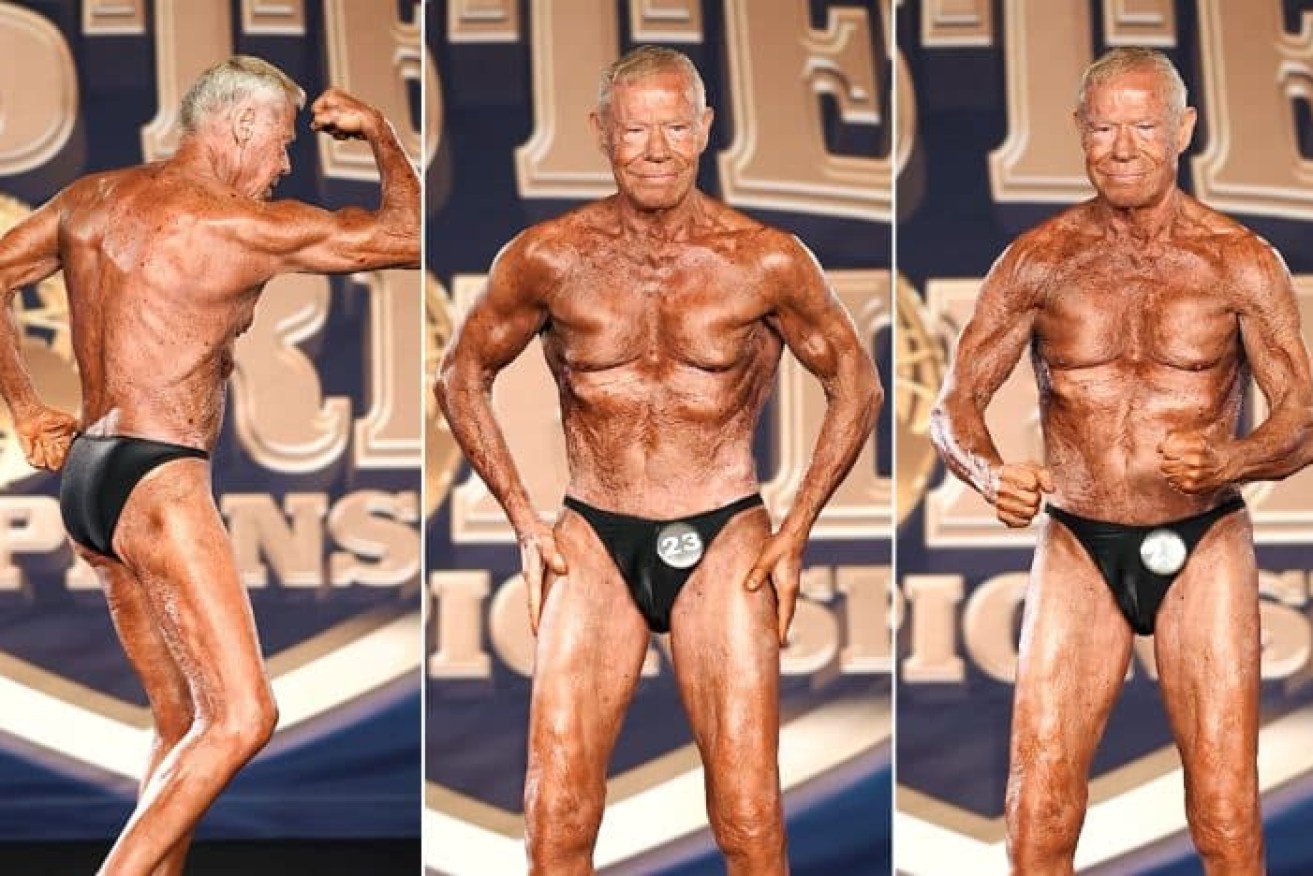
It's never too late. James Arrington, 91, is the world’s oldest bodybuilder.
Sometimes science lets us down by giving in to over-egged assumptions.
One such idea is that when people reach a certain age – let’s say seriously old – there’s not a lot of gain in them doing resistance training.
The world’s oldest competing bodybuilder is James Arrington, a 91-year-old American. He’s been striking poses and lifting weights since the 1940s.
A year ago, the world’s oldest competitive powerlifter, according to Guinness World Records, was a Florida great-great-grandmother, Edith Murway-Traina, aged 100. At that point, Edith was lifting upwards of 150 pounds (68 kilograms).
These people weren’t freaks, blessed with super abilities.
They had made a habit of keeping fit, notably in a way that built and preserved muscle, which is vital for mobility as we age.
And you, a person in their 50s or 70s, might say: Oh well, they’ve been doing it all their lives, it’s now too late for me.
Certainly bad science has all but said there’s not much point in starting weight-based training at the age of 80 or 90.
But that’s not true
A terrific new study found that people in their 80s and 90s – who had never trained with weights in their long lives – made significant gains in muscle mass and body strength after 12 weeks of progressive whole-body resistance exercise training.
The study involved two groups: One of them aged 65 to 75, and the other 85-plus. The participants lived independently, and had no debilitating illnesses.
The participants lifted weights three times a week for 12 weeks, in supervised sessions, using weights that were as much as 80 per cent of their full strength. They used gym machines such as the lat pulldown and leg extension.
As The Washington Post reported: The program was “more intense than some people might expect older people to tolerate”.
One might expect a high level of dropouts, but this wasn’t the case – attendance of the program was high, and injuries were rare.
The researchers – from the University of La Frontera in Chile, and Maastricht University Medical Centre, The Netherlands – noted that: “Importantly, no differences in the beneficial effects of prolonged exercise training were observed between the Older 65-75 and Older 85+ men and women.”
Also important: The participants were given real-world exercises, such as ‘timed up and go’ which measured how long it took for participants to get out of a chair.
The participants significantly improved their times.
Teasing apart the myth
Luc van Loon is a Professor of Physiology of Exercise and Nutrition and head of the M3-research group at the Department of Human Biology at Maastricht University. He’s also a co-author of the new study.
In August he published an essay on the university website.
He noted that 30 is the age “when muscle mass begins to decline, and it slowly becomes more and more difficult to stand up or climb stairs”.
Starting at age 30, he said, humans lose about one per cent per year of muscle. This increases with age. By age 70, it averages about three to five per cent per year.
“That’s the bad news,” he writes.
“The good news is that this is not because of the muscles, but mainly because of our behaviour.”
This average muscle breakdown “applies to the population as a whole and can largely be attributed to the fact that people are, on average, less and less physically active”, he said.
In other words, we can turn the tide if we make the effort.
“This is because muscle is constantly being broken down and rebuilt at a rate of one to two per cent per day. So after about two months you will have renewed your muscles, regardless of your age,” he said.
Dynamic muscles “allow people to adapt well to new physical conditions”.
Hence, you can become a bodybuilder even after age 80.
“But the disadvantage of our dynamic muscles is that you also lose them quickly when you start using them less. Maintaining muscles is an active process. You have to keep stimulating them,” he said.
For many people in their 60s, thinking that their best physical days are behind them, it may simply not be true.