Unwrapping plastic use in Australian supermarkets

Australians supermarkets are not doing enough to reduce their reliance on harmful plastics, according to a landmark, independent audit.
The Australian Marine Conservation Society (AMCS) and Boomerang Alliance have conducted the first independent audit of plastic in supermarkets, reporting not only that the retailers are failing to meet targets, but a “serious lack of transparency”.
“Most supermarkets are not doing enough to help Australia meet our national packaging targets,” AMCS plastics campaign manager Shane Cucow said.
“Supermarkets have a huge influence on the plastic in our daily lives, selling the vast majority of Australia’s groceries, cleaning and personal care products.
“Yet we continue to see ridiculous and wasteful plastics, such as unnecessary packaging of fruit and vegetables, plastic multipacks with several layers of packaging, and tiny plastic toy promotions that inevitably end up polluting the environment.”
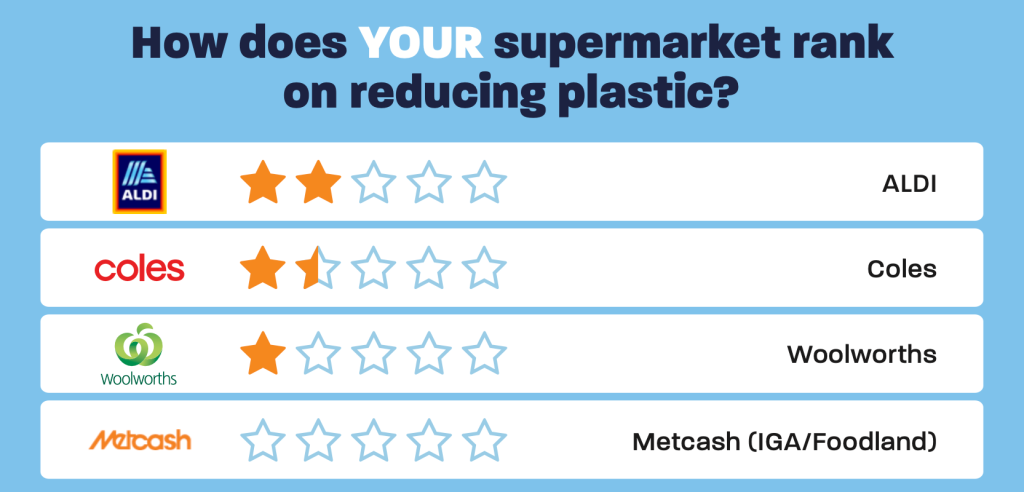
Aldi ranks the best with regards to reducing plastics. Photo: AMCS
How the supermarkets stack up
Aldi ranks first in terms of reducing plastic, followed by Coles and Woolworths, with Metcash (IGA and Foodland) in last place.
Despite ranking first, Aldi achieved a score of just 20 per cent. It topped the others for transparency and policy, planning and governance but was found to improvement in recycling and reusable, the Unwrapped report said.
Aldi has reached an 18 per cent reduction of plastic in fresh produce and has introduced specific initiatives to remove problematic packaging materials such as EPS and PVC in some of its products.
Sustainability director at Aldo Australia Daniel Baker said 83 per cent of Aldi’s packing is recyclable, reuasable or compostable.
“We have strong commitments and report on them transparently,” he said. “We’ve also committed to the packaging of exclusive brands to be 100 per cent recyclable, reusable or compostable by 2025.
Coming in second with a score of 15 per cent was Coles. While coming in third in the plastic reduction category, Coles made up for it with recycling and reusables.
The supermarket’s decision to ditch plastics in promotional giveaways was also acknowledged, as was trials in Tasmania and South Australia that allowed customers to bring their own containers and adding foaming hand wash tablets to its exclusive Koi brand range.
“This year we replaced soft plastic bags with reusable paper bags made from 100 per cent recycled content that can be recycled kerbside at the end of life,” a spokesperson said. “This decision removed 230 million plastic bags from circulation in one year.”
Woolworths finished second in plastic reduction but third overall with a score of 10 per cent.
However, Australia’s largest supermarket chain was lacking in transparency, as AMCS and Boomerang Alliance noted “it did not provide any data beyond its public sustainability reports and lack of further engagement”.
Woolworths dispute the report’s findings, with s spokesperson telling The New Daily the supermarket chain has “consistently led the grocery sector in broad scale changes to remove what used to be everyday single-use plastic items, such as plastic shopping bags and straws”.
“It’s disappointing to see that this report has based its ratings on incomplete data, and as a result is not a reliable reflection of packaging sustainability at Woolworths,” they said.
“Our data speaks for itself – we’ve removed more than 1.4 million kilograms of virgin plastic from our range since 2018, and across all the packaging we can control there is an average recycled content of 49 per cent.”
The spokesperson said “there is still more to do” and Woolworths will continue “posting data” to hold itself accountable.
It was also acknowledged in the report that Woolworths was the first in Australia to ban heavyweight reusable plastic bags ahead of bans.
Metcash scored just 3 per cent, receiving zero for plastic reduction.
However, while Metcash has done “little” to meet sustainability commitments, some independent IGA and Foodland retailers have implemented “impressive” reuse/refill and sustainability initiatives.
A statement from Metcash acknowledged there are further improvements to make, and confirmed the company was working to phase out “problematic unnecessary single-use packaging by 2025”.
“We have adopted national packaging targets including 100 per cent reusable, recyclable or compostable packaging, 70 per cent of plastic packaging being recyclable by 2025.”
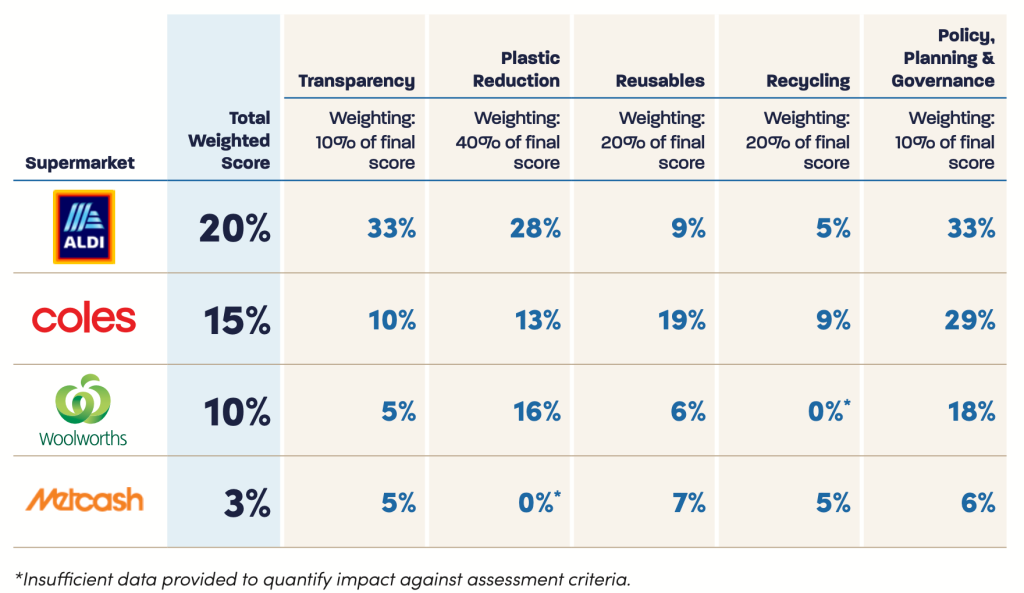
Australian supermarkets were put to the test with regards to plastic, recycling and transparency. Photo: AMCS
Takeaways from the report
There were six key findings which were outlined in the report, which cover lack of transparency, limited reuse and refill systems and the fact that often, pre-packaged produce is cheaper.
Supermarkets not transparent enough about plastic
The first finding was that most supermarkets are not transparent about their plastic footprint. While annual sustainability reports are the norm, the report says they “provide little evidence of impact, with cherry-picked statistics and initiatives that don’t paint the whole picture”.
AMCS and Boomerang Alliance acknowledged Aldi, Coles and Metcash’s “willingness” to engage during the audit process.
“Despite strong initial engagement and evidence of internal work to establish data collection systems, Woolworths did not provide any data beyond its public sustainability reports,” the report said.
“As the largest operator by market share, this is especially concerning.”
More reuse and refill systems needed
Australian consumers have little access to genuine reuse and refill opportunities at the supermarkets.
“As supermarkets are the main source of food and grocery items to Australian households, they are well placed to trial and develop reuse initiatives and to provide standardised systems,” the report said.
Coles showed the most evidence out of the big four supermarkets of implementing reuse trials, however, they are currently limited and need to be scaled up.
Supermarkets relying on ‘false solutions’
Instead of removing plastic from products and despite examples of “innovative and successful” packaging redesigns, it appears Aldi, Coles and Woolworths have mainly just reduced the overall weight of packaging.
The report alleges “lightweighting” is “hidden by reporting plastic reductions by tonnage, rather than by unit” and uses soft packaging that is hard to recycle over recyclable plastic.
Plastic incentives
78 per cent of volunteers conducting shopper surveys for the audit found that plastic wrapped produce was cheaper than loose fresh produce, when comparing price per kilogram.
“This price discrepancy not only incentivises customers to choose plastic packaged options, it penalises those who try to shop plastic-free,” the report says.
Given supermarkets are not paying for the cost of packaging on these products, it is concerning that environmentally conscious consumers are expected to pay more, particularly during a cost of living crisis.
Guidelines for suppliers ‘rarely enforced’
While all supermarkets assessed had guidelines for suppliers, most did not have systems to monitor or enforce compliance.
“Only Aldi specifies that certain items, such as plastic straws and cutlery pre-packed within products, will not be accepted at delivery,” the report says.
“By only measuring and reporting against targets for their own-brand packaging, Woolworths, Coles and Metcash avoid taking responsibility for the majority of plastics on their shelves.”
Recycling and recycled content a let down
Of all categories, recycling and recycled content was the worst performing for those assessed, despite it being a primary focus for supermarket sustainability strategies.
“All four supermarkets were unable to demonstrate evidence of significant progress in resource recovery and increasing the use of recycled plastic content,” the report said.
REDcycle’s collapse was noted, as was that the collapse exposed the difficulties of recycling soft plastics.
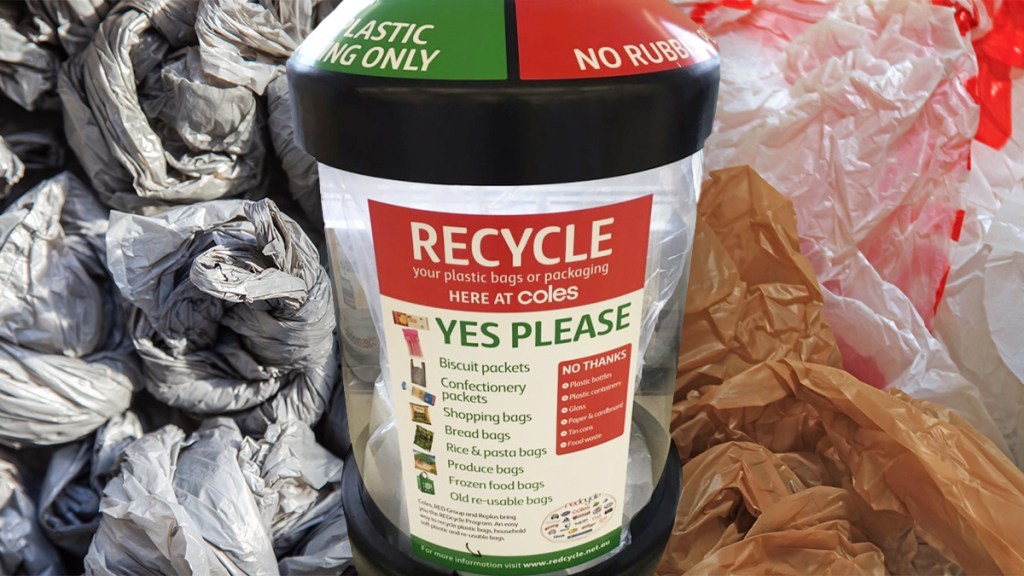
REDcycle’s collapse is a problem, but it was only recycling 5 per cent of the soft plastics Australia produced. Photo: TND
What supermarkets should do now to tackle plastic
AMCS and Boomerang Alliance outlined several recommendations for supermarkets, which will help improve their score in years to come.
The first is to implement “quick win” phase outs and policies, such as:
- Eliminate single-use plastic produce bags and plastic produce stickers
- Introduce reusable containers for deli items and delivery,
- Phase out pre-packaged plastic straws and cutlery
- Reduce or phase out individually wrapped small serving sizes
- Require loose fresh produce to be cost-competitive against packaged produce.
Additionally, supermarkets should strive to improve data collection and aim for reporting to be transparent and strengthen and enforce guidelines for suppliers and implementing policies that ban problematic plastics and chemicals of concern.
Time-bound targets can also be introduced for plastic reduction, high recyclability and recycled content and reusable packaging.
However, AMCS and Boomerang Alliance recommend governments step in and bring in mandatory packaging rules, require supermarkets to be transparent, improve recycling labels, harmonise kerbside collection and provide access to centralised life cycle assessment tools.