Inside Sydney’s new airport as it counts down to first flights

Source: Western Sydney International
Australia’s newest airport is about to open with a gentle start – despite having the capacity to grow as large as London’s Heathrow.
Western Sydney International Airport’s first freight flights will take off in a little over a month, on July 26.
Passenger flights begin three months later, the first on October 25, as airport bosses pledge the new facility will help ease demand on some of Australia’s busiest domestic routes.
Final terminal fitout work is under way at Western Sydney, which is Australia’s first major international greenfield airport in more than 50 years.
Initially, it will have just 21 domestic services a week, with Jetstar flights to Melbourne, Brisbane, and the Gold Coast. From March next year, Qantas will add four departures a week to each of Brisbane and Melbourne.
WSI chief executive Simon Hickey said the first services, which were only confirmed earlier this month, were a starting point. Availability would grow, giving passengers more choice.
“We can continue to grow and evolve as an airport, because we’re a greenfield we’ve been able to design for efficient growth in the airport,” Hickey said.
“We’re designed to grow to the size of Heathrow Airport, but that will be decades ahead.”
The airport will be able to handle about 10 million passengers a year when it opens, but has planned to eventually expand and cater to 82 million.
Australian Travel Industry Association chief executive Dean Long conceded it was a relatively tiny initial offering.
“But [the routes] link to some genuine holiday hotspots and mark the beginning of what WSI will grow into,” he said.
“More flights always means more options for travellers … WSI is a transformative addition to Australia’s travel landscape.”
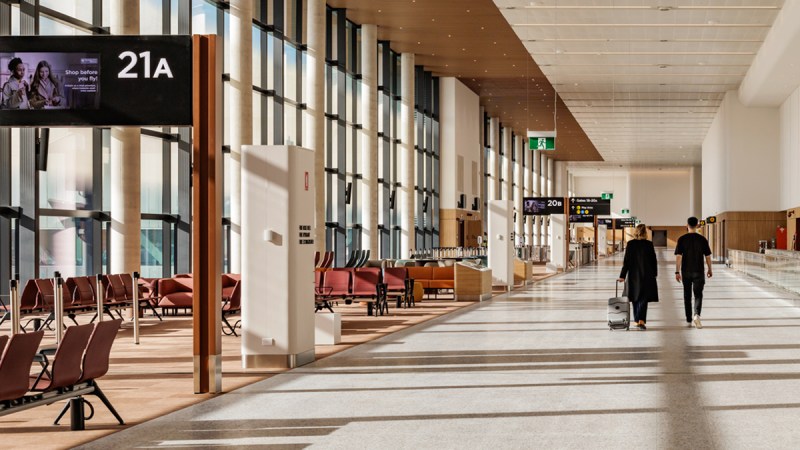
Final fitout is under way at the new airport.
First flights
The first flight out of Sydney’s second airport will be a Jetstar service to the Gold Coast at 11am on October 25.
Qantas chief executive Vanessa Hudson, whose group also owns Jetstar, said it was a major moment for Australian aviation.
“Jetstar has an incredible history of growing new markets and being the first airline to launch will give one of the country’s fastest growing regions better access to low fares to some of our most popular destinations,” she said.
Two international routes – Auckland and Changi – have also been announced. Singapore Airlines and Air New Zealand join Qantas and Jetstar as Western Sydney’s “launch partners”.
Getting there
The airport is about 45 kilometres west of Sydney’s CBD. It was finally approved in 2017 after decades of discussion around a second airport for the city began in the 1980s.
A connecting metro line is scheduled to open in 2027, with train stations built into the airport terminals. Federal Transport Minister Catherine King, who lives in Victoria, said it was a “pretty unusual” perk.
“To have both your airports having capacity to be connected by rail … we envy you a bit in Victoria. We are yet to get a rail connection to Melbourne Airport,” she said.
Last weekend, as the airport inched closer to completion, a $312 million motorway interchange at Cecil Hills opened. It is the final piece of Western Sydney’s road network, and will allow “seamless connections” from the Westlink M7 motorway onto the new M12, which serves WSI and the Bradfield “aerotropolis”.
Federal Werriwa MP Anne Stanley welcomed the opening of the interchange, which has seven new bridges and additional lanes.
“The Albanese government is proud to have worked with the NSW Government to deliver the incredible new M12 motorway, between Cecil Hills and the new Western Sydney International Airport,” she said.
“Now, the interchange between the M12 and the M7 – the final piece of the puzzle – has been delivered by the NSW government.
“I’m so pleased everyone will be able to make the most of seamless journeys across the motorway network, to catch their flight or head into work at the new airport.”
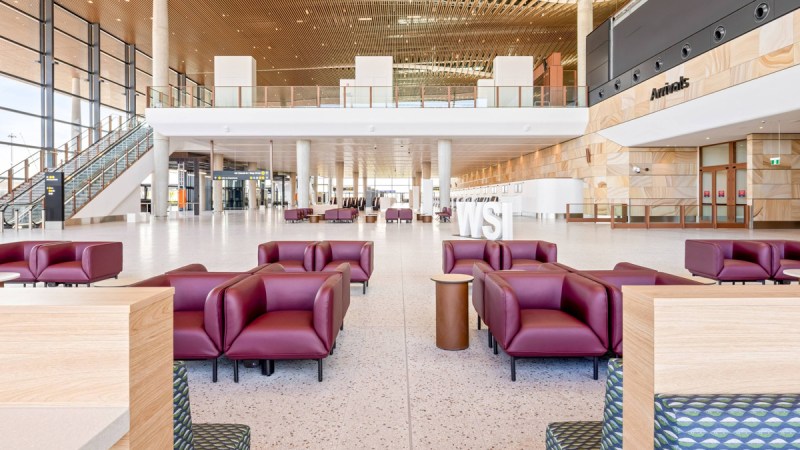
Inside the new terminal at Badgerys Creek.
What it means for fares
The consumer watchdog noted this week that domestic fares had been driven up in recent months, largely due to the conflict in the Middle East.
The Australian Competition and Consumer Commission found Qantas and Virgin had both hiked fares and cut capacity to help deal with the soaring price of jet fuel.
At the same time demand remained steady, driven largely by Easter school holidays and major events.
There are hopes that Western Sydney Airport – which won’t be curtailed by a curfew as Sydney’s main airport is – might help boost competition and drive down airfares.
Former Queensland Tourism Industry Council boss Professor Daniel Gschwind said the airport’s opening was a “matter of national interest” because it removed the bottleneck at Kingsford Smith Airport.
“Having a curfew-free airport in Sydney will certainly ease the pressure on prices and it will make it more attractive and more possible for current and potential new carriers to fly into Australia,” he told SBS News.
Kingsford Smith’s residential and Botany Bay surroundings also make expansion difficult, – although it is also projected to increase from 41 million passengers annually to 72 million by 2045.
Avlaw Aviation Consulting founding director Professor Ron Bartsch, told SBS News that airfares would only fall if capacity was increased — something WSI offers, driving Kingsford Smith to compete with it.
-with AAP