Why eating alone is seen as a major drawback of solo travel

Solo travel has been skyrocketing in popularity, particularly since the pandemic.
Google searches on the subject have quadrupled since 2020, while tapping #solotravel into Instagram yields a massive 9.2 million posts.
Still, with 50 per cent of Aussies considering going it alone this year, according to booking.com‘s latest Travel Predictions Report, it’s worth highlighting the fact that means half of us aren’t.
“Fear definitely makes some people reluctant to try it,” says Lee Mylne, author of Solo Travel for Dummies.
And while elements such as personal safety certainly come into it, that’s not the only type of fear she’s talking about. Case in point – the biggest obstacle for Mylne in the past was the concept of eating alone.
“I’m used to it now, but for many years I really dreaded it,” she admits.
“Breakfast and lunch were no problem, for some reason, but dining alone in a restaurant at night made me feel like someone with no friends, being pitied by everyone else.”
It turns out much of this is hardwired into us from birth.
“As humans, we have the mammalian brain, so we grow up as part of a group,” says clinical psychologist Dr Beverley David of Your Psychology Centre.
“On top of that, we’re fed by someone else from the moment we’re born, so there’s a very social aspect to eating. That’s not easy to shake off.”
Taking time for ourselves
Having said that, David points to a shift in recent years that prioritises time spent alone.
“Taking time for ourselves is seen as more important now than it ever has been – crucial, in fact, to our mental health,” he says.
“Meanwhile, social norms have altered so that we’re encouraged not to feel sorry for someone sitting alone. Instead of a last resort, we’re beginning to view it as a powerful choice.”
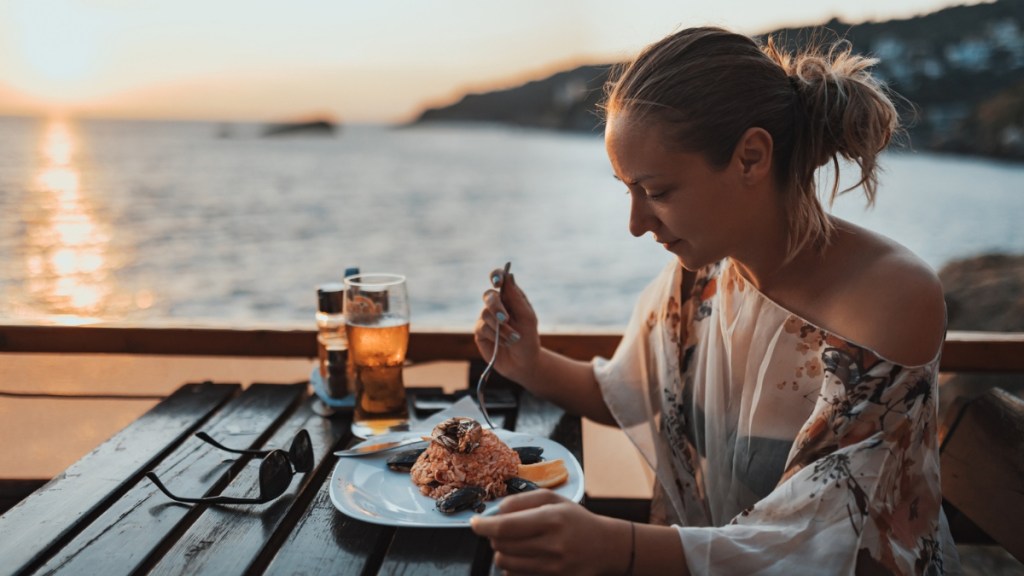
Getting used to enjoying your own time requires trial and error. Photo: Getty
As is so often the case, becoming comfortable with anything new takes practice, so Mylne suggests a gradual build-up to dining out solo, well before planning a holiday.
Start with a quick meal somewhere casual, and choose a seat at the bar, or at a window facing out: “Try to absorb your surroundings, rather than focusing inwards,” she says. “Indulge in people-watching and truly savour the meal.”
From there, you can work up to booking an actual table: “At first, I’d take a novel with me, or a notebook to write in while waiting for my meal.”
If all else fails, an easy fix (though not one found in Mylne’s book) is to scan the restaurant for parents with young children. Observe the napkins sodden with apple juice, the chicken nuggets squashed underfoot, the blue flicker of iPad screens. Take a deep breath, a sip of your drink, and relish having the table to yourself.
All of which is excellent preparation for booking a solo trip.
“The freedom you’ll feel when you do is unbelievable,” says Mylne. “You don’t have to compromise on anything. You can go where you want, at a time that suits you, with the budget you have, and do whatever you feel like.
“It’s been interesting to reflect on my own lifetime of travelling and to realise how far I’ve come personally in being comfortable with travelling solo – which I certainly haven’t always been. Hopefully my experiences – and fears – can encourage others to step out alone.”